Clear Sky Science · en
Four ppm measurement of the antihydrogen ground-state hyperfine splitting
Why antimatter atoms matter
Antimatter sounds like science fiction, yet it is real and helps scientists test whether the basic rules of nature apply everywhere and at all times. This study looks at antihydrogen, the antimatter twin of the familiar hydrogen atom, and measures a tiny energy difference inside it with record accuracy. By comparing this delicate “tick” of antihydrogen with that of ordinary hydrogen, researchers search for hidden cracks in fundamental physics and learn more about how matter and antimatter may differ, if at all.
Looking closely at the simplest antimatter atom
Hydrogen has long been a workhorse of physics, because its simple structure lets scientists test quantum theory in great detail. Antihydrogen, made from an antiproton and a positron, should behave in exactly the same way if a key principle called CPT symmetry holds. One important feature is the hyperfine splitting, a slight energy gap between different internal spin arrangements of the atom. In hydrogen this splitting is known with incredible precision, but in antihydrogen earlier measurements were far less sharp. The work reported here improves the precision of the antihydrogen ground state hyperfine splitting by about a factor of one hundred, down to just a few parts per million, and finds that it matches hydrogen within the current uncertainties.
How to trap and count fragile anti-atoms
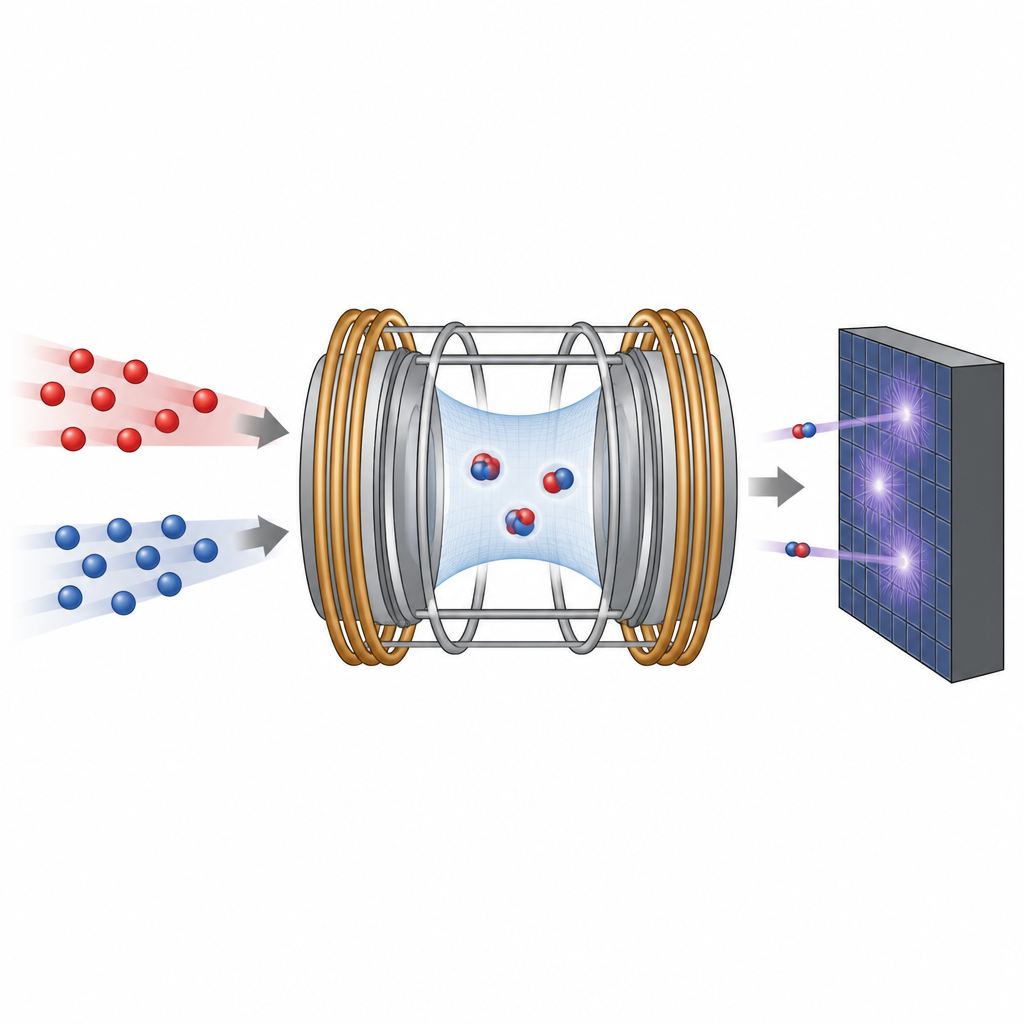
The experiment takes place at CERN, where beams of antiprotons and clouds of positrons are combined inside a sophisticated magnetic trap known as ALPHA-2. Because antihydrogen atoms annihilate as soon as they touch normal matter, they must be held in place using strong magnetic fields that create a shallow “magnetic bowl” in space. By cooling the positrons with laser-cooled ions, the team can now routinely collect about 100 trapped antihydrogen atoms in a few minutes and then repeat the process many times. In a typical run they build up samples of roughly 1,500 anti-atoms, all gently confined away from the surrounding hardware until they are deliberately pushed out and allowed to annihilate in a detector that records their disappearance.
Tuning microwave light to flip tiny spins
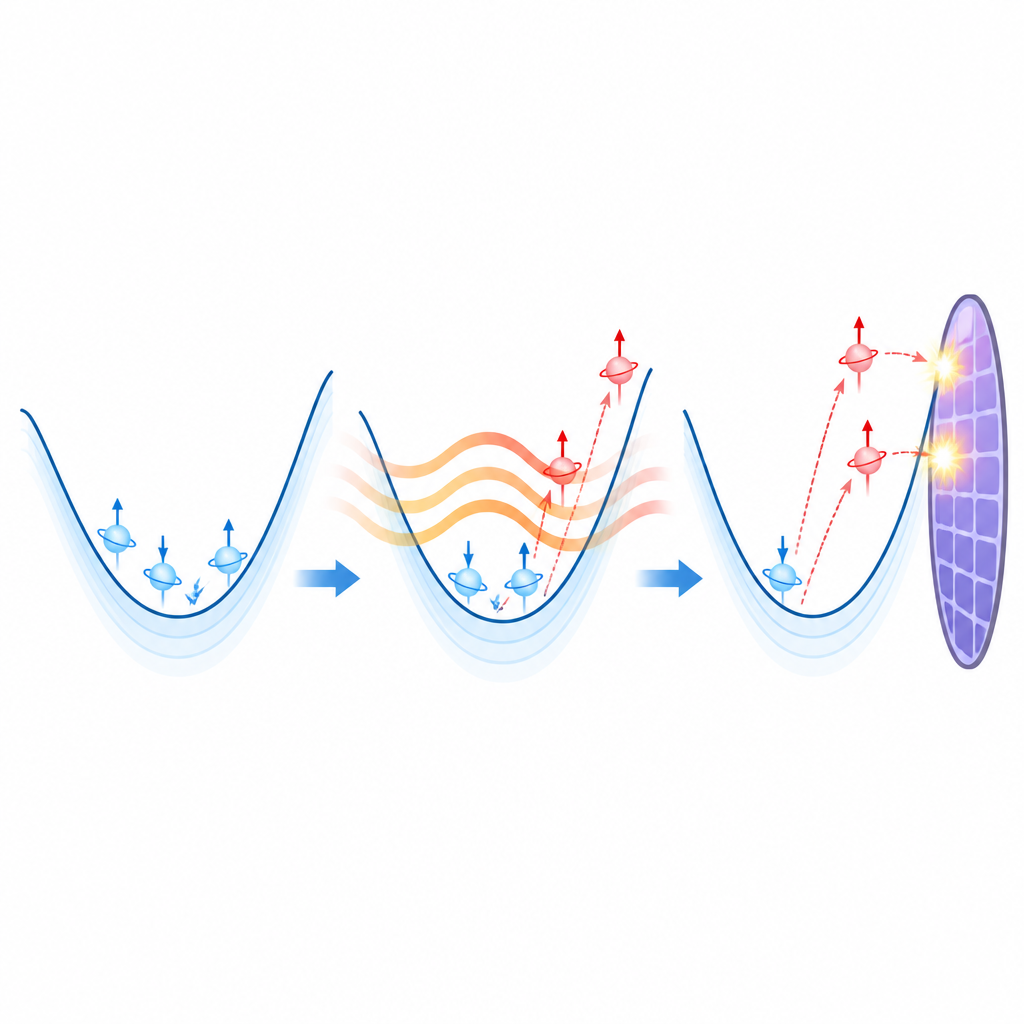
Inside the trap, the internal spins of the antiproton and positron can point in different relative directions, creating four closely spaced energy levels. Two of these are held by the magnetic bowl, while the other two are expelled. The researchers shine carefully chosen microwaves into the trap to flip the positron spin and drive atoms from trapped states into untrapped ones. As the microwave frequency is stepped upward in small increments, there comes a point where atoms at the very bottom of the magnetic bowl are driven out and annihilate on the surrounding walls. Each annihilation leaves a trace in a silicon detector, so a sharp rise in the event rate reveals that the microwaves have hit the right frequency for a particular spin-flip transition.
Extracting a precise frequency from drifting fields
Real-world magnets are imperfect, and the magnetic field that shapes the bowl slowly changes with time. This drift shifts the microwave resonance frequency during the hours-long experiment. To cope with this, the team performs the same sequence of spin-flip scans many times at two slightly different base fields, and tracks how the apparent resonance points slide downward in frequency. By fitting straight lines to the sets of resonance onsets, they determine the difference between two key transitions at the same effective field. This difference equals the hyperfine splitting frequency. After combining results and carefully estimating statistical and systematic uncertainties, they arrive at a value for the splitting in a one-tesla field that agrees with expectations based on hydrogen to within a few kilohertz.
What this means for our picture of matter
The new measurement is so precise that it starts to probe subtle details of the antiproton’s internal structure, rather than being limited by the experiment itself. It also sharpens related measurements of the splitting in an excited state of antihydrogen and of a quantity called the Sternheim interval, which together test high-order quantum effects while largely canceling nuclear structure contributions. For now, antihydrogen behaves just like hydrogen within the reach of these tests, supporting the idea that matter and antimatter obey the same basic rules. Future improvements in cooling and magnetic control could push the precision much further, potentially revealing tiny differences or confirming the symmetry between matter and antimatter at an even deeper level.
Citation: Akbari, R., de Araujo Azevedo, L.O., Baker, C.J. et al. Four ppm measurement of the antihydrogen ground-state hyperfine splitting. Nature 653, 1022–1026 (2026). https://doi.org/10.1038/s41586-026-10556-x
Keywords: antihydrogen, antimatter, hyperfine splitting, CPT symmetry, quantum electrodynamics