Clear Sky Science · en
Foreshock-induced slip transients set mainshock nucleation timing
Why small shakes before big quakes matter
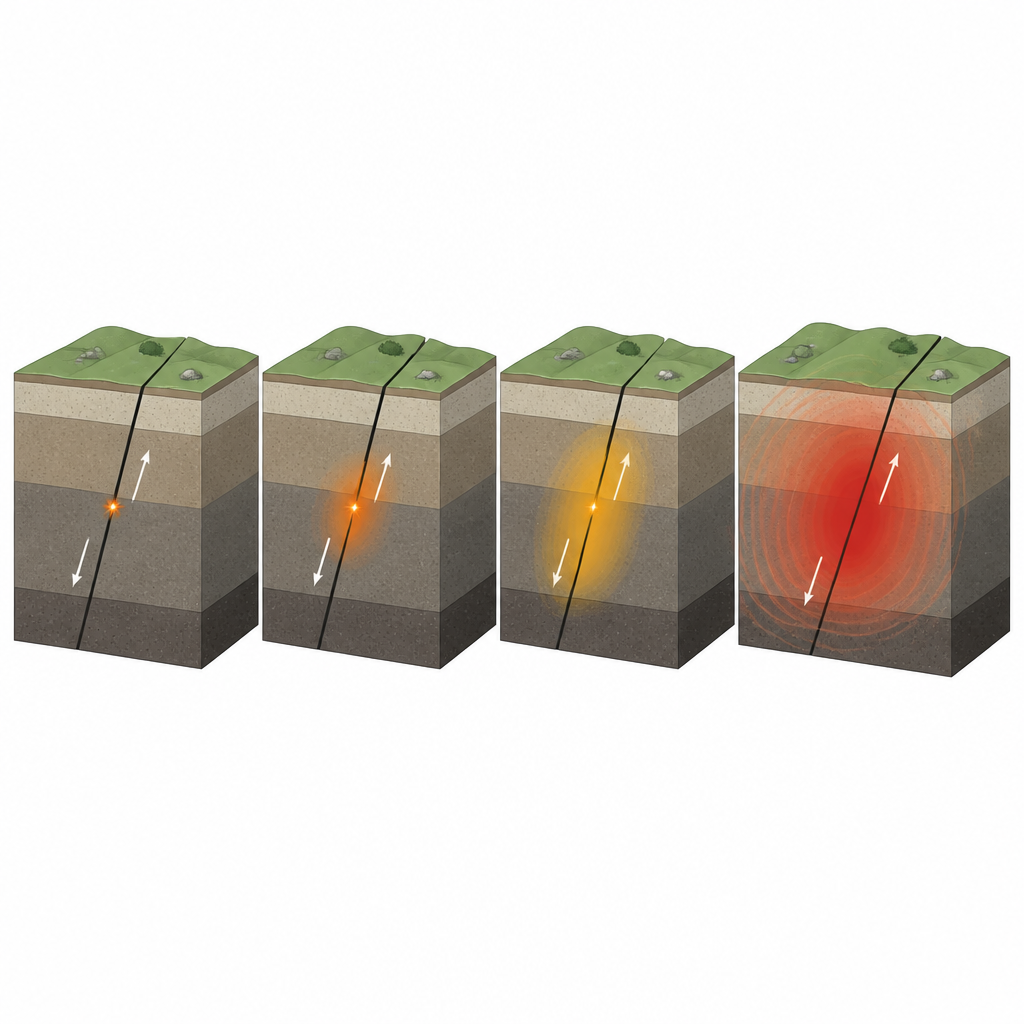
Earthquakes often seem to strike without warning, yet many large quakes are preceded by smaller rumblings called foreshocks. This study asks a deceptively simple question with big consequences for hazard monitoring: when a foreshock happens right on the fault that will later break, does that small jolt simply come and go, or can it actually set the clock for the main earthquake? By recreating earthquakes in the lab and linking the results to real faults in Earth’s crust, the authors show that these early slips can control how and when a big rupture gets going.
A lab-made fault to watch quakes grow
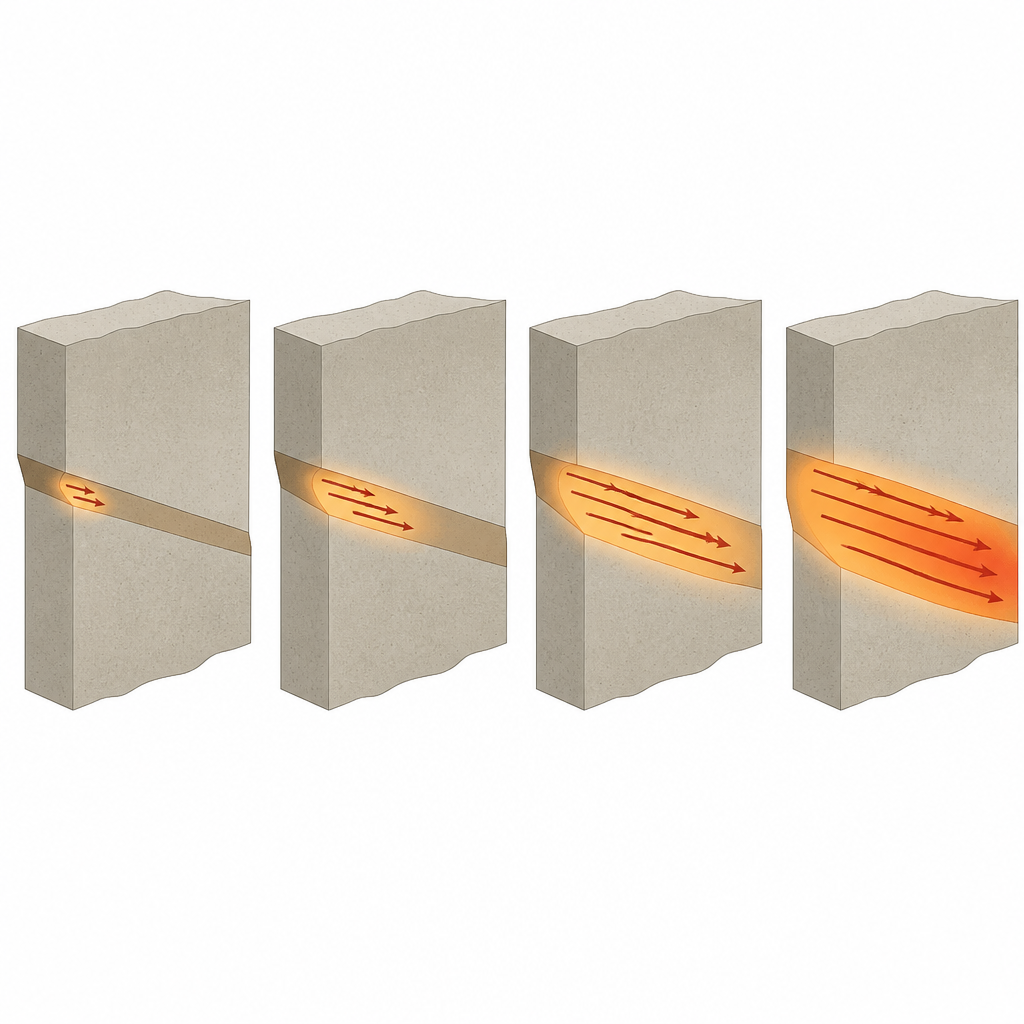
To probe the birth of earthquakes, the team built a miniature fault inside a powerful biaxial press. Two transparent plastic blocks were squeezed together and then slowly pushed sideways until they slipped in sudden, quake-like events. The material, a clear plastic known as PMMA, lets researchers see changes in stress using polarized light while sensors record the tiniest motions and vibrations. Across dozens of "lab quakes," many events started with a small, sharp foreshock on a limited patch of the fault, then evolved into a larger rupture that swept across the whole interface. Surprisingly, even when the overall stress on the fault looked nearly the same from one event to another, the time between the foreshock and the onset of fast rupture varied from less than a millisecond to tens of milliseconds.
From first nudge to runaway slip
Looking closely at the data, the authors found that how quickly a quake takes off is not mainly set by how fast friction weakens as the fault begins to slide, a focus of many previous models. Instead, the crucial quantity is the brief burst of sliding that the foreshock injects into the fault. Right after this small event, the sliding speed along the nucleating patch drops to a transient minimum value, called here the minimum sliding velocity. Large foreshocks push this minimum to higher values, so the fault patch is already moving relatively fast when it begins to grow. That higher starting speed shortens both the time and the distance over which the fault can creep quietly before the rupture becomes fully dynamic. Small foreshocks, by contrast, leave the fault crawling, so it can spend much longer in a slow, quasi-static phase, or even fail to develop into a mainshock at all.
A simple rule that links slip speed and waiting time
To explain these patterns, the authors turned to a theoretical framework that treats the growing rupture as a crack whose motion depends on both the background stress and the extra push from the foreshock. In this picture, the foreshock acts like a localized force that briefly accelerates the fault, while the broader stress field either helps or hinders further growth. Solving this equation of motion reveals three possible outcomes that mirror the experiments: the rupture stalls after slowing down, it creeps for a while before taking off, or it accelerates almost immediately with no detectable quiet phase. Crucially, all of these scenarios can be organized by a single observable: the minimum sliding velocity after the initial impulse. The theory predicts, and the data confirm, that for higher minimum velocities the nucleation duration shrinks roughly in proportion to one over that speed.
Scaling up from plastic blocks to real faults
Laboratory faults are tiny compared with tectonic plate boundaries, but the same rule appears to extend across this size gap. The authors compiled observations of slow slip and foreshock sequences before several large earthquakes, including events in Chile, Japan and Turkey. In these cases, geodetic data and repeating microquakes reveal slip that accelerates toward the mainshock. When they estimate the minimum sliding velocities for these natural nucleation phases and compare them with their durations, the points fall along trends predicted by the same model, once the larger characteristic slip distances of rocks in nature are taken into account. These comparisons suggest that the distance over which fault surfaces must slide to change their friction during nucleation is on the order of a millimeter, far smaller than values inferred for the later, fully dynamic stage of rupture.
What this means for watching faults in real time
For non-specialists, the key message is that not all foreshocks are equal. When a foreshock or a burst of slow slip imparts a strong enough jolt, it can shorten the quiet build-up phase and hasten the onset of a damaging earthquake. When the impulse is weaker, the fault may creep for a long time or never progress to a major rupture. Because the crucial control is the early sliding speed rather than just the background stress, detecting and tracking these subtle slip transients could help clarify when a sequence of small events is likely to fade out and when it may be on a path toward a large earthquake.
Citation: Fryer, B., Garagash, D., Lebihain, M. et al. Foreshock-induced slip transients set mainshock nucleation timing. Nature 653, 752–757 (2026). https://doi.org/10.1038/s41586-026-10497-5
Keywords: foreshocks, earthquake nucleation, fault slip, slow slip, seismology