Clear Sky Science · en
Electrocaloric effects across room temperature in multilayer capacitors
Cooling our world with electric fields
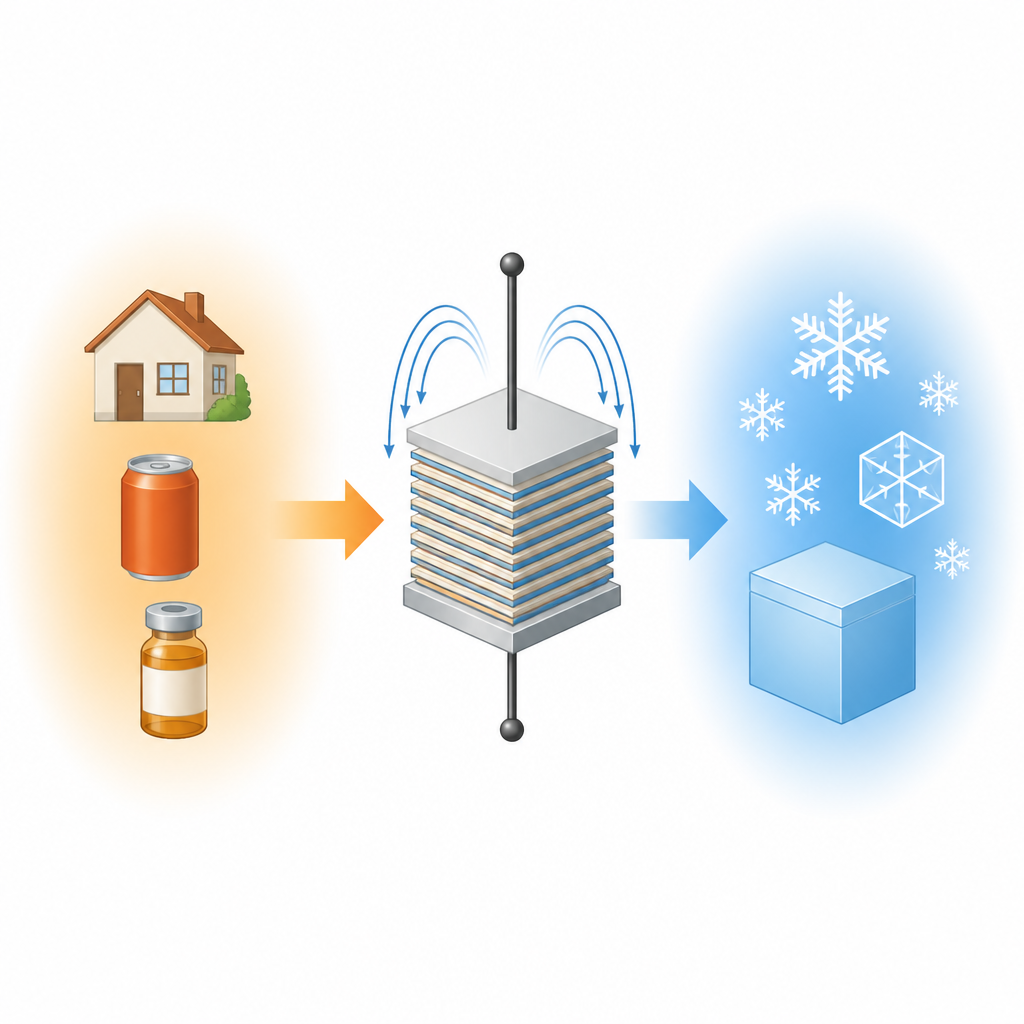
Refrigerators, air conditioners and medical freezers all keep things cold by compressing gases that can harm the climate. Scientists are searching for cleaner ways to move heat around. This study explores a solid ceramic device that warms up and cools down when an electric field is switched on and off, and shows how to make it work across and below room temperature, where most real cooling tasks actually happen.
A new way to shift heat
When certain crystals are exposed to an electric field, their internal structure changes and their temperature jumps. This electrocaloric effect lets devices act like tiny solid state heat pumps. Earlier designs based on a ceramic called PST could show sizeable temperature changes, but only above room temperature and only after a slow, expensive heat treatment. That made them less useful for cooling food, buildings or medical supplies, where crossing room temperature is crucial.
Mixing two materials for better performance
The researchers tackled this problem by blending PST with another ceramic, PMW, to form a solid solution. The trick is that the mixture keeps the ordered pattern of heavy and light atoms that gives PST a strong heat change, but the added PMW disturbs the electric dipoles that control when the material switches phase. This combination lowers the temperature at which the phase change occurs, pushing the useful electrocaloric response down to about 230 kelvin while preserving large latent heat, all without the need for a lengthy anneal.
Testing tiny layered capacitors
To turn the material into a practical device, the team built multilayer capacitors, which look like stacks of thin ceramic sheets separated by metal electrodes. They drove these stacks with high electric fields more than ten million times without breakdown. Using a mix of indirect calculations from electrical measurements and direct readings from calorimeters and thermocouples, they found that the active ceramic layers can change temperature by around 4 to 4.5 kelvin, and that the effective temperature swing available to the outside world is about 3 kelvin even after including inactive parts of the device.
From laboratory chips to working coolers
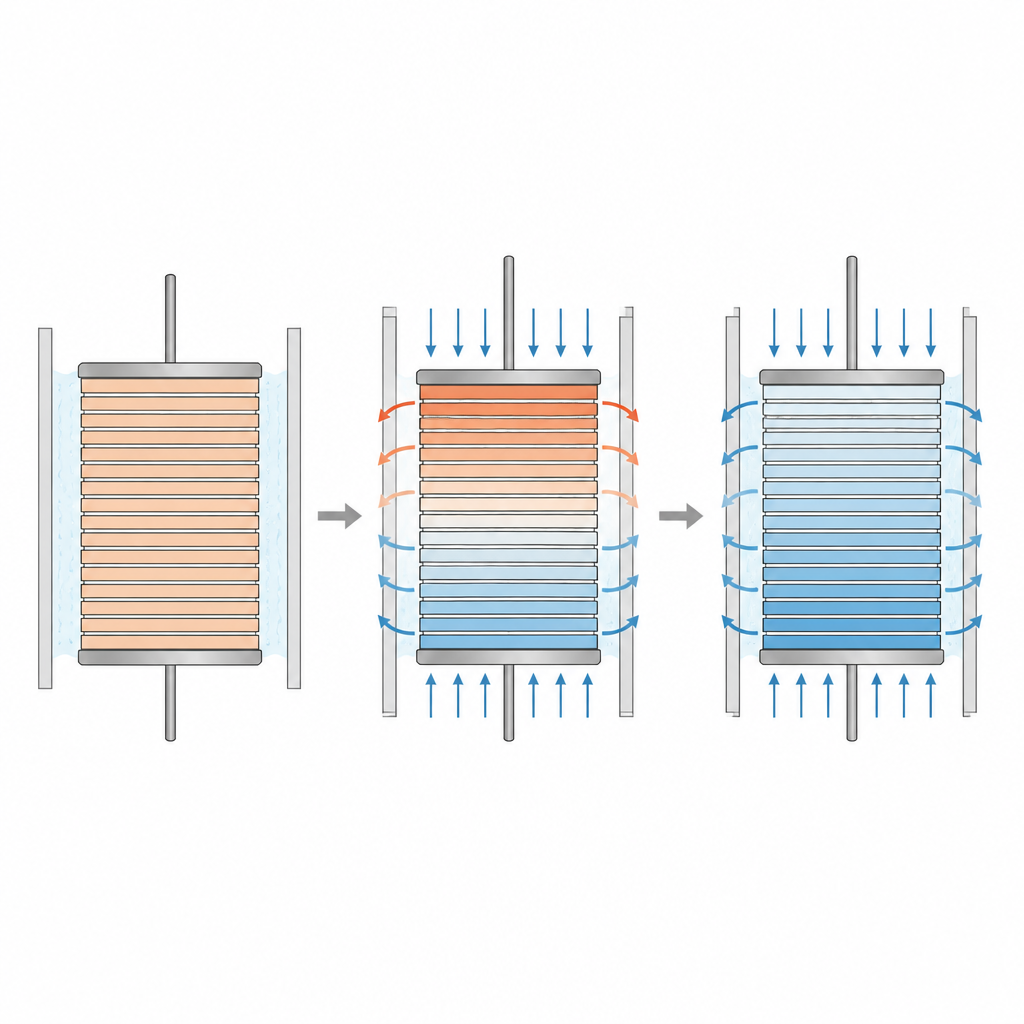
The study then asks how these multilayer capacitors would behave inside an idealized cooling machine. The authors model cycles in which one or more capacitors shuttle between the hot and cold ends of a fluid regenerator while the electric field is switched on and off. Under realistic driving voltages similar to those already used in prototypes, the new PST–PMW devices could cool from above ambient down to about 230 kelvin and achieve cycle efficiencies between roughly 70 and 90 percent of the Carnot limit, slightly better than earlier PST based devices and competitive with some magnetocaloric systems.
What this means for future cooling
In simple terms, the work shows how a clever mix of two ceramics can turn a lab curiosity into a more practical solid state cooler that works across the temperatures people care about. By preserving atomic order while shifting the phase change to lower temperatures, the authors obtain strong, repeatable heat shifts without lengthy processing. They argue that these improved multilayer capacitors should replace older PST devices in electrocaloric prototypes, opening a path toward compact, efficient refrigerators and heat pumps that rely on electric fields instead of greenhouse gases.
Citation: Guo, M., Farenkov, V., Chen, X. et al. Electrocaloric effects across room temperature in multilayer capacitors. Nature 653, 398–403 (2026). https://doi.org/10.1038/s41586-026-10492-w
Keywords: electrocaloric cooling, multilayer capacitors, solid state refrigeration, ferroelectric ceramics, energy efficient cooling