Clear Sky Science · en
More concentrated precipitation decreases terrestrial water storage
Why storm patterns matter for everyday water
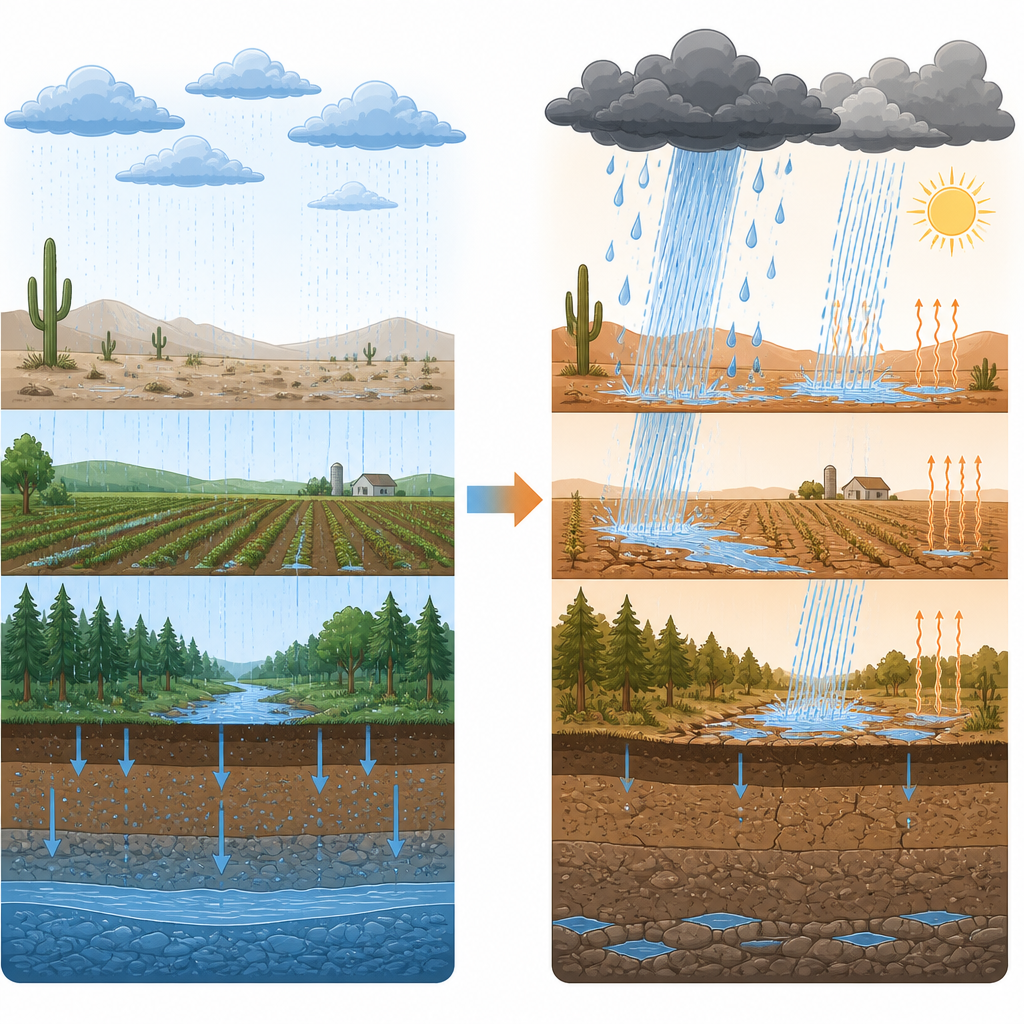
Most people think of water security in terms of how much rain or snow falls in a year. This study shows that when and how that rain arrives can be just as important. As the climate warms, wet days are changing: fewer days bring more intense downpours, with longer dry spells in between. Using satellites, weather records and computer models, the authors show that this shift quietly drains the water stored on land, affecting rivers, soils, and underground reserves that support communities and ecosystems.
From gentle showers to rare cloudbursts
Instead of treating all rainy days as equal, the researchers focused on how uneven rain is spread through the year. They borrowed a tool from economics, the Gini coefficient, to describe whether water arrives in many modest events or a handful of very heavy ones. A value near zero means rain is evenly shared across days, while a value close to one means almost all rain falls in a few bursts. Mapping this measure around the globe, they found that even today rainfall is quite concentrated, especially in deserts, and that in many regions it has become more concentrated over recent decades.
Taking Earth’s pulse with gravity
To see how this pattern affects stored water, the study used data from the GRACE satellites, which track tiny changes in Earth’s gravity as water moves in and out of soils, aquifers, snow, and surface reservoirs. By comparing year to year changes in land water storage with changes in rainfall concentration, while holding total rainfall and temperature constant, the authors could isolate the role of timing. They found that in years when rain is more concentrated into heavy events, land water storage tends to be lower almost everywhere, from dry regions to humid forests. In fact, this drying influence is nearly as strong as the wetting effect of simply getting more total rain.
How heavy storms can leave the ground drier
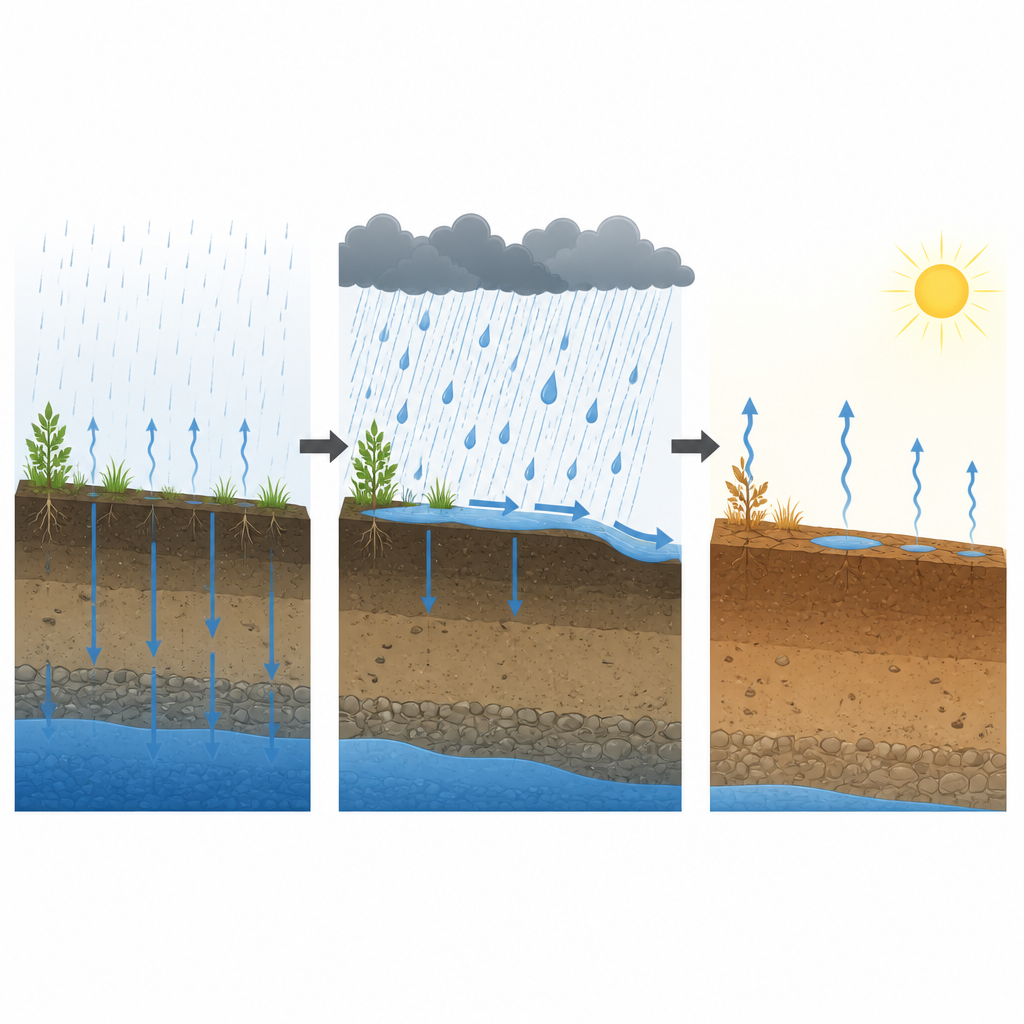
The team then asked why bunching rain into downpours would make landscapes lose water. Two linked processes emerged. First, intense rain is more likely to overwhelm the ground’s ability to soak it up, causing water to pool at the surface or rush away instead of sinking in. Second, the longer dry gaps between storms allow more sunlight to reach the surface, boosting evaporation from these shallow pools and the upper soil. Simple and complex land models both support this picture: when storms are stronger but less frequent, more water ends up in easily evaporated surface layers and less reaches deeper, longer lasting stores.
Global patterns and future risks
Because this effect shows up across climates and in many major river basins, including the Amazon, Nile, Mississippi, Ganges and Yangtze, it is not just a local curiosity. In irrigated regions, farmers’ responses to drying, such as increased groundwater pumping, can amplify the loss of stored water. Looking ahead, the study used a basic physical model to estimate how further warming will concentrate rainfall even more. Combining these projections with today’s observed relationship between concentration and storage, the authors estimate that about half of the world’s population could see a noticeable drop in land water storage from rainfall concentration alone at around 2 °C of global warming.
What this means for water planning
For a layperson, the core message is that “how” rain falls matters almost as much as “how much” falls. A future with fewer, fiercer storms can paradoxically leave rivers lower, soils drier, and underground water more depleted, even if yearly rainfall totals do not change. This work suggests that water managers, farmers and planners need to look beyond average rainfall and consider the changing rhythm of wet and dry days when preparing for drought, irrigation demand and ecosystem health.
Citation: Lesk, C.S., Mankin, J.S. More concentrated precipitation decreases terrestrial water storage. Nature 653, 425–432 (2026). https://doi.org/10.1038/s41586-026-10487-7
Keywords: precipitation patterns, terrestrial water storage, climate change, evaporation, water availability