Clear Sky Science · en
Hybrid calculation of hadronic vacuum polarization in muon g − 2 to 0.48%
Why tiny particles still matter
The magnetic behavior of the muon, a heavier cousin of the electron, has puzzled physicists for decades. A small mismatch between theory and experiment raised the hope that new, unknown particles might be lurking in nature. This paper tackles the most uncertain part of the theoretical prediction and shows that, when it is calculated more precisely, the apparent tension with experiment almost disappears, offering a strong test of our current picture of the subatomic world.
A spinning particle under scrutiny
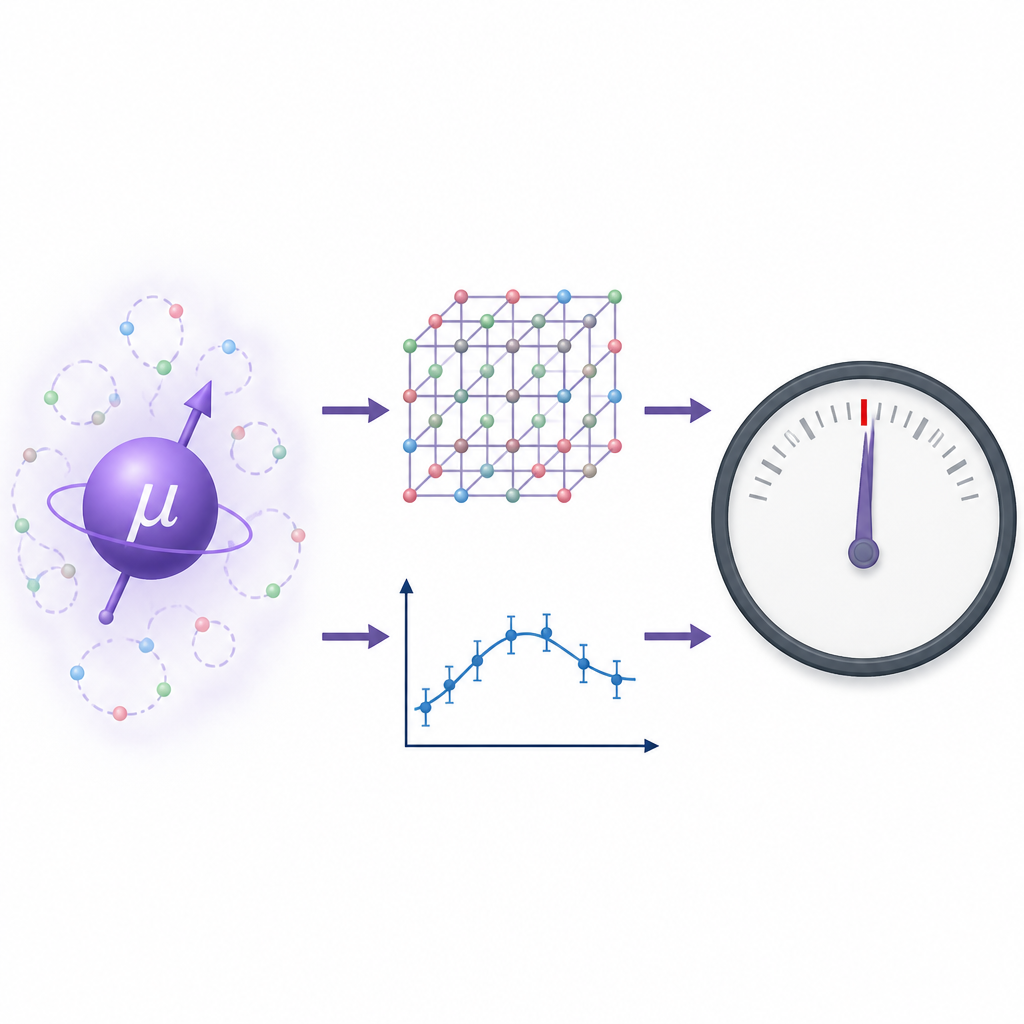
Muons are short lived particles with the same electric charge as electrons but over 200 times the mass. Like tiny bar magnets, they have a magnetic moment tied to their spin. Simple theory says this moment should follow a very strict rule, giving a value called g equal to 2. In reality, quantum fluctuations slightly nudge this value, so physicists focus on the small difference, known as the anomalous magnetic moment. Because muons are heavier, they are more sensitive than electrons to quantum effects from both known and possibly unknown particles, making precise tests of the muon magnetic moment a powerful way to search for new physics.
The hardest piece of the puzzle
Most parts of the theoretical prediction for the muon magnetic moment can be computed very accurately. The main stumbling block comes from the strong force, the interaction that holds quarks together inside protons, neutrons and other hadrons. This contribution, called hadronic vacuum polarization, describes how a virtual photon briefly turns into a cloud of quarks and antiquarks before turning back again. Because the strong force becomes highly nonlinear at the relevant energies, this effect cannot be handled by simple formulas and has been the dominant source of uncertainty for over twenty years.
Blending supercomputer theory with real data
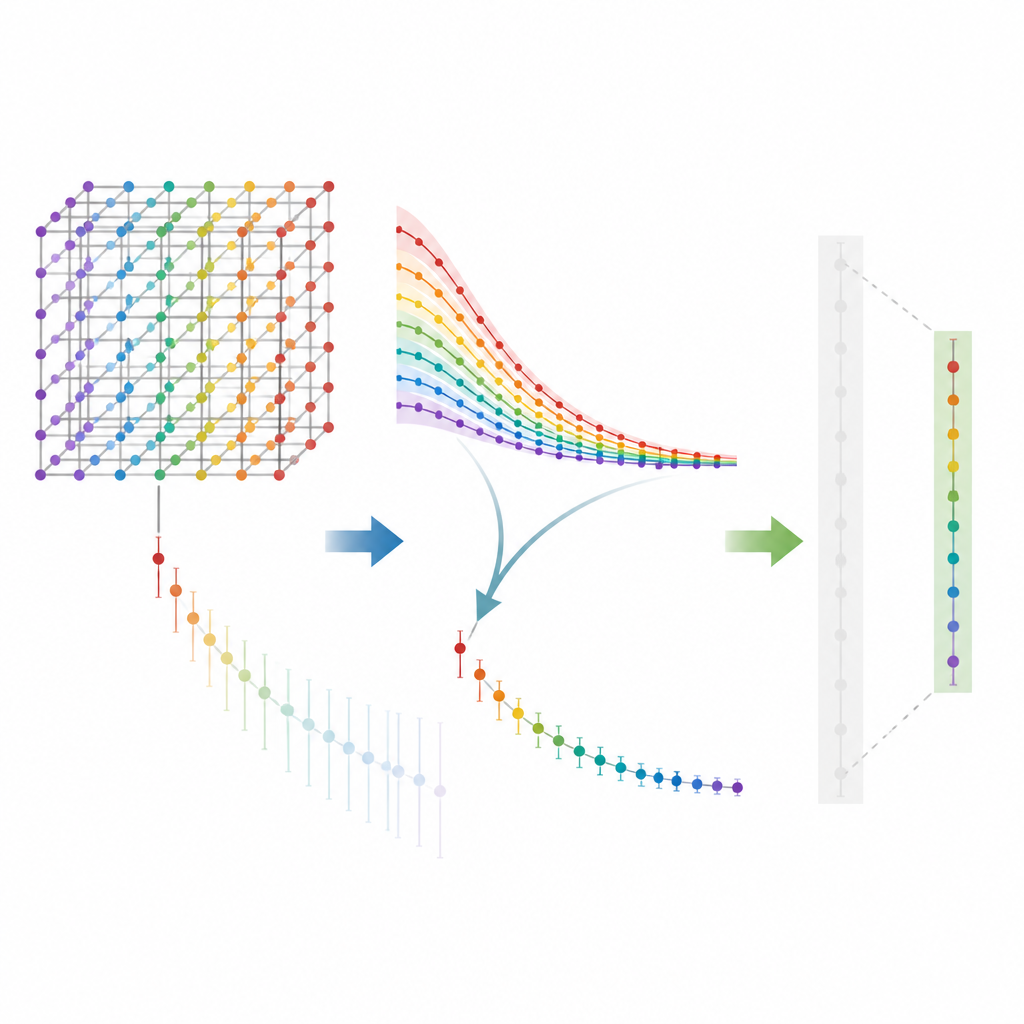
The authors use a powerful numerical method called lattice quantum chromodynamics, which represents space and time as a fine grid and follows quarks and gluons on that grid using supercomputers. They improve on earlier work in two key ways. First, they use a finer grid than before, which reduces errors that come from approximating continuous space by discrete points. Second, they split the calculation into separate time windows and treat each one with the strategy that works best there. For short and intermediate time ranges, the lattice approach dominates and benefits from enhanced statistics. For very long distances, where the signal on the lattice becomes noisy, they instead use a data driven input extracted from precise measurements of electron–positron collisions and tau decays, but only in an energy region where all experiments agree well.
Pinning down uncertainties
The team carefully tracks several sources of error, including statistical noise, the finite size of the simulated box, the step from discrete grid to continuous space, how physical parameters are fixed, and small effects from the slight mass difference between up and down quarks. By adding a finer grid spacing and refining how they correct for finite size and long distance effects, they reduce the overall uncertainty in the hadronic vacuum polarization contribution by a factor of 1.6 compared with their 2020 calculation and by more than a factor of 5 compared with their 2017 effort. They also compare their results with other lattice calculations and with various ways of using experimental data alone, clarifying where tensions remain among different experimental datasets.
What the new number tells us
With their improved method, the authors find a value for the hadronic vacuum polarization that, when combined with other known contributions in the standard model, leads to a predicted muon magnetic moment that differs from the latest direct measurement by only half a standard deviation. In plain terms, theory and experiment now agree within their tiny error bars to about eleven decimal places. This agreement does not rule out new physics but shows that any new effects must be even subtler than many had expected. It also demonstrates that our current framework for describing particles and forces, built on quantum field theory, can deliver astonishing precision when high quality data and large scale computations are brought together.
Citation: Boccaletti, A., Borsanyi, S., Cotellucci, A. et al. Hybrid calculation of hadronic vacuum polarization in muon g − 2 to 0.48%. Nature 653, 373–377 (2026). https://doi.org/10.1038/s41586-026-10449-z
Keywords: muon g minus 2, hadronic vacuum polarization, lattice QCD, standard model test, precision physics