Clear Sky Science · en
Quantum coherent manipulation and readout of superconducting vortex states
A New Way to Store Quantum Information
Quantum computers promise to solve problems far beyond today’s machines, but their basic building blocks—qubits—are fragile and hard to engineer. This study reveals an unexpected new kind of qubit hiding inside superconducting materials themselves: tiny whirlpools of magnetic field, called vortices, that can quietly store quantum information for surprisingly long times. Turning what was once seen as a nuisance into a useful resource could open new paths toward simpler, more robust quantum technologies.
When Superconductors Let Magnetism Sneak In
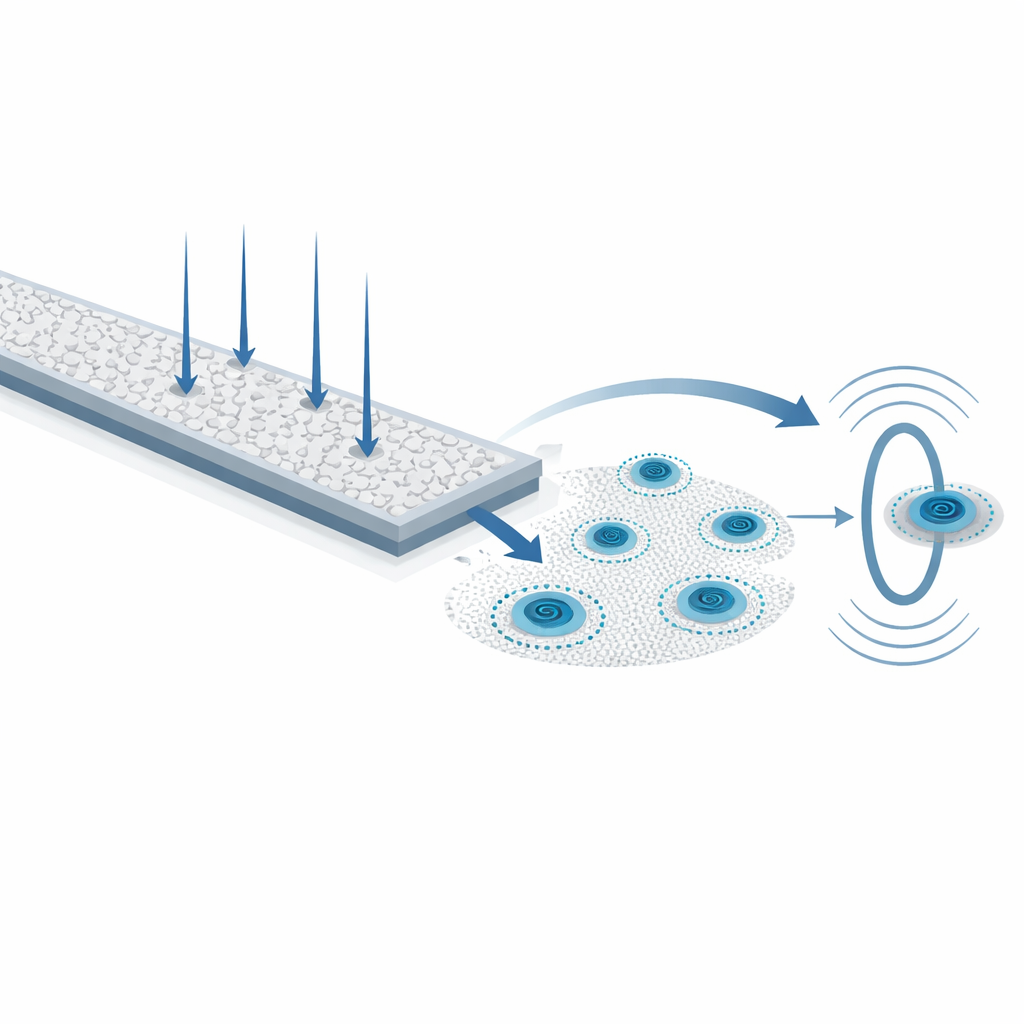
Superconductors are famous for pushing magnetic fields out of their interior, a phenomenon that underpins technologies from MRI scanners to sensitive detectors. Yet when the applied magnetic field becomes strong enough, it can pierce the superconductor in discrete, threadlike bundles known as vortices. In ordinary materials, the center of each vortex behaves like normal metal, causing friction and energy loss whenever the vortex moves. That is why vortices have long been viewed as troublemakers that degrade the performance of superconducting devices and quantum bits. The key twist explored here is that in a strongly disordered, granular superconductor—made of many tiny aluminum grains separated by thin insulating barriers—the interior of a vortex can remain “gapped,” meaning it does not easily dissipate energy. Under these conditions, vortices may stop behaving like classical objects and begin to show fully quantum behavior.
Turning Vortices into Quantum Two-State Systems
The researchers fabricated a slender microwave resonator from granular aluminum, cooled it to a few thousandths of a degree above absolute zero, and applied a small magnetic field as it cooled. This procedure traps vortices in the device at specific locations. By then sweeping the magnetic field and probing the resonator’s microwave response, the team observed clear signatures that the resonator was strongly coupled to a distinct, tunable two-level system—essentially a quantum object with only a ground and excited state—linked to the presence of vortices. They could drive transitions between these two states with short microwave pulses, just as one would manipulate a conventional superconducting qubit, and they could read out the state in a way that did not destroy it, known as quantum non-demolition measurement.
Long-Lived Quantum Whirlpools
Time-resolved measurements revealed that these vortex-based states retain their energy for hundreds of microseconds, rivaling the lifetimes of some carefully engineered qubits used in today’s leading experiments. The phase coherence—the property that allows quantum superpositions to exist—lasted for microseconds, and could be extended using echo techniques that cancel out slow environmental drifts. Statistical studies over many cooling cycles indicated that these “vortex qubits” are stable over hours to weeks, but their microscopic configuration can change from one cooldown to the next, reflecting different arrangements of vortices in the granular landscape.
A Landscape of Traps and Quantum Tunneling
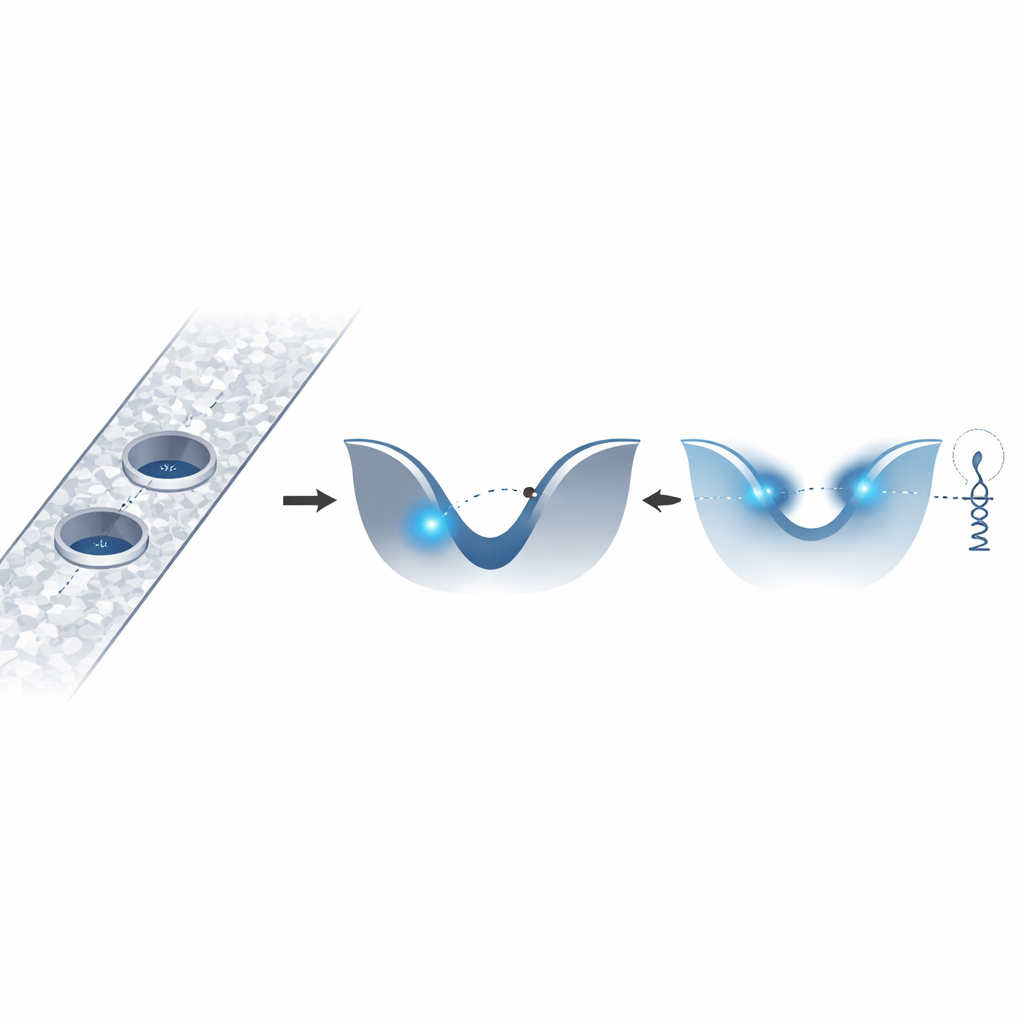
To explain how a vortex can act as a quantum two-state system, the authors modeled how it experiences the energy landscape inside the narrow superconducting strip. Because the film is granular and disordered, there are many tiny “pinning” sites that locally trap vortices. As the magnetic field is adjusted, the relative depth of these traps changes, effectively creating a double-well potential: two nearby low-energy positions separated by a barrier. Near a special “sweet spot” field, the two wells become nearly equal in energy, and the vortex can tunnel quantum mechanically between them rather than hopping classically. In that regime, the vortex is no longer confined to one side or the other; instead, its state is a superposition of being in both traps at once, forming the two-level system that couples to the resonator.
From Unwanted Defects to Useful Quantum Tools
By showing that trapped vortices in a granular superconductor can behave as controllable, long-lived quantum bits, this work turns a long-standing drawback of superconducting devices into an opportunity. If the basic picture—vortices tunneling between nearby pinning sites in a disordered, junction-like network—is confirmed by future imaging and spectroscopy experiments, similar vortex-based qubits may be realized in a wide range of materials. Because they arise directly from the structure of the superconductor, such states could serve both as built-in probes of microscopic disorder and as elements of a new, vortex-based platform for quantum information processing and ultrasensitive sensing.
Citation: Nambisan, A., Günzler, S., Rieger, D. et al. Quantum coherent manipulation and readout of superconducting vortex states. Nature 653, 63–67 (2026). https://doi.org/10.1038/s41586-026-10441-7
Keywords: superconducting qubits, granular aluminum, magnetic vortices, quantum coherence, quantum materials