Clear Sky Science · en
Higher-order interactions enhance the latitudinal tree diversity gradient
Why forests change from tropics to poles
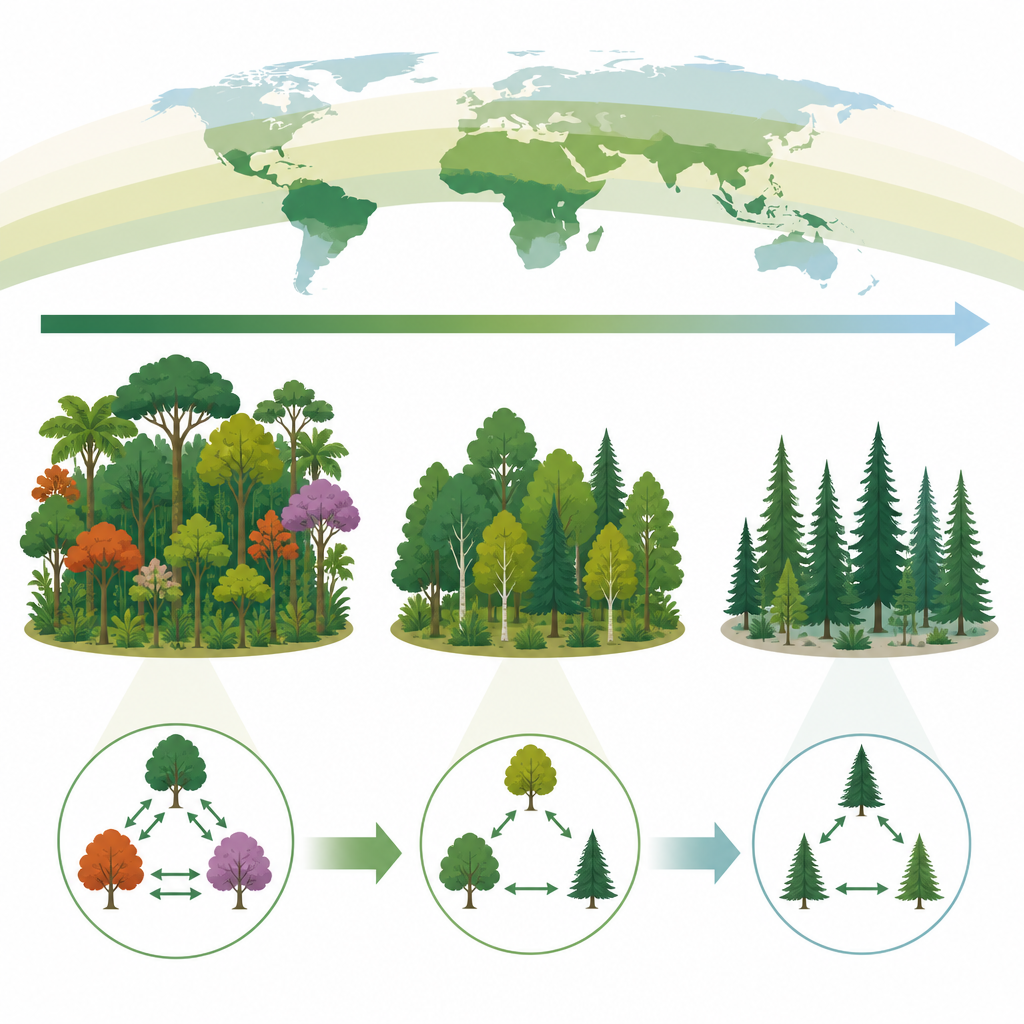
Walk from the equator toward the poles and you will notice a striking pattern: tropical forests are packed with many kinds of trees, while northern forests are dominated by just a few. This study asks why that global trend exists and argues that to understand it, we must look beyond simple one‑on‑one competition and consider how groups of trees influence one another in more complex ways.
More than just neighborly rivalry
For decades, ecologists have focused on how a tree is helped or harmed by trees of its own species growing nearby. If too many close neighbors of the same kind make life harder, rare species can persist because common ones are held in check. This idea, called negative density dependence, has been proposed as a key reason why tropical forests host so many species. Yet global studies have produced mixed results about whether this neighbor effect really gets stronger toward the equator, leaving a major debate unresolved.
When three trees are company
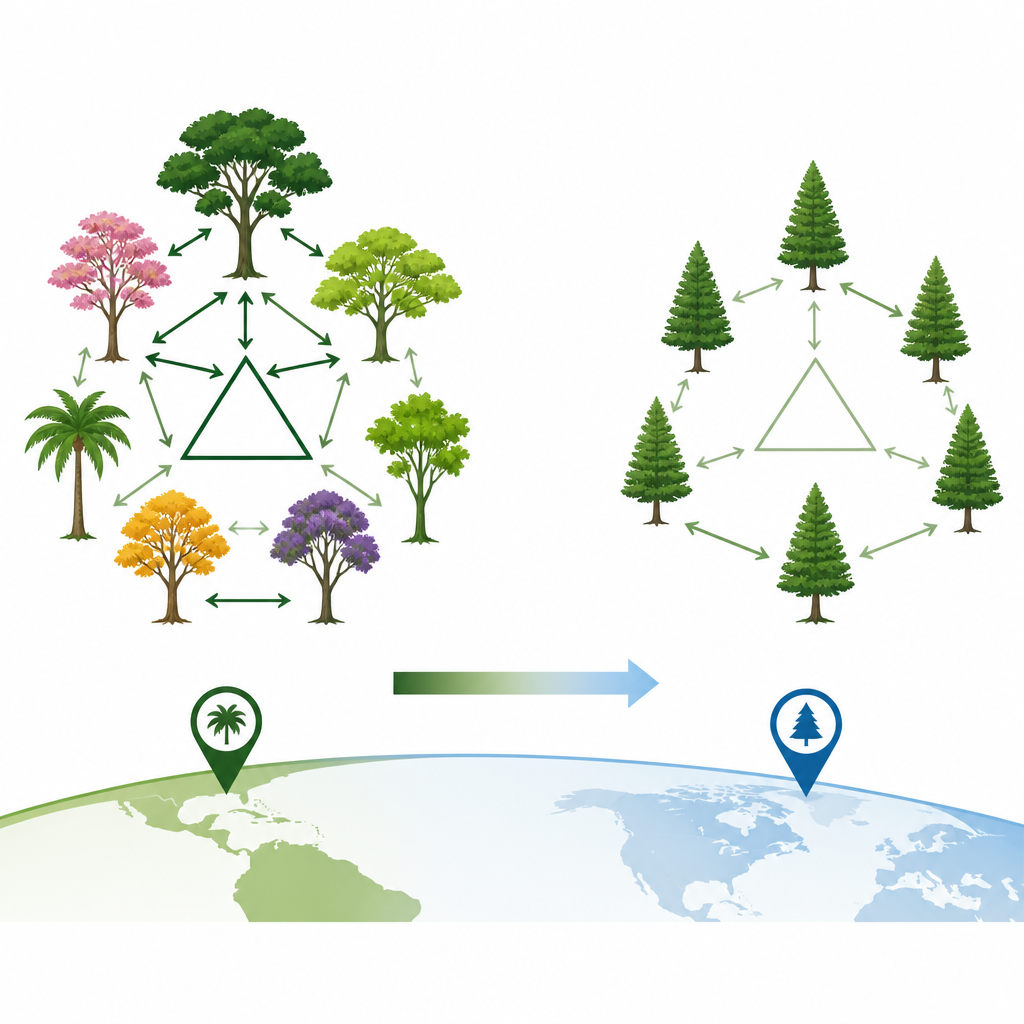
The authors argue that the missing piece is what happens when a third tree enters the picture. In these higher‑order interactions, the impact of one neighbor on a focal tree is changed by the presence of other neighbors. For example, one species may stunt a second species, which in turn reduces how strongly that second species can compete with a third. Using detailed census data from more than 3 million trees in 32 large forest plots across the world, the team built models that could separate simple pairwise effects from these more complex, multi‑tree influences on growth and survival.
Complex interactions are common and strongest in the tropics
Across the plots, models that included higher‑order interactions did a better job of predicting how trees grew and survived than models that only considered one‑on‑one effects. Evidence for higher‑order influences appeared in about 40 percent of species–site combinations for growth and nearly a quarter for survival, showing that such effects are widespread rather than rare curiosities. Importantly, the strength of these multi‑tree interactions declined toward higher latitudes: they were strongest in tropical plots and weaker in temperate and boreal forests.
Boosting rare species while restraining common ones
The researchers then asked what these interactions mean for which trees thrive. They calculated how much local neighbors, acting through both simple and higher‑order effects, changed each species’ growth rate. In forests of all climate zones, the combined influence of neighbors tended to help rare species and hinder common species, a pattern that encourages many kinds of trees to coexist. However, the stabilizing role of higher‑order interactions weakened toward higher latitudes. In other words, the very processes that give rare species a helping hand are strongest where diversity is highest and fade in simpler, colder forests.
What this means for understanding global tree diversity
By showing that multi‑tree interactions are common and fade with latitude, the study suggests a fresh way to explain why tropical forests are so rich in species. Rather than relying only on direct competition between pairs of trees, the authors highlight a web of indirect influences that shift the balance in favor of rare species in warm, diverse regions. As these higher‑order effects weaken toward the poles, common species face fewer checks, and forests become dominated by a smaller set of tree types. This more complex view of tree interactions helps clarify an old puzzle in ecology and points to new ways of thinking about how forests around the globe will respond to environmental change.
Citation: Li, Y., Xiao, J., Jiang, Y. et al. Higher-order interactions enhance the latitudinal tree diversity gradient. Nature 653, 433–438 (2026). https://doi.org/10.1038/s41586-026-10434-6
Keywords: tree diversity, tropical forests, species interactions, latitudinal gradient, forest ecology