Clear Sky Science · en
Evolutionary characterization of lung cancer metastasis
Why the spread of lung cancer matters
Most deaths from cancer occur not because of the original tumor in an organ, but because cancer cells travel to form new growths elsewhere in the body. Lung cancer is a leading cause of this kind of spread, yet doctors still know surprisingly little about exactly when and how it happens inside a person. This study follows the full course of disease in a group of people with non small cell lung cancer, from the first operation to research autopsies after death, to map how their cancers evolved and migrated over time.
Following tumors from diagnosis to death
The researchers combined two large UK projects: one that closely tracks early lung cancers after surgery, and another that collects tissue during research autopsies. For 24 patients, they analyzed 501 samples taken from the original lung tumors and from tumors that appeared later around the body. Using powerful DNA sequencing, they reconstructed each cancer’s family tree, identifying subclones, which are branches of the tumor with their own sets of genetic changes. This allowed them to compare how similar or different the original lung tumors were from the metastases that eventually proved fatal.
Metastases are genetically diverse and keep changing
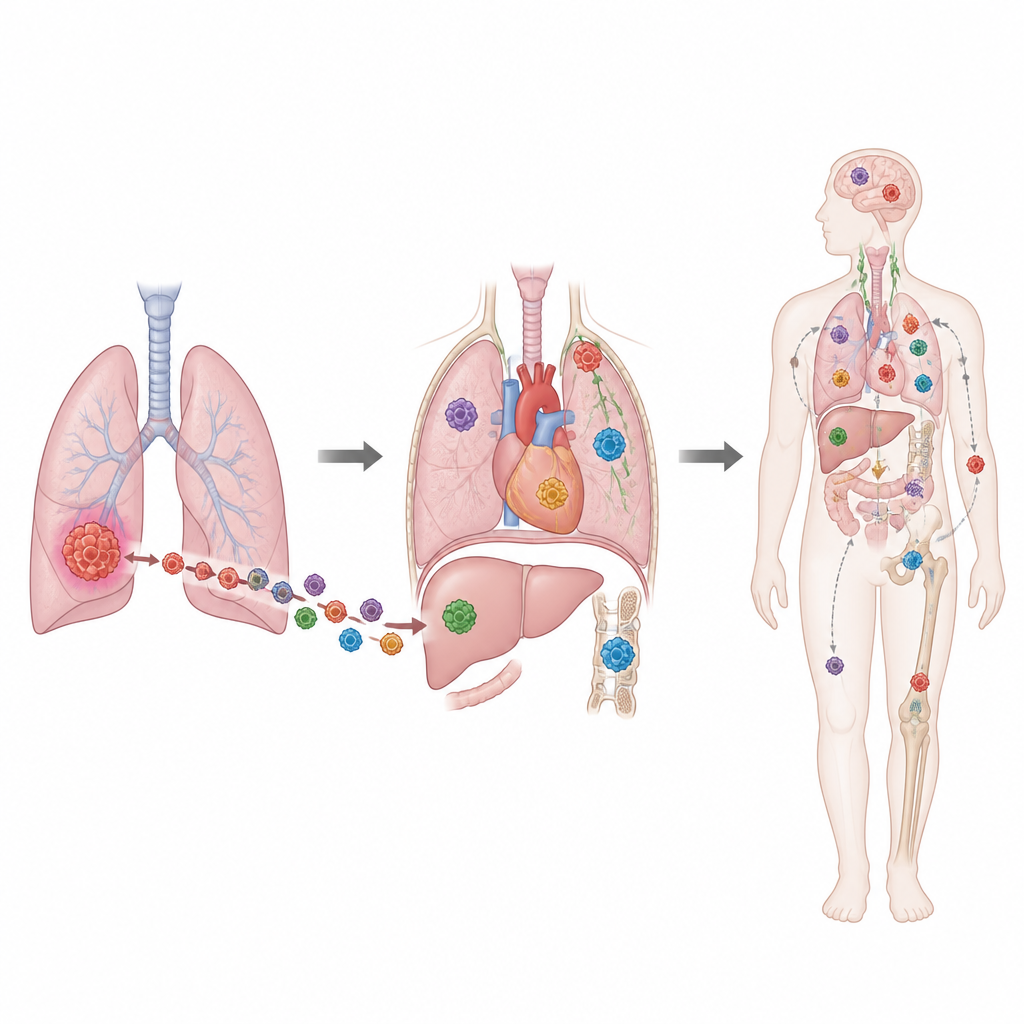
The team found that metastases often looked very different from the tumor that was removed at surgery. The new sites carried many extra genetic alterations, including large scale changes in chromosome number and, in many cases, whole genome doubling, where the entire set of DNA is copied. Most patients had additional cancer driving mutations that appeared only in metastases, often linked to chemotherapy exposure. When many regions of metastatic tumors were sampled, almost four out of five individual metastases contained at least one unique subclone not seen anywhere else. This shows that taking a biopsy from just one metastatic site can seriously underestimate the genetic diversity of advanced disease.
Metastases can seed new metastases
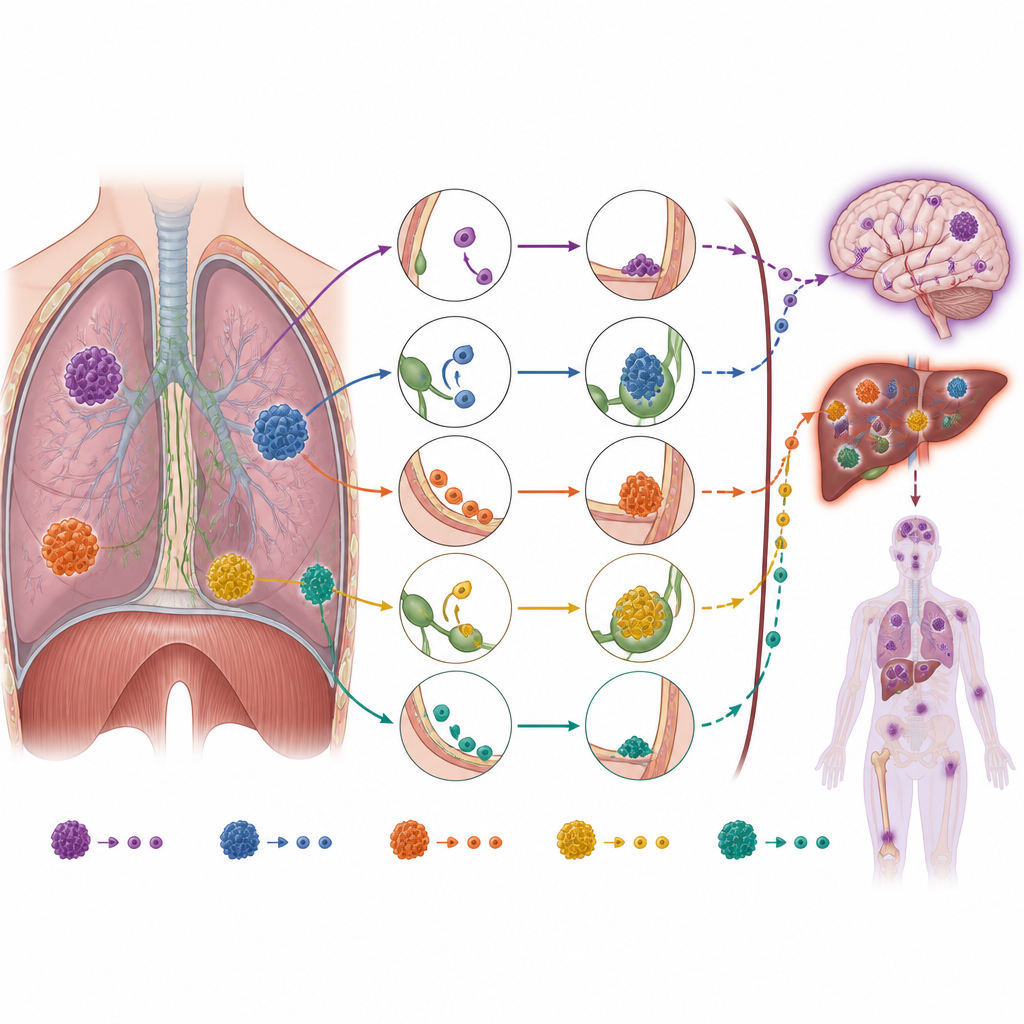
By overlaying the DNA based family trees onto patients’ scan histories, the researchers asked which subclones founded each metastatic site and where they came from. In nearly two thirds of patients, several distinct branches of the original lung tumor each gave rise to different metastases. More strikingly, most of the sampled metastases were not seeded directly from the lung at all, but from other metastases. Once a few metastatic sites were established, they often acted as hubs, sending out further waves of migrating cancer cells. This cascade tended to stay within the same body cavity: metastases in the chest usually seeded other sites in the chest, while the rarer subclones that escaped the thorax often spread widely to distant organs.
Time and place shape seeding power
Not every metastasis played the same role. Metastases that were present for longer, and that grew to larger sizes, were more likely to seed new sites. These long lived metastases had accumulated more mutations and contained more subclones, suggesting that both time in place and internal diversity increase the chances that a capable seeding subclone will arise. The pattern also depended on location. Metastases in the lungs and nearby chest lymph nodes were usually detected earlier on scans and more often seeded others, whereas late appearing metastases in places like the liver or peritoneum rarely did so. Subclones that managed to seed outside the chest tended to carry more widespread chromosomal changes than those that stayed within the thorax, linking chromosomal instability to the ability to colonize distant organs.
What this means for treating advanced lung cancer
For a lay reader, the key message is that advanced lung cancer is not a single entity but a constantly branching forest of related tumors, many of which can send out further offshoots. The original lung tumor removed at surgery is often a poor guide to the genetic make up of late metastases. In many patients, a few early metastases act as relay stations that later seed much of the remaining disease, especially within the chest. Those that acquire especially unstable chromosomes are more likely to break out to distant organs. These insights help explain why local treatments that target persistent metastases, such as focused radiation or surgery, can sometimes improve outcomes: removing or controlling major seeding hubs may slow the metastatic chain reaction. The work also highlights why it is so hard to fully control lung cancer once it has spread, and why future treatments may need to account for the evolving, multi site nature of metastatic disease.
Citation: Hessey, S., Bunkum, A., Huebner, A. et al. Evolutionary characterization of lung cancer metastasis. Nature 653, 911–922 (2026). https://doi.org/10.1038/s41586-026-10428-4
Keywords: lung cancer, metastasis, tumor evolution, chromosomal instability, cancer genomics