Clear Sky Science · en
Two-qubit logic and teleportation with mobile spin qubits in silicon
Moving information without moving wires
As quantum computers grow larger, connecting many tiny quantum bits without drowning them in wiring and noise is a major challenge. This study shows a new way to let qubits themselves move around a silicon chip, meet briefly to talk, and then fly apart again, all while keeping their fragile quantum information largely intact. The same trick even lets information be teleported from one place to another without the particle itself traveling the full distance.
Why mobile qubits matter
Most quantum chips today keep each qubit fixed in place and only let neighbours interact. That makes it hard to link distant qubits and demands complicated layouts and control lines. The team behind this work explores an alternative: mobile qubits, where single electrons carrying quantum information ride inside moving electrical pockets on a silicon chip. By shuttling these electrons between storage zones and special interaction regions, a processor could rewire itself on the fly, adapt to different error-correcting schemes, and share resources more efficiently across the chip. 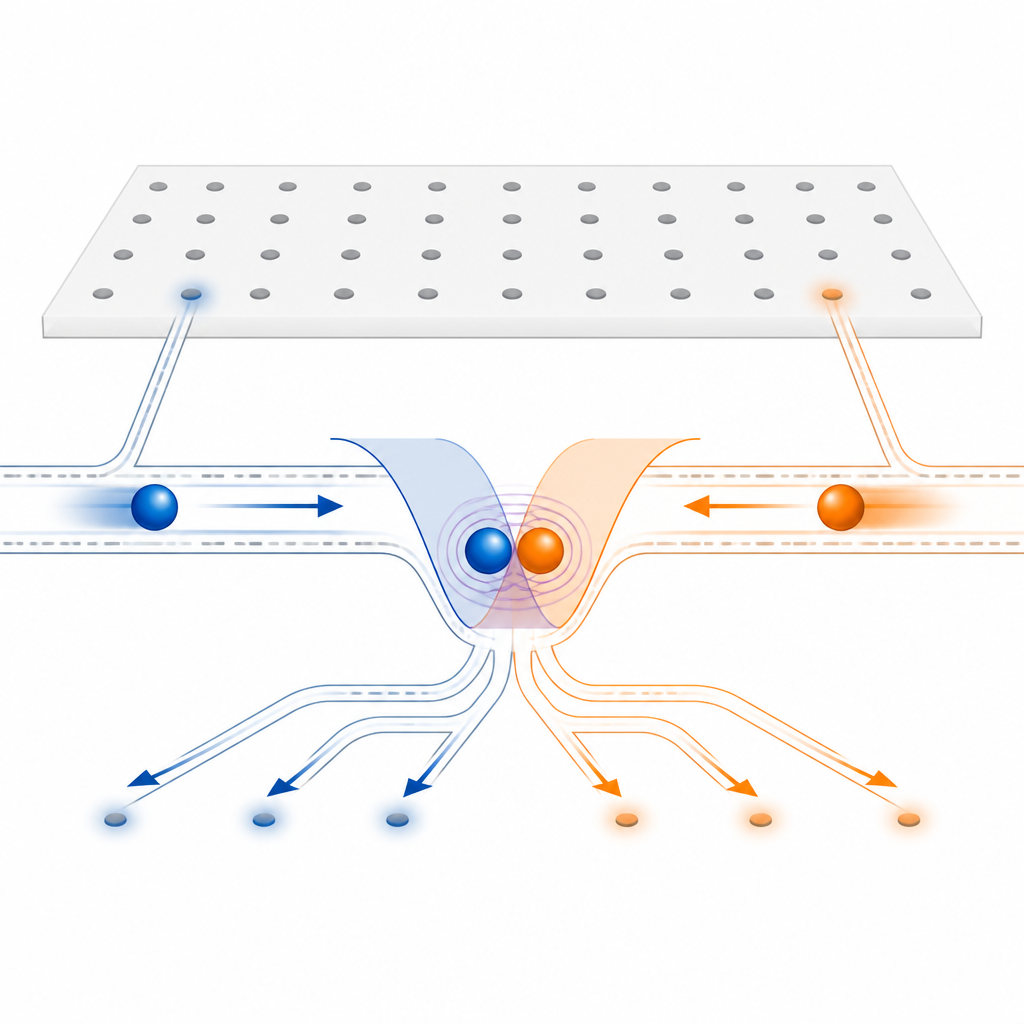
How the silicon conveyor belt works
The researchers built a device containing six tiny traps for electrons, known as quantum dots, in an ultra-clean silicon–germanium structure. Surrounding metal gates create and steer these traps using carefully timed voltages. By applying phase-shifted sine waves to a sequence of gates, they generate a smooth, travelling wave of electric potential, like a conveyor belt for electrons. Two electrons, each encoding a qubit in its spin, are loaded from distant dots into separate moving pockets. As the conveyor runs, the pockets carry the electrons toward the centre of the chip, where their quantum “clouds” can overlap and allow the spins to interact.
Tuning interaction strength and gate quality
When the two moving electrons draw close, their spins feel an exchange interaction whose strength depends sensitively on how much their wavefunctions overlap and on the height of the barrier between them. By changing both the shuttle distance and a key barrier voltage, the team maps out how this interaction grows, peaks, and even saturates in different regimes. They also track how long the moving qubits keep their phase coherence. Interestingly, motion can average out some types of noise, so coherence while shuttling can exceed that of parked qubits. Using these insights, they identify a sweet spot where the interaction is strong enough for fast operation but the spins remain coherent long enough to complete a two-qubit logic gate.
Fast logic between distant moving qubits
At this operating point, the team implements a controlled-Z gate, a basic building block for quantum algorithms. The conveyor first loads the electrons from their static dots into moving pockets, quickly brings them closer, slows down to let them interact for a carefully shaped time, and then returns them to their original locations. The gate lasts only about 58 billionths of a second, during which the spins never leave the protection of their moving traps. Using a standard benchmarking method that compares random sequences with and without the two-qubit gate, the experiment reaches an average controlled-Z fidelity of about 99 percent, on par with leading fixed-qubit silicon devices but now achieved between qubits that start hundreds of nanometres apart.
Teleporting quantum states across the chip
To show that mobile spins can support more than local logic, the researchers use them to teleport a quantum state from one distant qubit to another. First, two remote qubits are entangled using the shuttling-based gate. Then one of them is jointly measured with a third qubit in a special way that, depending on the outcome, projects the original state onto a faraway partner. Because their parity measurement cannot distinguish all possible outcomes, the team post-selects the successful cases, much like many optical experiments. After correcting for preparation and measurement errors, the average fidelity of the teleported state reaches about 87 percent, safely above the best any classical scheme could do. 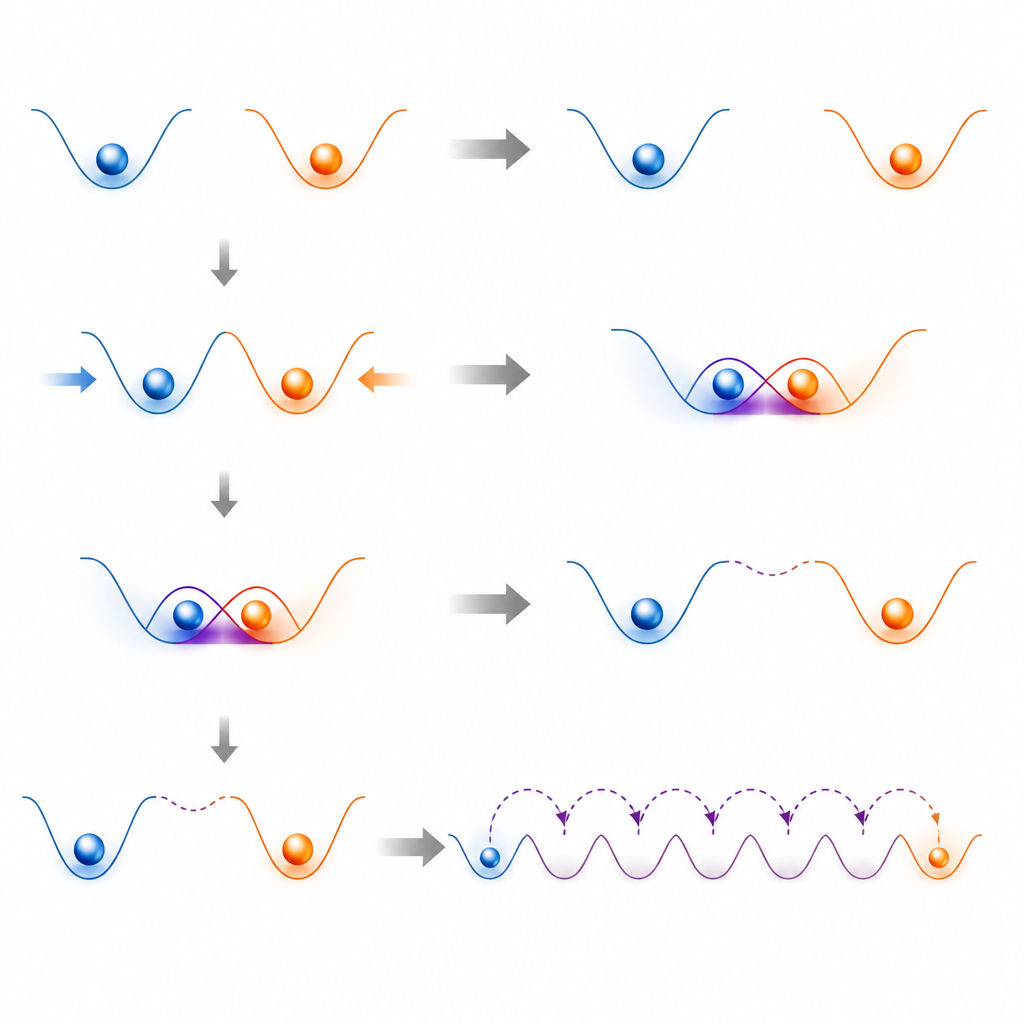
What this means for future quantum chips
This work shows that high-quality two-qubit logic and quantum teleportation are possible with moving spin qubits in silicon. Instead of weaving ever-denser wiring around fixed qubits, future processors could rely on shared conveyor “highways” that ferry electrons between sparse storage zones and well-controlled interaction regions. In such designs, tasks like error correction or special state preparation could take place in dedicated areas, with results teleported or shuttled to where they are needed. Although turning this idea into large, fully deterministic machines will require longer conveyor lines, parallel channels and faster readout, the experiments here demonstrate that mobile qubits are a practical and powerful ingredient for scalable, reconfigurable quantum computing.
Citation: Matsumoto, Y., De Smet, M., Tryputen, L. et al. Two-qubit logic and teleportation with mobile spin qubits in silicon. Nature 653, 391–397 (2026). https://doi.org/10.1038/s41586-026-10423-9
Keywords: quantum computing, spin qubits, silicon quantum dots, quantum teleportation, mobile qubits