Clear Sky Science · en
Efficiency-optimized relativistic plasma harmonics for extreme fields
Light so intense it can shake empty space
Lasers have grown so powerful that they can rip electrons from atoms and turn solid matter into plasma. This study shows how to squeeze even more punch from today’s biggest lasers by using a clever mirror made of plasma itself. By learning how to steer and compress the light it reflects, scientists move a step closer to field strengths so extreme that even the “empty” vacuum of space is predicted to flicker with particles popping in and out of existence.
Turning solids into brilliant mirrors
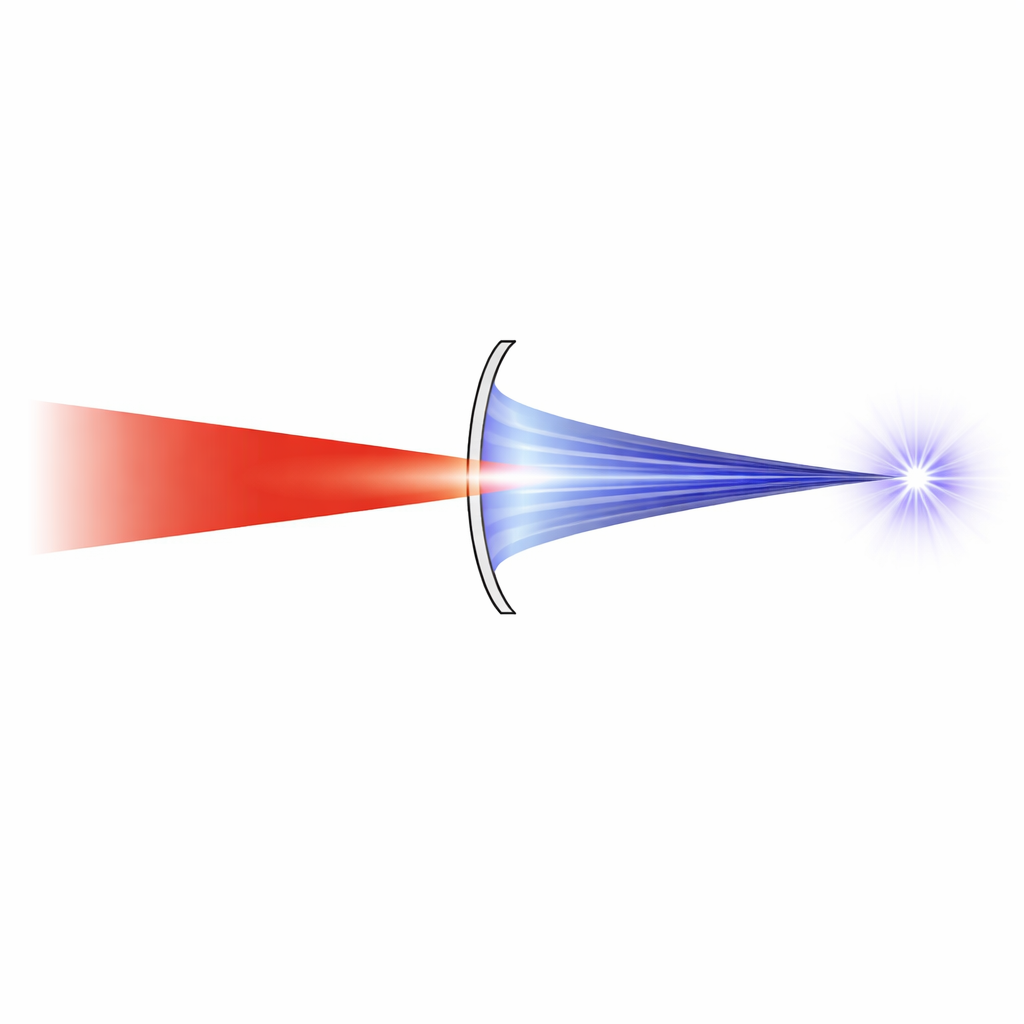
When an ultra‑intense laser hits a solid target, its front edge strips electrons from the surface, creating a paper‑thin layer of plasma. If that layer is sharp enough, it behaves like a mirror that moves back and forth at nearly the speed of light as the laser’s electric field pushes on it. This motion forces the reflected light to bunch into very short flashes and shift to much higher colors, far into the extreme ultraviolet and X‑ray range. These flashes are known as high harmonics and, if many of them line up in phase and are focused together, they can form an exceptionally tight and intense bright spot called a coherent harmonic focus.
Why efficiency is the missing ingredient
Previous experiments had already shown that such plasma mirrors can bend the outgoing light like a perfect lens and lock the phases of the harmonic flashes down to attosecond (billion‑billionth of a second) precision. What was missing was the ability to pour a large fraction of the incoming laser energy into the harmonic beam itself. Theory predicts that, under ideal conditions, the strength of successive harmonics should fall off only slowly, so that many orders remain strong enough to contribute to the final focused field. In practice, however, experiments had fallen far short of the simulated efficiencies, suggesting that the plasma conditions were only briefly passing through the optimal state during each laser shot.
Fine‑tuning the laser’s leading edge
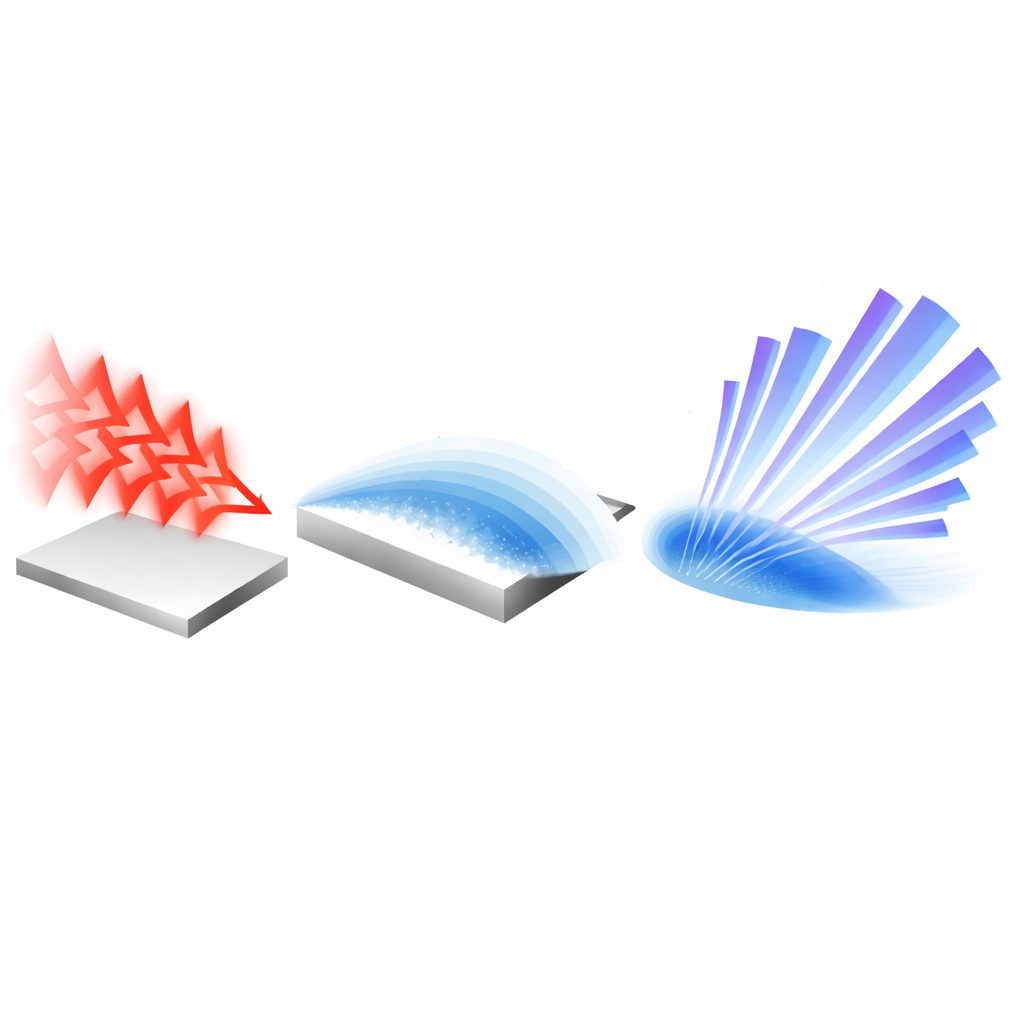
The team used the Gemini petawatt‑class laser and added a double “plasma mirror” system placed upstream of the main target to clean up the laser pulse before it hit the solid. These extra mirrors act like ultrafast optical switches: at low intensity they are dull, but once the light climbs past a threshold they suddenly turn highly reflective. By modifying the coatings on these mirrors, the researchers shortened the time it takes for the main pulse to rise from a tiny background level to full strength by a few hundred femtoseconds (less than a trillionth of a second). This seemingly modest change transformed the interaction. With the faster rise, the laser created a steeper, better‑shaped plasma surface on the main target, leading to a harmonic beam more than a hundred times brighter in energy than before, with over 9 millijoules carried between the 12th and 47th harmonics.
Balancing intensity and plasma shape
Computer simulations running alongside the experiment reproduced the measured efficiencies across three orders of magnitude and revealed why the tuning is so delicate. At lower laser intensities, the natural weak “prepulse” preceding the main shot is too small to pre‑shape the plasma surface properly, so the efficiency falls below the theoretical limit. The researchers restored optimal conditions by adding a separate, carefully timed miniature pulse to pre‑prepare the target with just the right density gradient. As the intensity increased toward 1021 watts per square centimeter, the harmonic yield stopped growing rapidly and entered a saturation regime. In this regime the entire focal spot, not just its bright center, contributes efficiently, and the plasma surface is dented into a gentle concave shape by the laser’s pressure. The resulting harmonic beam widens and develops intricate angular patterns, clear signs that the system has reached the desired efficiency limit.
A new route to extreme fields
By combining precise control of the laser’s temporal profile with an understanding of how the plasma surface bends and radiates, the study delivers the final missing piece needed to exploit coherent harmonic focusing in the laboratory. Under these efficiency‑optimized conditions, simulations indicate that a coherent harmonic focus produced by today’s multi‑petawatt lasers could boost intensities by more than an order of magnitude beyond what the original beams can reach on their own, pushing toward 1023–1029 watts per square centimeter. That is approaching the “Schwinger limit,” where the quantum vacuum itself is expected to break down into pairs of particles and antiparticles. While many technical challenges remain, this work shows a realistic path toward tabletop experiments that probe some of the most extreme predictions of modern physics.
Citation: Timmis, R.J.L., Fitzpatrick, C.R.J., Kennedy, J.P. et al. Efficiency-optimized relativistic plasma harmonics for extreme fields. Nature 652, 1153–1158 (2026). https://doi.org/10.1038/s41586-026-10400-2
Keywords: plasma mirrors, high harmonic generation, ultraintense lasers, coherent harmonic focusing, quantum electrodynamics