Clear Sky Science · en
Biodiversity resilience in a tropical rainforest
Why this rainforest story matters
Tropical rainforests are often portrayed as on the brink of collapse, yet this study offers a more hopeful twist: if we simply stop cutting and planting, many forests can begin to heal themselves. By tracking thousands of species in an Ecuadorian rainforest, the researchers ask a deceptively simple question with big implications for climate, wildlife and people: when farmland is abandoned, how completely—and how fast—does life return?
From farms back to forest
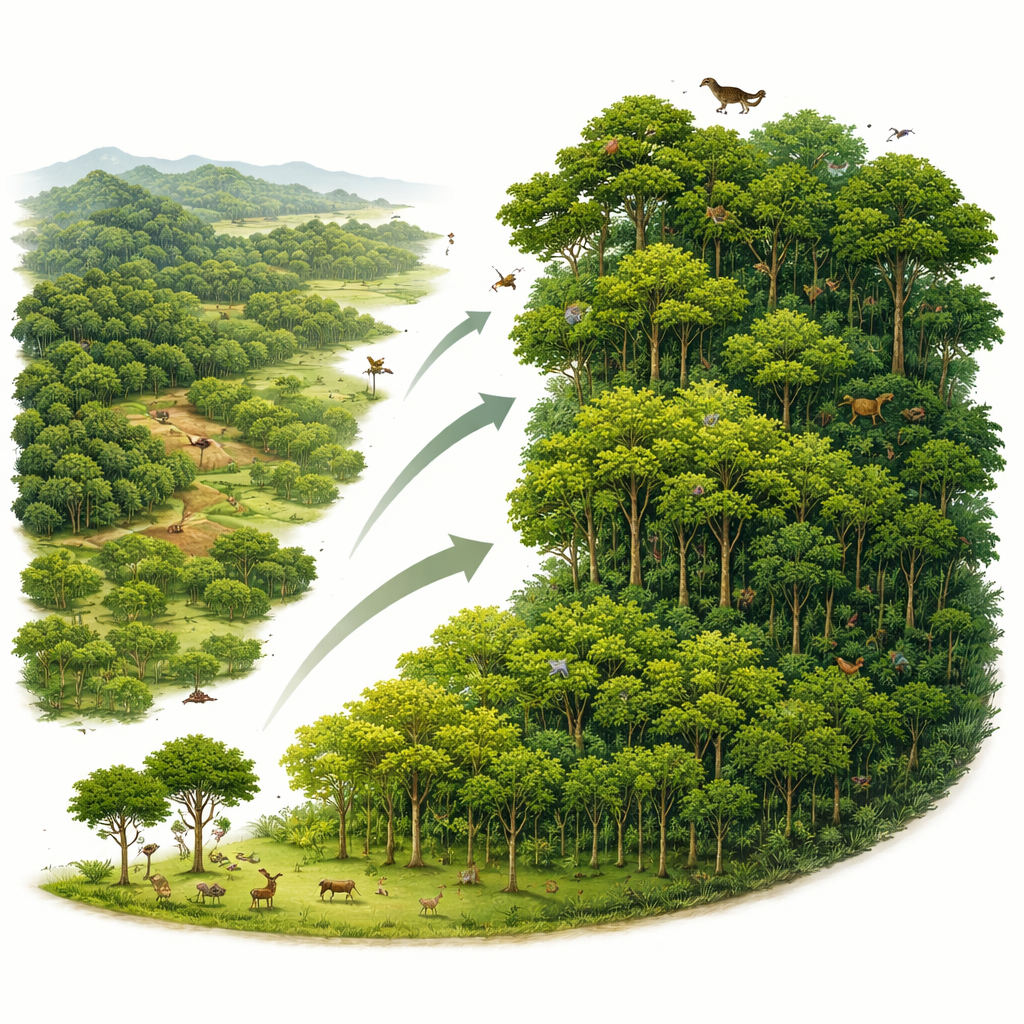
The team worked in the Chocó lowland rainforest, one of the planet’s most species-rich and threatened regions. Over the past decades, large areas here were cleared for cattle pasture and sun-grown cacao plantations. Instead of following a single spot through time, the researchers compared 62 plots representing different stages along a disturbance cycle: intact old forest, active farms and regrowing “secondary” forests between 1 and 38 years old. In each plot they surveyed 16 major groups of organisms, from trees, seedlings and soil bacteria to ants, beetles, frogs, birds, bats and mammals—more than 10,000 species plus tens of thousands of bacterial lineages. This broad view let them see how a whole forest community, not just trees, rebuilds itself after clearing.
Measuring a forest’s bounce-back
To understand recovery, the authors borrowed ideas from stability science. They defined “resistance” as how much of a group’s abundance and diversity survive during farming, and “return rate” as how quickly it moves back toward conditions in old forest once land is abandoned. They then used a curve that bends upward over time to estimate how long it would take each group to reach 90% of old-growth levels. Crucially, they distinguished simple counts of individuals and species from the actual mix of species present. A young forest might host many birds and insects, for example, but not yet the same species as the original forest.
Fast numbers, slow identities
The results show that nature can rebound impressively, but with hidden delays. Within about 30 years, the regrowing forests regained more than 90% of the overall abundance and species diversity, on average, across most groups. Even the identity of communities—the particular combination of species—reached about three-quarters similarity to old forest. Yet full return of the original cast of characters often requires many more decades, and in the case of soil bacteria, possibly centuries or may stall altogether. Mobile animals such as birds, bats and bees tended to resist disturbance better and recover faster than trees and leaf-litter creatures. They were common in farmed plots and returned quickly once fields were left to regrow, while many slow-growing tree species and ground-dwelling animals lagged behind.
Helpers on wings and feet
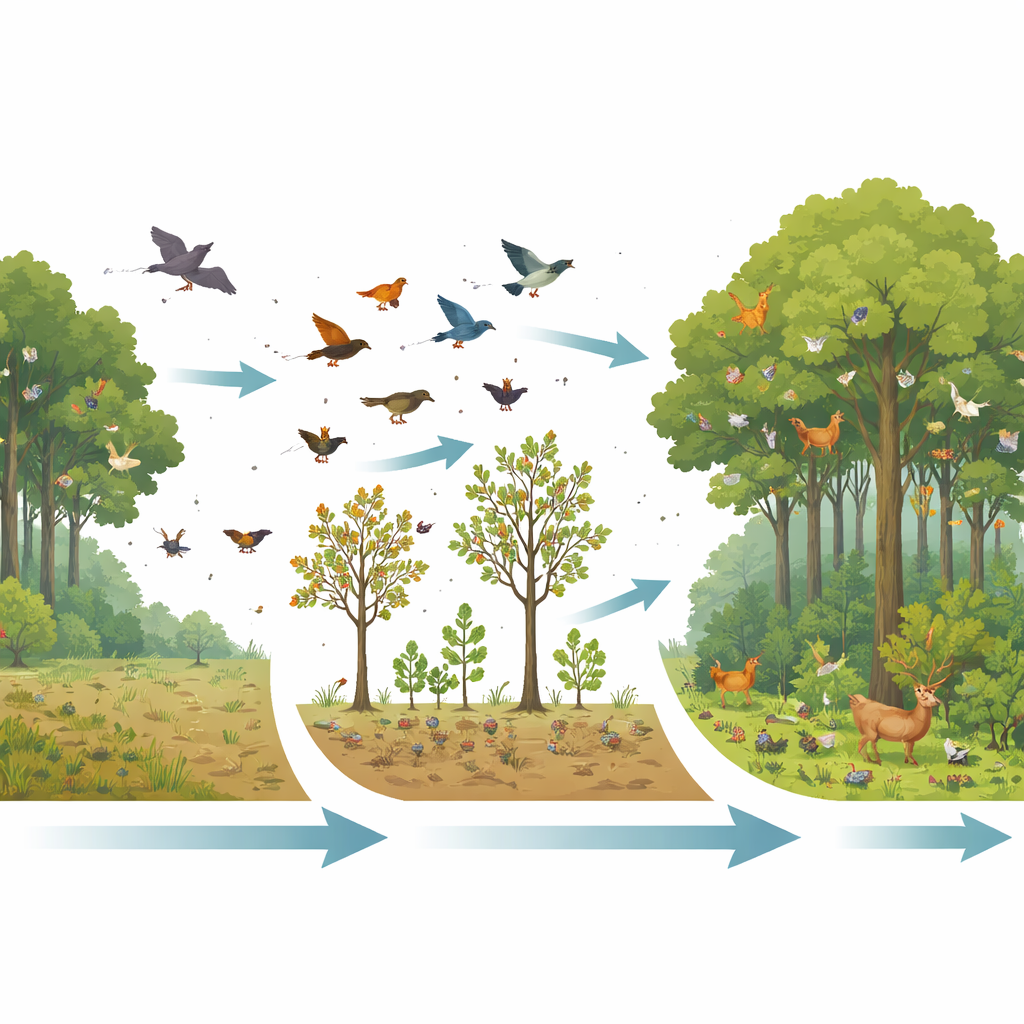
Seed-dispersing and pollinating animals emerged as key allies of forest recovery. Bats and fruit-eating birds frequently visited farms and young forests, carrying seeds from intact forest into cleared areas. Bees, moths and other insects bridged old and new habitats as they foraged, helping flowers set seed even before the canopy closed. These groups combined relatively high resistance—they were not wiped out by farming—with rapid return rates once fields were abandoned. Together with fast-growing pioneer trees, they formed positive feedback loops: early trees provide nectar and fruit, which attract more animals, which in turn bring more seeds and maintain pollination, gradually rebuilding a complex, interlinked community.
Land-use legacies and limits
The history of a plot shaped how quickly life came back. Many animal groups and tree seedlings recovered faster on former cacao plantations than on pastures, probably because cacao fields retain more shade, humidity and scattered trees than open grasslands. By contrast, adult trees showed similar recovery times regardless of previous use, reflecting their long lifespans and slow reproduction. When the authors compared their results to dozens of other tropical studies, a consistent pattern emerged: across regions and species, the fine details of who lives where take much longer to recover than simple counts of how many species are present. Return rates generally mattered more than resistance in determining overall recovery time, underscoring the importance of surrounding forest and the ability of organisms to move back in.
What this means for saving forests
For non-specialists and policymakers, the message is both encouraging and sobering. Protecting naturally regenerating secondary forests can quickly restore much of the living richness lost to deforestation, especially in landscapes that still contain large blocks of old forest nearby. Abandoning agriculture and allowing forests to regrow for several decades can yield communities that are already highly similar to pristine forest in terms of abundance and diversity. Yet the rare, slow species that make old-growth forests unique need more time—and uninterrupted recovery—to return. The study suggests that extending logging and clearing cycles, prioritizing the abandonment of tree-based farms over open pasture, and preserving remaining old forests as sources of seeds and animals are crucial steps if we want tropical landscapes that truly recover, not just look green from afar.
Citation: Metz, T., Farwig, N., Dormann, C.F. et al. Biodiversity resilience in a tropical rainforest. Nature 652, 1232–1239 (2026). https://doi.org/10.1038/s41586-026-10365-2
Keywords: tropical forest regeneration, biodiversity recovery, secondary forests, seed dispersers and pollinators, ecosystem restoration