Clear Sky Science · en
High-fidelity collisional quantum gates with fermionic atoms
Why smashing atoms can power future computers
Designing new drugs, better batteries or exotic materials often comes down to one hard task: predicting how clouds of electrons move and interact. Today’s computers struggle with this problem, but quantum computers promise a shortcut by mimicking those electrons directly. This paper shows how to do exactly that with clouds of ultracold atoms, using carefully controlled “collisions” between atoms to perform some of the cleanest quantum logic operations yet reported.
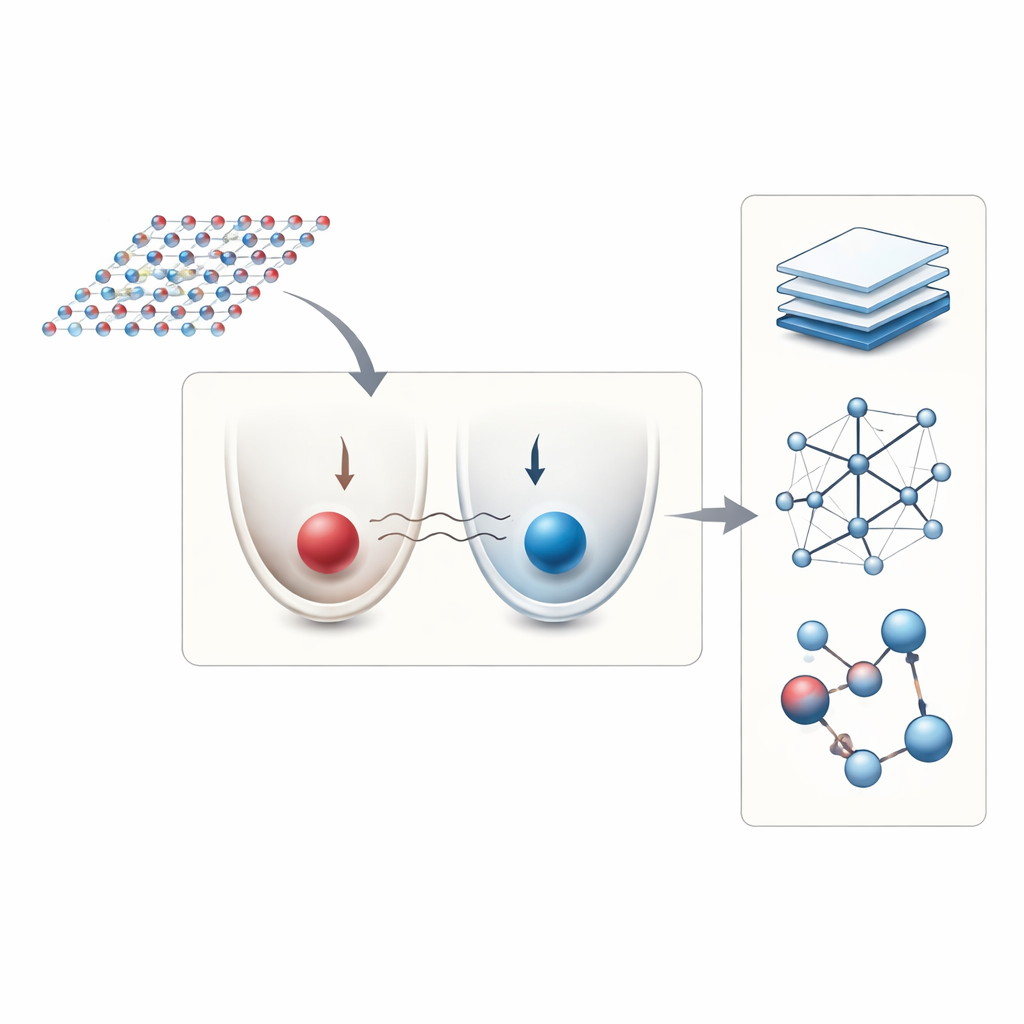
Turning a crystal of light into a quantum chip
The researchers work with a gas of lithium atoms cooled to a fraction of a degree above absolute zero and trapped in an “optical lattice” – a crystal made of intersecting laser beams. Each bright spot in this lattice can hold atoms much like the wells in an egg carton hold eggs. By arranging the light in a special superlattice pattern, the team splits each site into a pair of neighboring wells, forming millions of identical double-well “slots,” each able to host two atoms. The two lowest internal states of lithium play the role of an effective spin, so each atom acts as a tiny quantum bit. This setup creates a natural playground for imitating electrons in solids while retaining the programmability of a digital quantum computer.
Using gentle collisions as logic operations
When two atoms are trapped in one of these double-wells, they can tunnel between left and right and repel each other when they occupy the same side. Together, these motions generate a subtle exchange of their spins and positions: if the barrier between the wells is lowered for a precise time, the atoms effectively swap their quantum states. This swap operation is a fundamental two-qubit gate. The team shapes the light pulses that control the barrier height so that the unwanted motion is minimized, achieving an entangling gate with a fidelity of about 99.75%—among the best ever realized with neutral atoms. Using a quantum gas microscope, they can see, site by site, how the atoms move and verify that the gates perform as intended across dozens of double-wells simultaneously.
Building long-lived quantum links
Beyond performing fast and accurate gates, the researchers test how robust the resulting entangled states are. After creating a Bell state—one of the simplest maximally entangled pairs—they let it evolve in a carefully controlled magnetic field gradient, which slowly nudges the relative phase between the two atoms. By reversing the gate sequence, they read out how that phase changes over time. They find that the entanglement survives for more than ten seconds, vastly longer than the roughly millisecond gate time. This long lifetime means that the fragile quantum information lives mainly in degrees of freedom that are naturally shielded from noise, an important requirement for any large-scale quantum processor.
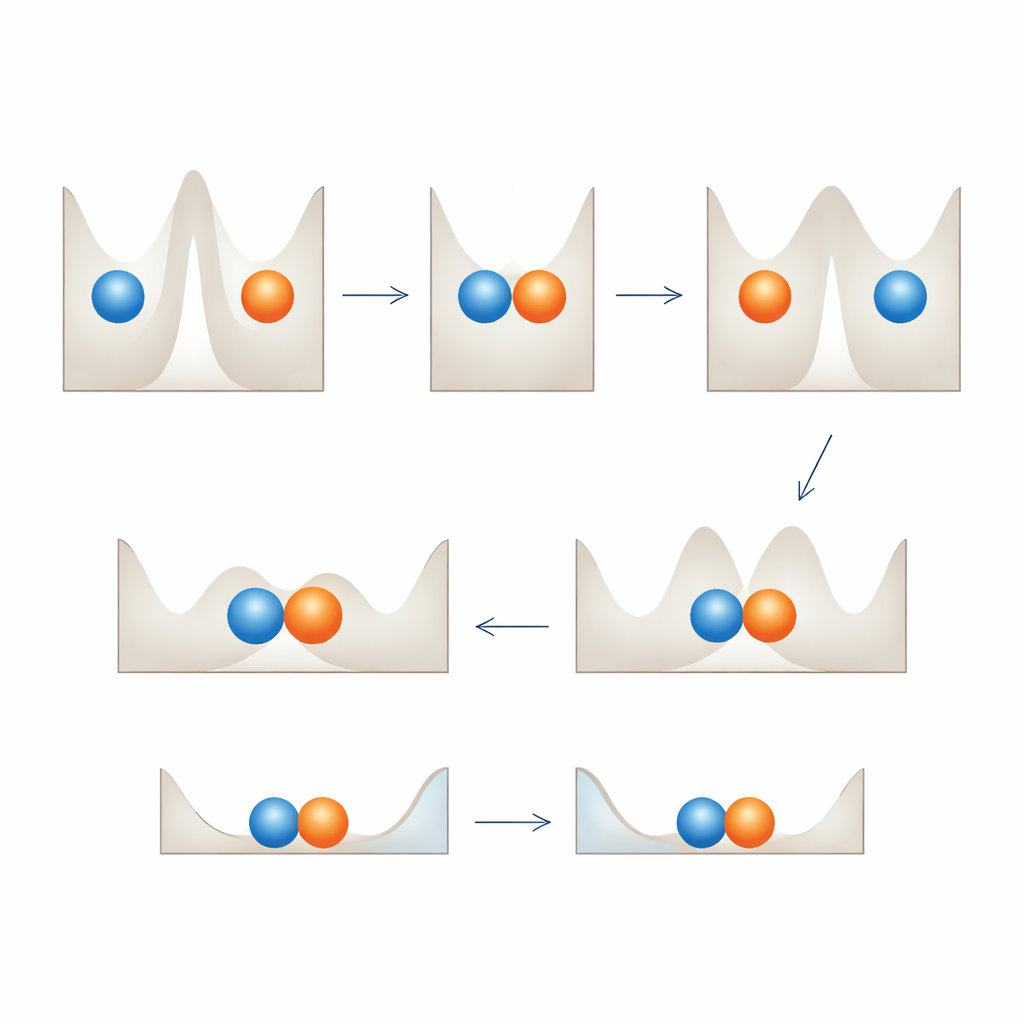
Moving pairs of atoms together
Many problems in chemistry and materials science involve electrons moving in correlated pairs rather than one by one. To capture this behavior, the authors engineer a more intricate operation called a pair-exchange gate. Instead of swapping individual atoms, this gate moves a bound pair from one side of a double-well to the other without breaking it apart. They realize this by interleaving interaction pulses with a controlled tilt between the two wells, so that only states containing a pair feel the energy offset. Carefully timed, this composite sequence leaves single-atom spin states untouched while coherently shuttling pairs back and forth. In effect, they gain separate knobs for single-particle motion and paired motion—exactly the ingredients needed to encode realistic electronic processes directly in the hardware.
From laboratory arrays to practical quantum tools
Putting these pieces together, the work establishes collisions between fermionic atoms in optical lattices as a competitive route to quantum computing. Because the platform naturally respects the rules that electrons obey—such as fixed particle number and antisymmetric exchange statistics—it avoids many bookkeeping overheads of more generic qubit schemes. The demonstrated gates already enable hybrid schemes in which analogue simulations of complex materials are complemented by digital steps for state preparation and readout. Looking ahead, the authors argue that modest technical advances could shrink gate times below ten microseconds and scale the arrays to tens of thousands of sites, paving the way for error-corrected, fully digital fermionic quantum processors capable of tackling realistic problems in chemistry, condensed matter and even lattice gauge theories.
Citation: Bojović, P., Hilker, T., Wang, S. et al. High-fidelity collisional quantum gates with fermionic atoms. Nature 652, 602–608 (2026). https://doi.org/10.1038/s41586-026-10356-3
Keywords: fermionic quantum computing, neutral-atom qubits, optical lattices, entangling gates, quantum simulation