Clear Sky Science · en
Population-scale repeat expansions elucidate disease risk and brain atrophy
Why tiny DNA repeats matter for the brain
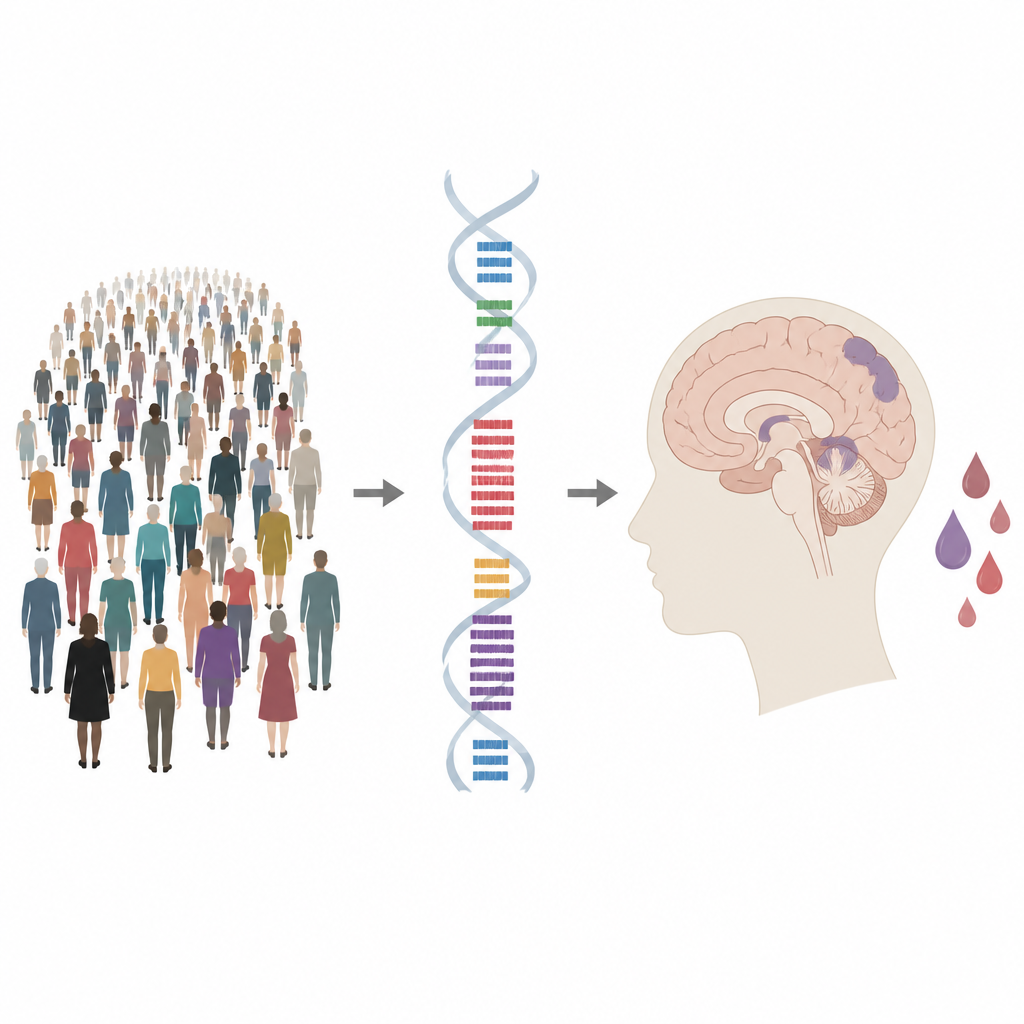
Some rare brain and muscle diseases are caused by short pieces of DNA that repeat too many times, like a word typed over and over in our genetic text. This study looked for those extra-long repeats in the DNA of more than one million people and asked a simple question: how often do these risky patterns appear in the general population, and what do they mean for brain health long before any diagnosis is made?
Hunting for hidden risks in everyday DNA
The researchers focused on 37 known trouble spots in the genome where repeated DNA letters can expand and cause conditions such as Huntington’s disease, certain ataxias that affect movement, myotonic dystrophy, and some forms of motor neuron disease. Using standard medical sequencing data from seven large cohorts, they estimated repeat lengths at these sites for more than one million volunteers from diverse ancestry groups. They then compared how many people carried repeats long enough to be considered risky, and how those numbers stack up against the known rates of the corresponding diseases.
Many more carriers than diagnosed patients
Across several genes, the team found that people carrying clearly pathogenic repeat expansions were considerably more common than patients with the matching clinical diagnoses. For example, harmful expansions in the Huntington’s gene HTT appeared at roughly two to ten times the rate of diagnosed Huntington’s disease. Similar patterns were seen for expansions in genes such as CACNA1A, C9orf72 and DMPK, which are linked to spinocerebellar ataxia, motor neuron disease and myotonic dystrophy. The study also showed that the odds of disease climb steadily as repeats get longer, rather than switching on at a sharp cut-off, and that this pattern holds for several major repeat-related disorders.
Genetic risk differs across ancestry and repeat size
Because the volunteers came from multiple ancestry groups, the researchers could see how carrier rates vary worldwide. They confirmed known patterns, such as higher frequencies of CACNA1A expansions in east Asian groups and C9orf72 expansions in people of European ancestry, which mirror regional differences in the matching diseases. They also uncovered new hints of elevated carrier rates for certain repeats in African ancestry groups that might help explain under-recognized conditions there. By running a broad scan of thousands of medical traits, they showed that longer repeats at specific sites were tied to the expected clinical problems, and that the risk and penetrance – the chance that a carrier actually develops disease – rose in a graded way as both age and repeat length increased.
Early changes in brain structure and blood markers
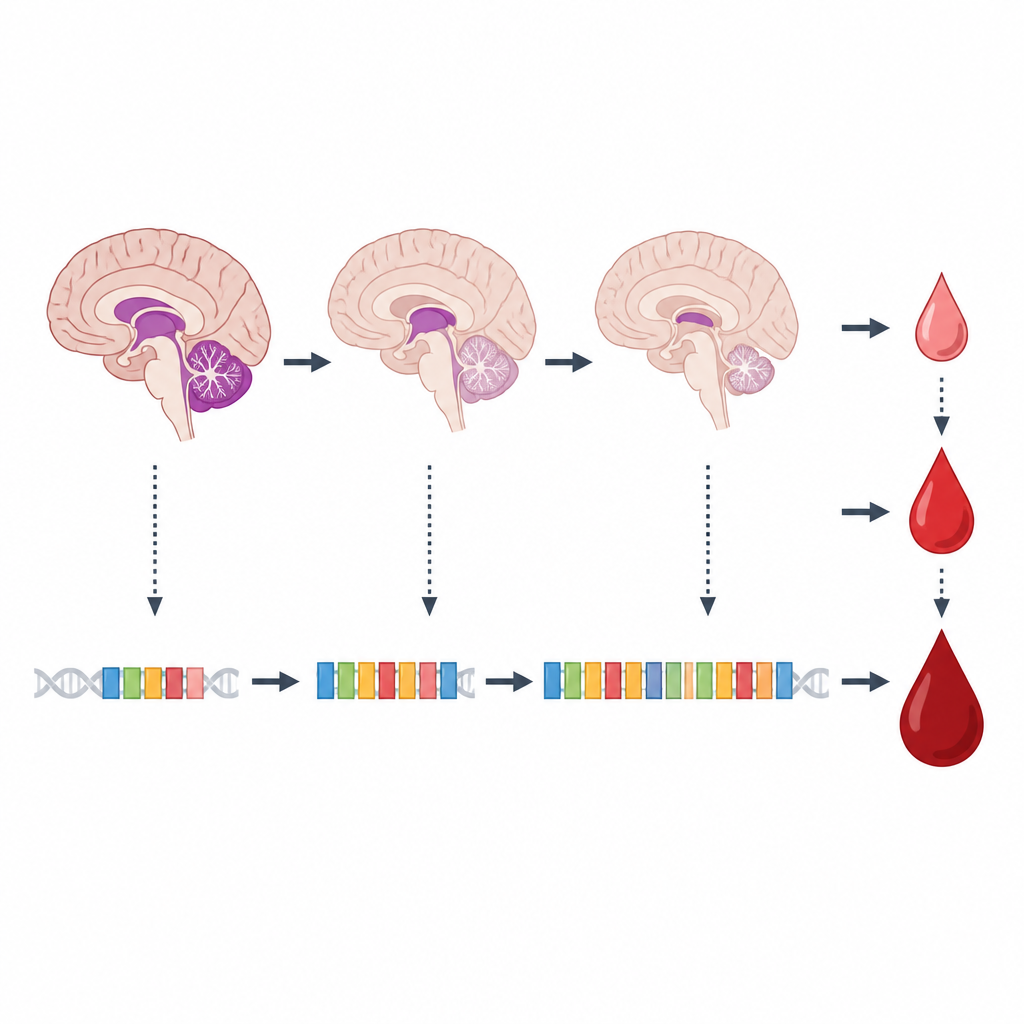
Next, the team asked whether people carrying long repeats, but not yet diagnosed with disease, already show signs of brain stress. Using brain MRI scans from tens of thousands of UK participants, they saw that carriers of expanded repeats in HTT, CACNA1A and C9orf72 had smaller volumes in precisely the brain regions known to be hit early in the related diseases. For instance, people with pathogenic HTT expansions but no Huntington’s diagnosis yet had about 22 percent less volume in a deep motor region called the putamen. Carriers of CACNA1A expansions lost nearly a quarter of cerebellar grey matter, and C9orf72 carriers showed measurable shrinkage of the thalamus. In blood samples, carriers of long HTT repeats also tended to have higher levels of neurofilament light chain, a protein that reflects nerve cell damage.
What this means for patients and future care
Taken together, these results suggest that many people quietly carry strong genetic risk for repeat-driven brain diseases, but not all will develop symptoms during their lifetime. The length of the repeat, a person’s age and other genetic and environmental factors help determine whether disease appears and when. The fact that brain shrinkage and damage-linked blood markers are detectable years before diagnosis hints that standard DNA sequencing, combined with imaging and blood tests, could one day flag vulnerable individuals early. This large-scale work shows that it is possible to read these tricky repeat expansions from routine sequencing data, connect them to disease risk across populations and begin to chart when the brain starts to change long before illness is recognized.
Citation: Pounraja, V.K., Sul, J.H., Herman, J. et al. Population-scale repeat expansions elucidate disease risk and brain atrophy. Nature 653, 796–808 (2026). https://doi.org/10.1038/s41586-026-10345-6
Keywords: repeat expansions, Huntington disease, brain atrophy, neurofilament light chain, population genetics