Clear Sky Science · en
High-precision calculation of the quark–gluon coupling from lattice QCD
Why the strength of the strong force matters
The strong nuclear force glues the atomic nucleus together and shapes everything from the stability of matter to the production of Higgs bosons at the Large Hadron Collider (LHC). Yet, surprisingly, physicists have long known its overall theory while still struggling to pin down one key number: how strong this force actually is at different energies. This paper presents the most precise calculation so far of that strength, known as the strong coupling, using massive supercomputer simulations rather than delicate modelling assumptions.
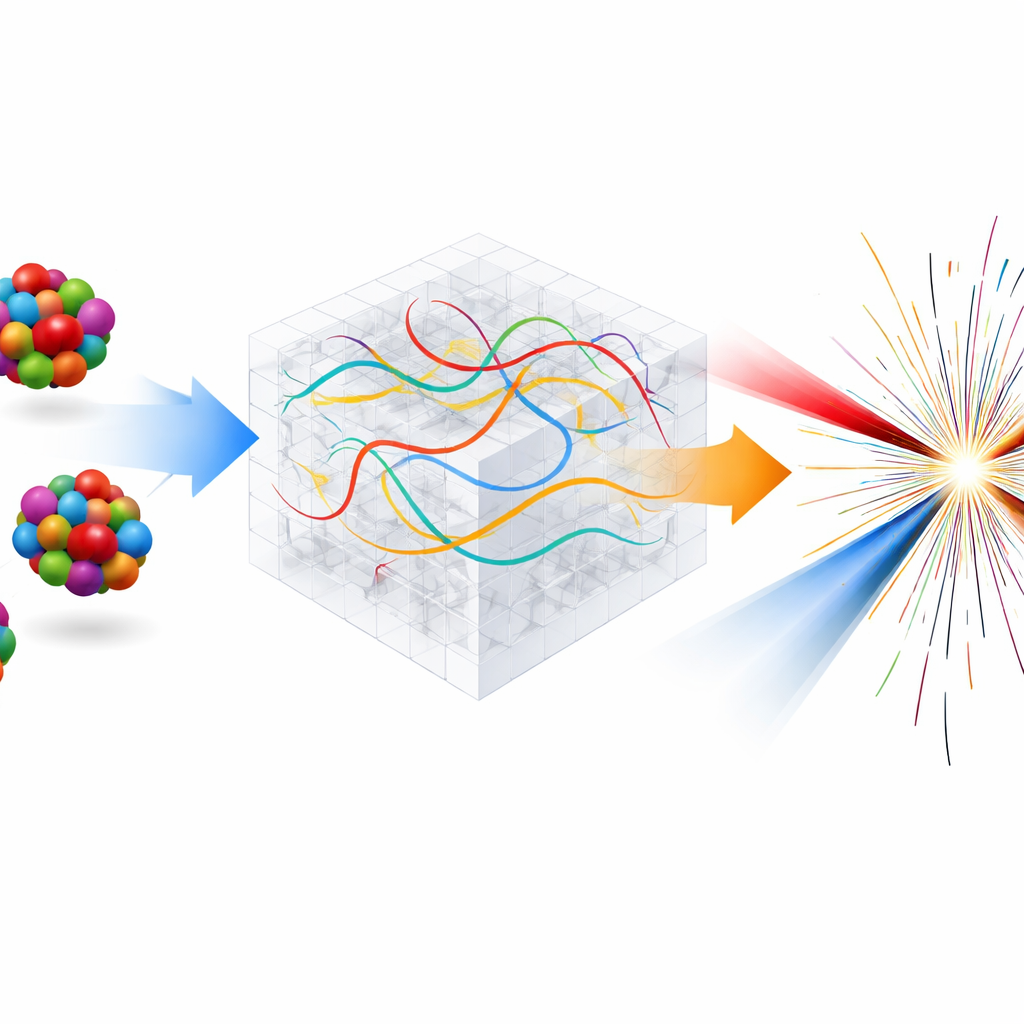
A hidden force behind everyday matter
Inside protons and neutrons, quarks are held together by particles called gluons. Their interactions are described by quantum chromodynamics, or QCD, a theory in which the strength of the force changes with energy: at very short distances quarks interact only weakly, but at nuclear scales the force becomes so strong that quarks and gluons can never be seen alone. Because we cannot isolate them in the laboratory, past estimates of the strong coupling had to rely on indirect signatures in many different experiments, each with its own set of assumptions about the messy, low‑energy behaviour of QCD. Even when combined into a global “world average”, these determinations still carried about a 1% uncertainty, large enough to blur precision tests of the Standard Model.
Putting QCD on a space–time grid
To sidestep these modelling issues, the authors use lattice QCD, in which space and time are replaced by a fine grid. Quarks live on the grid points, gluons on the links between them, and powerful Monte Carlo simulations sample the possible configurations. In this framework confinement is not guessed but emerges directly from the simulated dynamics. The challenge is that the grid spacing sets an upper limit on the energy one can reach, while the physical processes that fix the overall scale of the theory—such as the proton mass or meson decay rates—live at low energies. Bridging this enormous gulf in a controlled way is the central technical problem that this work solves.
Climbing the energy ladder step by step
The first pillar of the strategy is called step scaling. Instead of trying to simulate a single lattice that spans all energies, the authors define the energy of interest by the size of the simulated world: smaller boxes correspond to higher energies. By comparing pairs of boxes whose sizes differ by a factor of two, and repeating this many times, they non‑perturbatively track how the strong coupling changes over several orders of magnitude in energy. They use one definition of the coupling that works especially well at low energies, and another that is better suited to high energies, matching them smoothly at an intermediate scale. This “ladder” of volumes allows them to extract QCD’s intrinsic scale, called ΛQCD, with high precision using only well‑understood numerical and statistical tools.
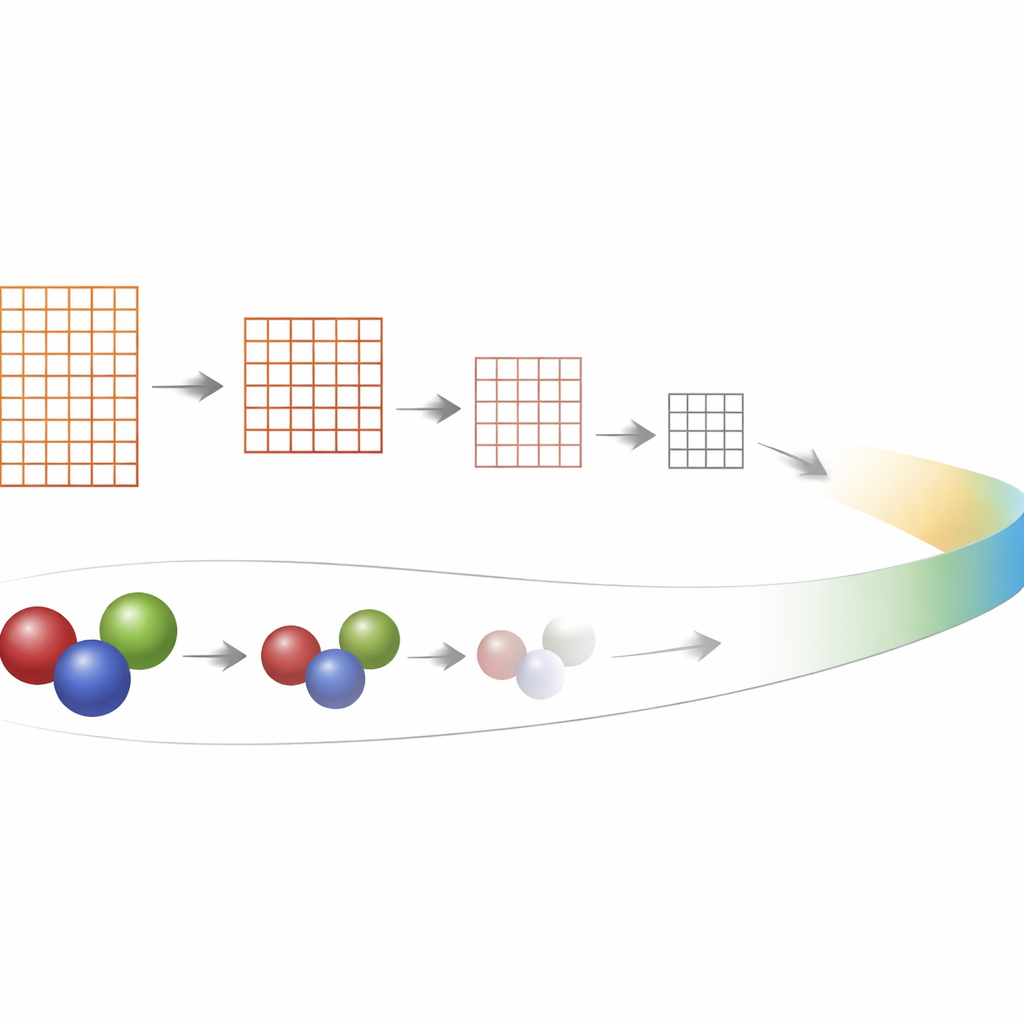
Peeling away heavy quarks for extra control
The second pillar is a complementary method known as decoupling. Here the authors perform a thought experiment in which the three lightest quark flavours are artificially given very large masses. At energies far below those masses, the quarks effectively disappear from the dynamics and the theory reduces to a simpler version of QCD without quarks at all. That simpler theory is easier to simulate extremely precisely. By tuning the heavy masses in their simulations and carefully extrapolating to the limit of infinitely heavy quarks, the team can match the complicated real‑world theory to the simpler one and back again. Crucially, they improved the lattice formulation so that the most dangerous numerical artifacts from heavy quarks are cancelled, and they verified that the remaining corrections behave exactly as theoretical arguments predict.
Pinning down the number and why it matters
Using these two independent routes, the authors obtain consistent values for ΛQCD and combine them into a single result. After accounting, with perturbation theory, for the real‑world charm and bottom quarks that were not fully simulated, they arrive at a value for the strong coupling at the mass of the Z boson: αs(mZ) = 0.11876 with an uncertainty of only about 0.5%. Most of this uncertainty is purely statistical, coming from the finite amount of supercomputer time, and has a clear probabilistic meaning. This new level of precision sharpens predictions for Higgs production and decay at the LHC, helps refine studies of whether our universe’s Higgs‑based vacuum is truly stable, and tightens constraints on proposed physics beyond the Standard Model. Perhaps most importantly, the result is anchored in low‑energy measurements of hadron masses and decay rates that are independent of collider data, making it an especially clean benchmark against which to look for subtle signs of new physics.
Citation: Dalla Brida, M., Höllwieser, R., Knechtli, F. et al. High-precision calculation of the quark–gluon coupling from lattice QCD. Nature 652, 328–334 (2026). https://doi.org/10.1038/s41586-026-10339-4
Keywords: strong coupling, quantum chromodynamics, lattice QCD, Higgs physics, Standard Model tests