Clear Sky Science · en
Disequilibrium response to tapping crustal magma reveals storage conditions
Why drilling into magma matters
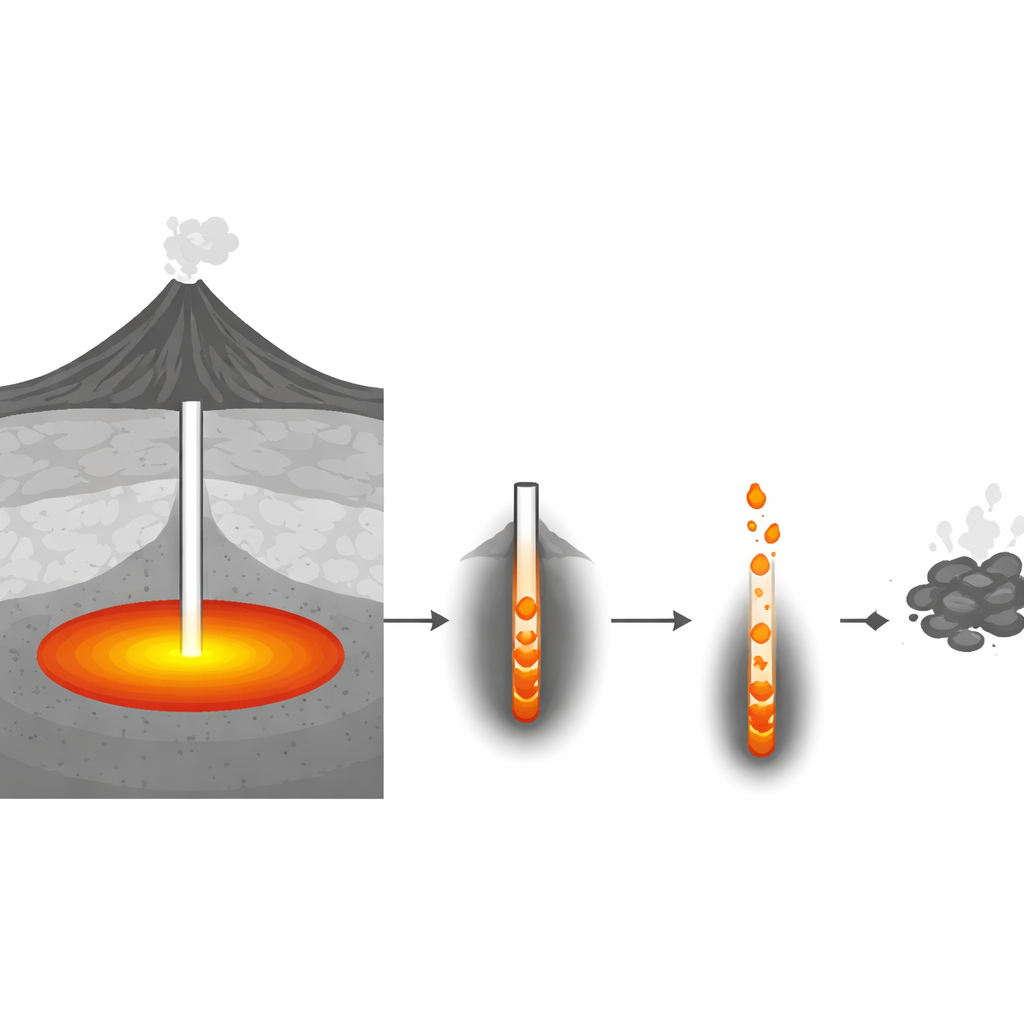
Far beneath our feet, pockets of molten rock quietly shape the crust, fuel volcanoes and power geothermal energy. Yet even at some of the world’s best-studied volcanoes, scientists still argue over where exactly this magma is stored and under what pressures and temperatures it sits before an eruption. This study takes advantage of a rare and dramatic event—actually drilling into magma beneath Iceland’s Krafla volcano—to show how the molten rock responds in the first minutes after being tapped, and to use that fleeting response to pin down its true storage conditions.
A rare look inside Earth’s molten underworld
At Krafla, geothermal wells unexpectedly hit a body of sticky, silica-rich magma a little more than two kilometers below the surface. As the drill cut into the melt, pieces of it were rapidly cooled by water-based drilling fluids and shot back up the borehole as glassy fragments. Unlike lavas that have risen through kilometers of rock and erupted at the surface, these fragments record only a short journey of a few meters and a few minutes. That makes them an unusually clean window into what the magma was like at depth—if scientists can untangle how the sudden change in pressure and temperature during drilling altered them.
Watching bubbles tell the pressure story
Inside the recovered glass, the authors measured tiny gas bubbles and the amounts of water and carbon dioxide still dissolved in the solidified melt. These ingredients are key, because the amount of gas that can remain dissolved depends strongly on pressure: higher pressure squeezes more gas into the liquid, while pressure drops cause bubbles to form and grow. The puzzle was that earlier interpretations of these glasses suggested the magma had been stored at pressures lower than the weight of the overlying rock would imply, as if it were partly degassed or connected to the overlying hot-water system. That view conflicted with other petrological and geophysical evidence and with expectations for how such magmas are arranged in the crust.
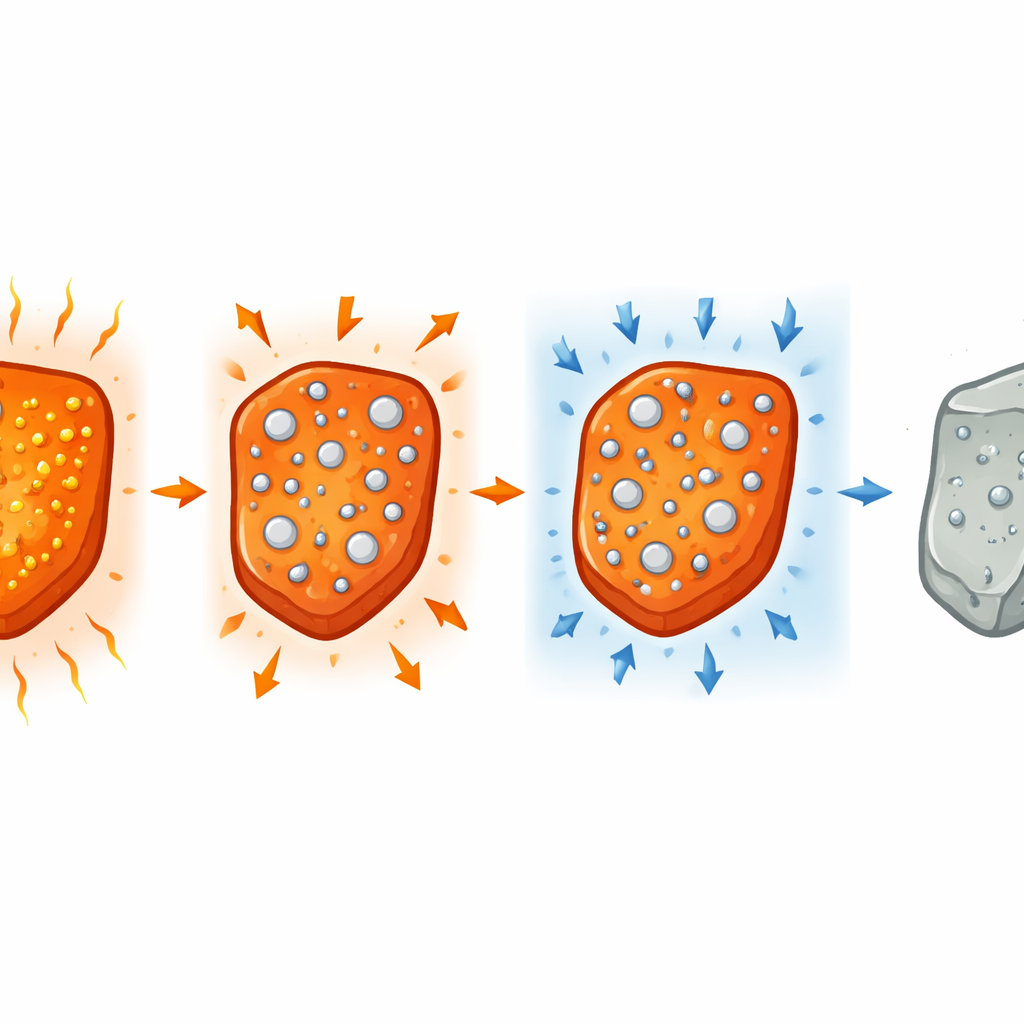
To resolve this, the team built a detailed numerical model that follows what happens to water and carbon dioxide in the magma as drilling suddenly changes both pressure and temperature. The model tracks how bubbles nucleate and expand as pressure drops, how quickly water and carbon dioxide molecules move between bubbles and melt, and how cooling can reverse some of that process by causing bubbles to shrink as gas is reabsorbed. Crucially, they explored many possible paths of decompression and cooling, matching model outcomes against the observed bubble content, final water and carbon dioxide concentrations, and the way water is bonded in the glass.
Moments that matter: minutes of change, millions of years of insight
The simulations show that the magma experienced rapid but not instantaneous decompression over distances of only a few meters and timescales of up to several minutes as it flowed into the borehole. At the same time, strong cooling from the drilling fluids fractured the magma into fragments, dramatically increasing surface area and driving a "thermal shock" front inward. This fracturing allowed cooling and decompression to progress together, with bubble growth first increasing vesicularity and then partial resorption during cooling reducing the number and size of bubbles. Only scenarios in which the magma started out fully saturated with gas at rock-overburden pressure, and in which decompression and cooling occurred on similar short timescales, could reproduce the low bubble contents and specific mix of water and carbon dioxide seen in the glass chips.
These results overturn the idea that the Krafla magma body was stored at unusually low gas pressures. Instead, the best-fitting models require storage at lithostatic pressure—the pressure expected from the full weight of the overlying crust—with the melt fully saturated in water and carbon dioxide before drilling disturbed it. The work also shows that some effects, such as gas resorption and related changes in isotopes, can be subtle and may not leave obvious gradients near bubbles, meaning that seemingly simple glass records can hide a complex history of rapid, out-of-equilibrium processes.
From volcano safety to future geothermal drilling
By correcting for the brief disequilibrium caused by drilling, this study extracts a robust snapshot of the natural state of magma in the shallow crust. For a general reader, the key message is that we can now use carefully modeled, rapidly quenched magma samples to infer how and where molten rock is stored beneath volcanoes—with far less guesswork than before. Beyond improving our picture of magma plumbing systems and their role in eruptions, the new model offers a practical tool: engineers can use similar simulations to design drilling strategies that safely tap high-temperature resources while minimizing the risk of magma rising up boreholes. In short, the few minutes during which magma was shocked, bubbled and frozen at Krafla are opening a new path to understanding and managing Earth’s fiery interior.
Citation: Birnbaum, J., Wadsworth, F.B., Kendrick, J.E. et al. Disequilibrium response to tapping crustal magma reveals storage conditions. Nature 652, 387–392 (2026). https://doi.org/10.1038/s41586-026-10317-w
Keywords: magma storage, Krafla volcano, geothermal drilling, volcanic gases, crustal magmatism