Clear Sky Science · en
Dynamic antigen expression and cytotoxic T cell resistance in HIV reservoir clones
Hidden pockets of HIV
People living with HIV can take daily medicines that drive the virus in their blood down to undetectable levels, often for many years. Yet if treatment stops, the virus almost always returns. This study asks a pressing question for patients and scientists alike: where does HIV hide for so long, and why is the immune system unable to wipe out these last strongholds, even when the virus occasionally reveals itself?
Cloned hideouts inside helper cells
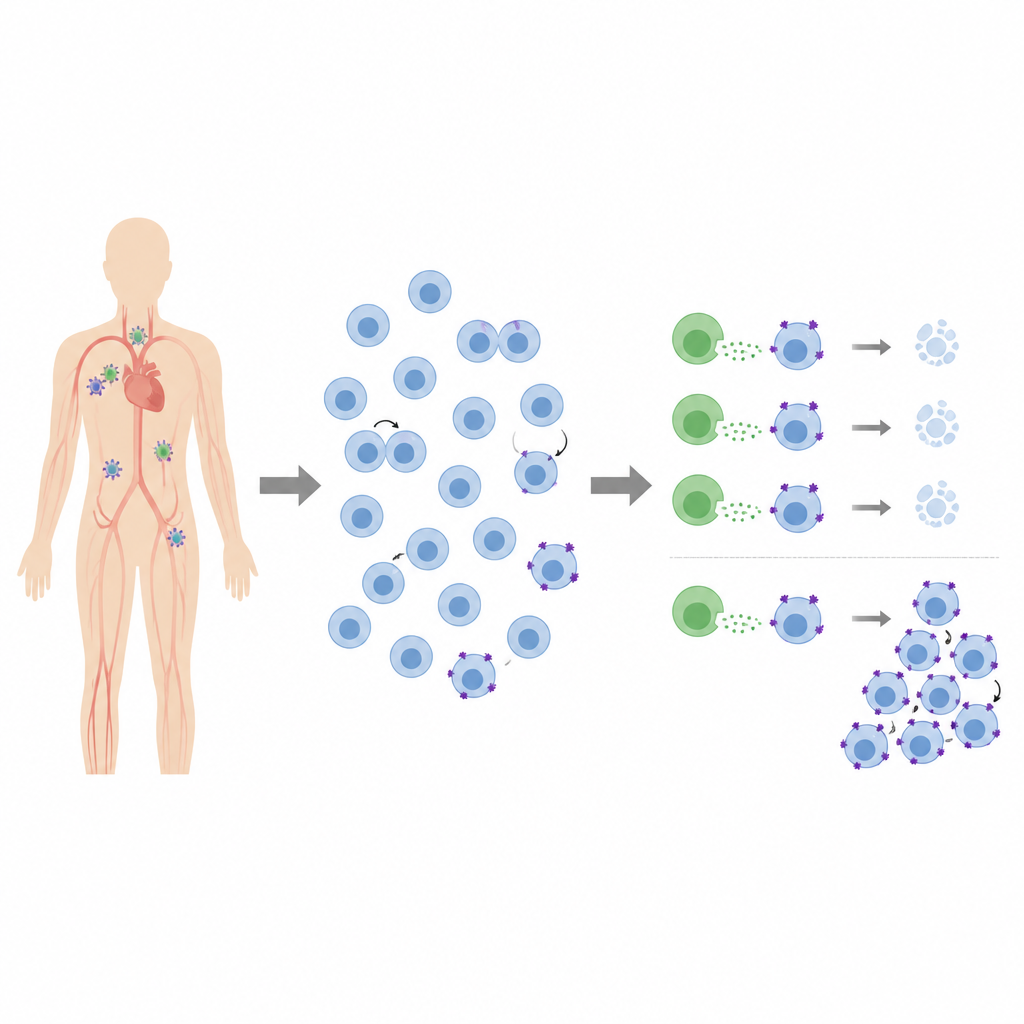
The researchers focused on special groups of immune cells called CD4 T cells, which HIV infects. In some patients on long term treatment, a few of these cells quietly copy themselves again and again, creating large families or clones that all carry the same viral blueprint. The team developed methods to isolate such families, which they call authentic reservoir clones, from people whose HIV had been kept in check by standard drugs. They showed that many of these clones can produce fully functional virus and have persisted in the body for more than a decade, even as most other infected cells gradually disappear.
Virus on a dimmer switch
Surprisingly, only a tiny fraction of the cells within each reservoir family were actively making HIV proteins at any given moment. Most members appeared silent, even when the scientists pushed them hard with strong laboratory signals that usually switch on viral production. By reading out which human genes were turned on in thousands of single cells, they found that the rare virus producing cells shared a common activity pattern: they looked like strongly stimulated immune cells that had pumped the brakes on growth and energy use. The rest of the family members kept dividing without much virus on display, helping the clone to grow while staying mostly under the immune radar.
Slow but steady pressure from killer cells
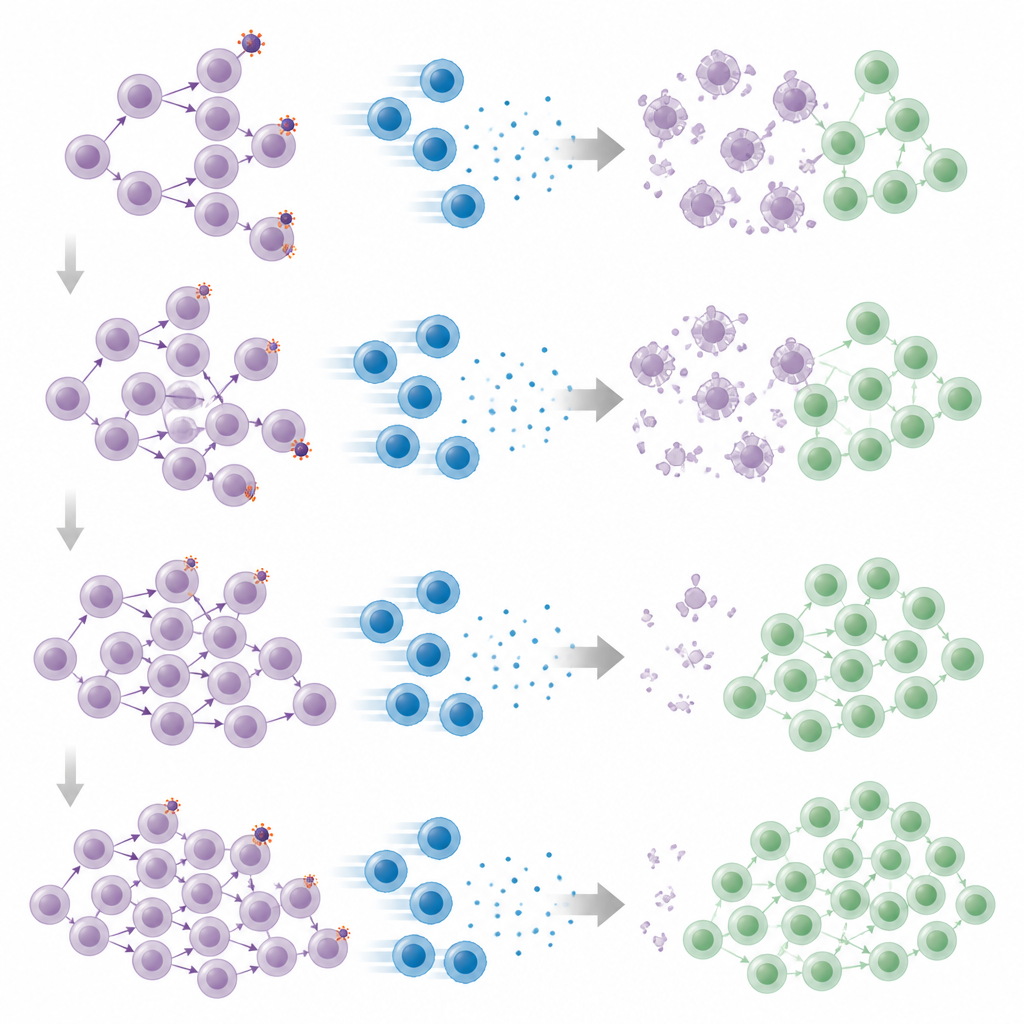
The team then recreated, in dishes, a long running battle between infected clones and cytotoxic T cells, the immune cells that normally kill virus infected targets. They paired each reservoir family with a highly active killer T cell clone tuned to recognize a specific piece of HIV. At first glance, the odds looked bad for the killers, because at any moment only about one or two cells out of a hundred in the clone showed viral protein on their surface. Yet over a week of constant contact, many reservoir families were cut down by more than 90 percent. Mathematical modeling suggested that although each individual cell switched the virus on only briefly and infrequently, over time enough members lit up for the killers to find and remove a substantial share of the clone.
Stubborn cells that refuse to die
Not all infected families were equally vulnerable. One notable reservoir clone with features of regulatory T cells, which normally help calm immune responses, hardly budged under killer T cell attack. To pinpoint the reason, the researchers compared this stubborn family with more easily eliminated ones and with freshly infected cells. They found that resistance was tied to properties of the host cell rather than the virus itself. Resistant cells showed signs of low stress and a muted response to low oxygen, conditions that make it harder for the toxic molecules released by killer T cells to trigger cell death. When the team treated these resistant cells with an approved drug called deferoxamine, which alters iron handling and boosts certain stress signals, the same killer T cells suddenly became much more effective at clearing them.
What this means for future cures
For people hoping for a cure, these results offer both caution and hope. They confirm that HIV can survive long term by nesting in cell families that rarely show their viral hand and by sometimes adopting cell states that blunt immune attack. At the same time, the work shows that when killer T cells are strong enough and given sustained access, they can slowly chip away at many of these hidden reservoirs. Importantly, the study identifies cell based resistance pathways, such as how cells manage internal stress, that could be targeted with existing or future drugs. Combining treatments that briefly wake up the virus with therapies that boost killer T cell strength and strip away the infected cells’ natural defenses may be a promising path toward shrinking, and perhaps one day eliminating, the enduring HIV reservoir.
Citation: Ferreira, I.A.T.M., Herrera, A., Huynh, T.T. et al. Dynamic antigen expression and cytotoxic T cell resistance in HIV reservoir clones. Nature 653, 850–860 (2026). https://doi.org/10.1038/s41586-026-10298-w
Keywords: HIV reservoir, CD4 T cells, cytotoxic T cells, immune evasion, HIV cure strategies