Clear Sky Science · en
A strong constraint on radiative forcing of well-mixed greenhouse gases
Why this study matters for our warming planet
Most of us know that greenhouse gases warm the Earth, but it is surprisingly hard to say exactly how much extra energy they are adding to the planet today. That number, called the radiative forcing of greenhouse gases, is a key input to every climate projection, yet it still carries enough uncertainty to blur our estimates of future warming. This paper tackles that gap by combining cutting-edge radiation physics with satellite observations to pin down how strongly long‑lived greenhouse gases are heating Earth now, and to show how climate models can be checked and improved using a simple new method.
Taking a fresh global look at heat trapping
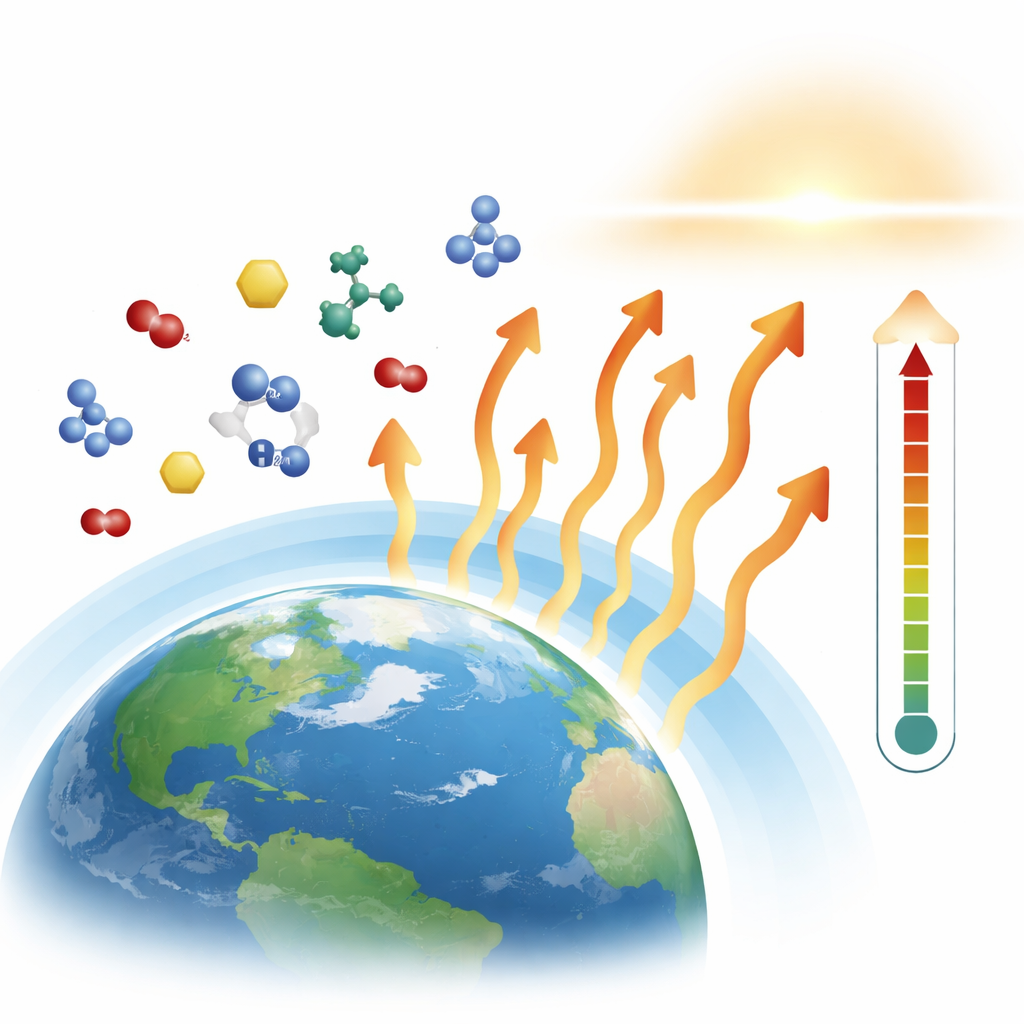
The authors focus on well‑mixed greenhouse gases—long‑lived gases such as carbon dioxide, methane, nitrous oxide and industrial fluorinated gases that are spread fairly evenly around the globe. These gases trap some of the infrared energy that Earth would otherwise radiate to space. The team uses an advanced “line‑by‑line” radiation code, which calculates how light interacts with gases at individual wavelengths, to simulate how much extra longwave energy is being held back compared with the year 1850. Unlike earlier benchmarks that looked only at clear skies and a handful of atmospheric profiles, they run simulations worldwide, month by month, including clouds and realistic weather conditions from the ERA5 reanalysis dataset.
How much extra heat are we talking about?
The simulations show that by 2024, increases in well‑mixed greenhouse gases since 1850 have boosted the longwave radiative forcing at the level of the tropopause by 3.69 ± 0.07 watts per square metre. Roughly speaking, that is like adding several small Christmas‑tree lights over every square metre of the planet, running day and night. About 38% of this increase has occurred just since 2001, reflecting the rapid rise of carbon dioxide and other gases in recent decades. Carbon dioxide provides the largest share of the forcing, while methane, nitrous oxide and fluorinated gases make smaller but still significant contributions.
Finding a simple rule in a complex atmosphere
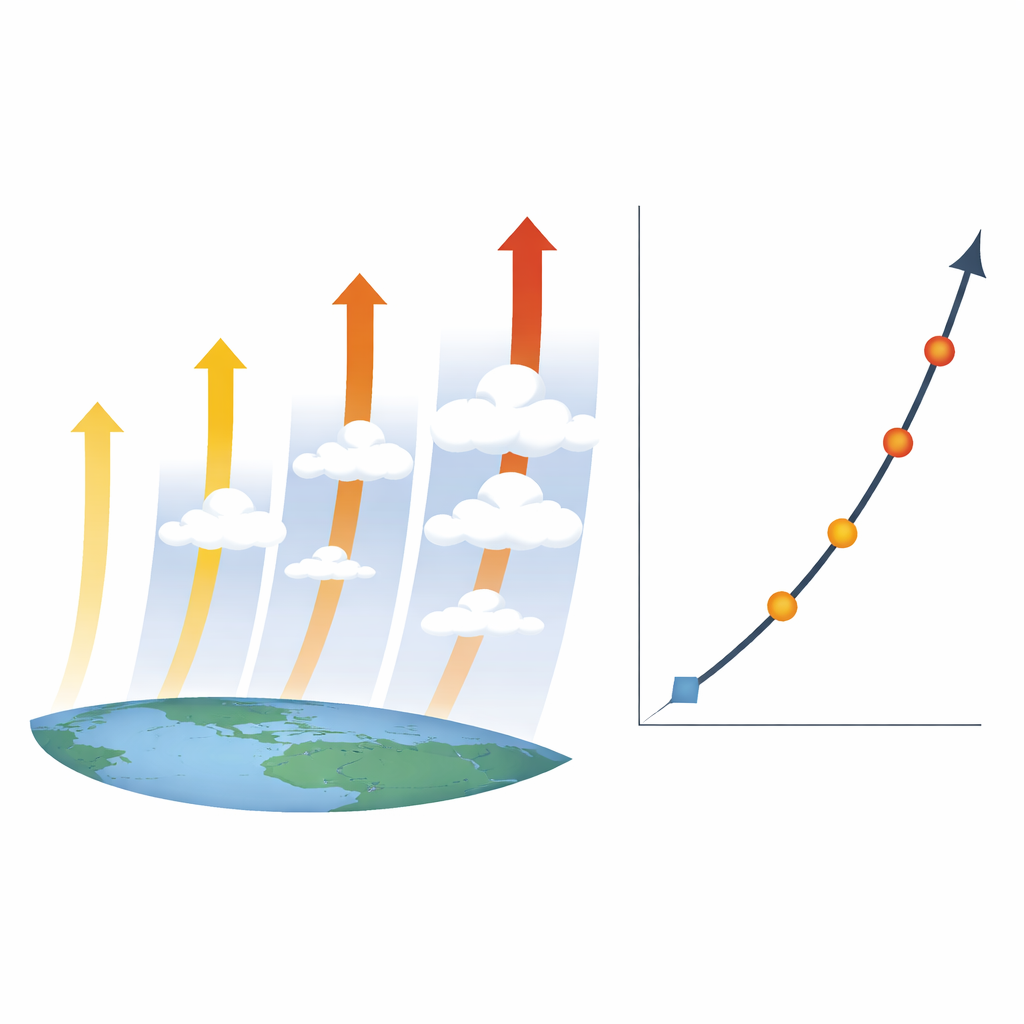
Although the atmosphere is messy—with changing temperatures, humidity and clouds—the authors uncover a remarkably simple pattern: across the globe, the extra heat trapped by greenhouse gases is almost linearly related to the amount of infrared energy escaping to space, known as outgoing longwave radiation. Where more energy escapes, the additional greenhouse forcing is larger; where thick clouds or moist air already block infrared energy, the extra forcing is smaller. By carefully testing this relationship with thousands of detailed simulations, they show that a straightforward regression using outgoing longwave radiation can predict greenhouse forcing with only a few percent uncertainty, even when clouds and weather are included.
Turning satellite eyes into a climate yardstick
This linear link opens a powerful shortcut: instead of rerunning expensive radiation codes for every scenario, one can feed observed outgoing longwave radiation into the regression and directly estimate the forcing from greenhouse gases. Applying this to two decades of satellite data from NASA’s CERES mission, the authors confirm that the total longwave forcing from well‑mixed greenhouse gases rose from about 2.65 to 3.69 watts per square metre between 2001 and 2024, with tight error bars. They then use the same method to benchmark climate models. In simulations where carbon dioxide is suddenly quadrupled, they show that differences between models in this tropopause‑level forcing explain about 91% of the spread in how strongly the models say Earth’s energy balance is disturbed. By correcting for biases in each model’s radiation scheme using the regression, they can cut the spread in model estimates of this forcing by roughly half.
What this means for understanding future warming
For non‑specialists, the main message is that scientists can now say with much greater confidence how strongly long‑lived greenhouse gases are pushing Earth out of energy balance today. The study provides a clear, observation‑anchored number for that extra heating and a practical recipe for checking and improving climate models. By tying together high‑precision physics and satellite measurements with a surprisingly simple rule, the work reduces one of the key uncertainties in projections of future warming and strengthens the scientific basis for long‑term climate assessments and policy decisions.
Citation: Feng, J., Paynter, D., Menzel, R. et al. A strong constraint on radiative forcing of well-mixed greenhouse gases. Nature 652, 105–111 (2026). https://doi.org/10.1038/s41586-026-10289-x
Keywords: radiative forcing, greenhouse gases, outgoing longwave radiation, climate models, satellite observations