Clear Sky Science · en
Non-equilibrium condensation of the first Solar System solids
How the First Space Dust Shaped Our Worlds
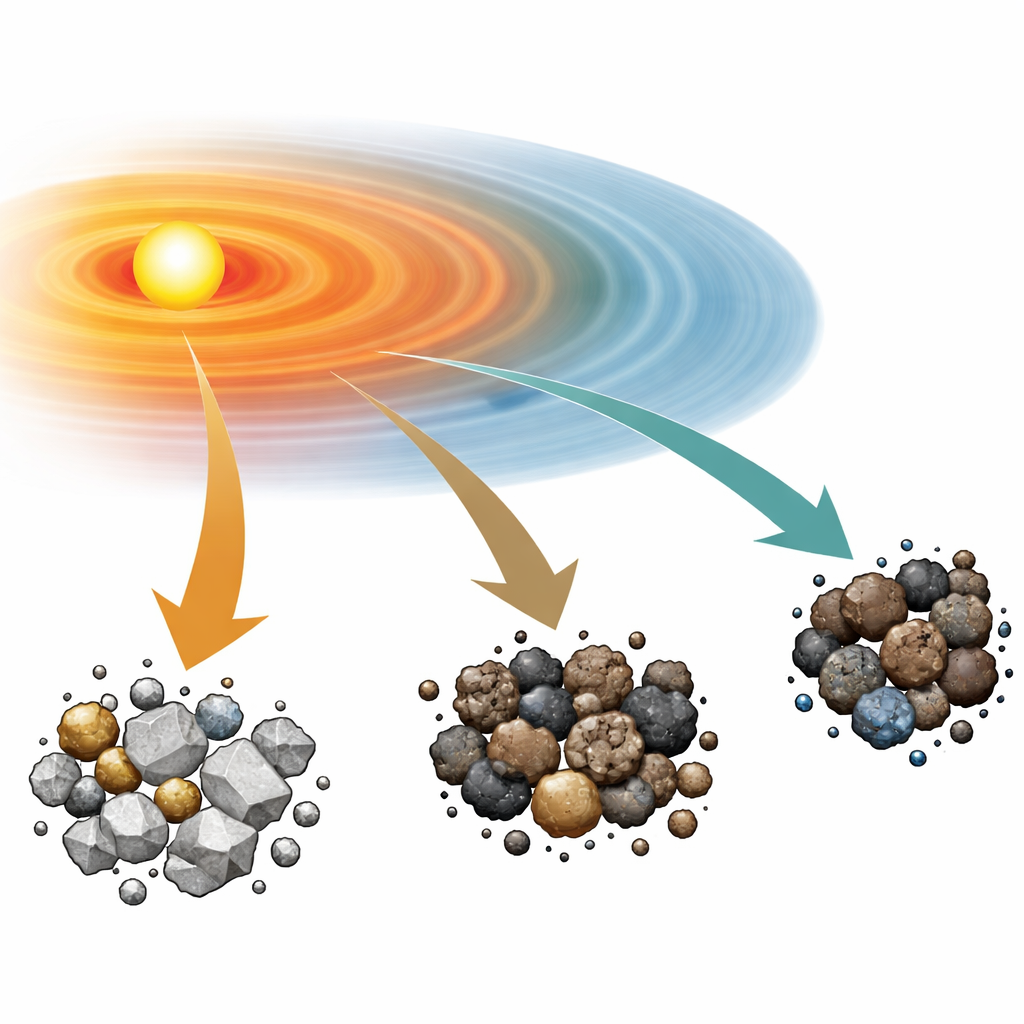
The rocky worlds and asteroids we see today were built from the very first grains that condensed from hot gas around the newborn Sun. These grains, now preserved inside meteorites, come in three main "flavors" that have puzzled scientists for decades. This study shows that the way the gas cooled and the pressure it experienced—not exotic changes in chemistry—may have been enough to create those distinct building blocks of the Solar System.
Space Rocks as Time Capsules
Primitive meteorites, called chondrites, are among the most untouched materials from the early Solar System. They are packed with tiny minerals that formed as the swirling solar nebula gas cooled. Curiously, chondrites fall into three broad classes that differ mainly in how oxidized their iron is: some are packed with metallic iron, others contain mixtures of metal and iron-bearing rock, and still others are rich in rust-like, water-bearing minerals. Traditional models assume that minerals and gas always had time to reach chemical balance. Those models can reproduce some high-temperature ingredients but struggle to explain why nature produced exactly three main mineral families.
Cooling Too Fast for Balance
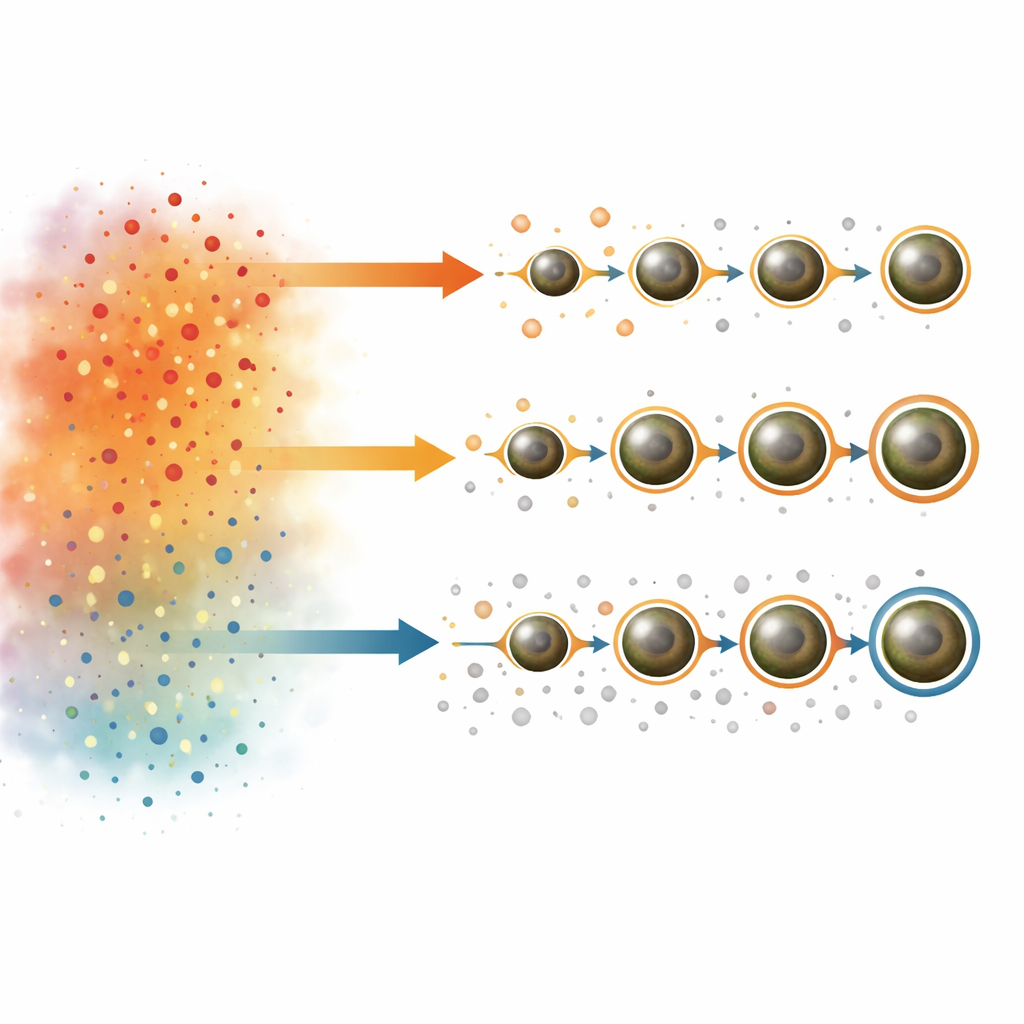
The authors explore a different picture: what if the gas cooled so quickly—and under such low pressures—that minerals could not keep up and never reached full chemical equilibrium? They built a new computer model, KineCond, that tracks how 39 different minerals grow, evaporate and react with gas as the temperature falls from blazing hot to icy cold. The model allows gas molecules themselves to stay in balance, but treats their interactions with grains as time-limited processes controlled by kinetics—essentially, by how often atoms hit and stick to grain surfaces. By varying only the pressure of the gas and how fast it cools, they scan a wide range of conditions expected in the young solar disk.
Three Natural Outcomes from One Starting Mix
Across this large parameter space, the model does something striking: instead of a smooth continuum of mineral mixtures, it naturally produces only three distinct types of assemblages. Under high pressure and slow cooling, iron condenses mostly as metal together with magnesium-rich silicates, closely matching the most reduced meteorites known as enstatite chondrites (type A in the model). At the opposite extreme—low pressure and rapid cooling—the gas falls out of balance. Iron does not fully condense at high temperature and later reappears in oxidized forms such as fayalite, magnetite and water-bearing phyllosilicates, while some very high-temperature minerals remain preserved. This highly oxidized, hydrous mixture resembles carbonaceous chondrites (type C). An intermediate set of conditions produces a transitional blend with both metal and rock-bound iron that lines up with ordinary chondrites (type B). Remarkably, changing the detailed reaction rates or even tweaking the bulk composition of the gas barely shifts this threefold pattern.
Redox Map of Early Solar Matter
To compare their synthetic condensates with real meteorites, the authors plot how iron is partitioned between metal and oxidized forms in a classic redox diagram. Paths traced by the model as condensation proceeds cluster in three regions that coincide with the three main chondrite classes. When the modeled mixtures are hypothetically allowed to re-equilibrate at a fixed temperature, they yield apparent oxygen conditions that span almost the full range inferred for meteorite parent bodies—from very reducing to moderately oxidizing—without ever changing the underlying gas from its original, highly reducing solar composition. In the most oxidized cases, the minerals also naturally trap a few percent water by mass, again without needing to add extra water or oxygen from outside.
Fitting Into the Bigger Solar System Story
The study then places these results into astrophysical context. Modern simulations of star and disk formation show that gas can fall onto the disk in different ways: near the young Sun at high pressure, in hot shocks above the disk, or in outflows that cool rapidly at low pressure. Each pathway offers regions with different combinations of pressure and cooling rate, providing natural homes for the model’s three mineral types. Early gaps and barriers in the forming disk could have kept these distinct solid populations from thoroughly mixing, preserving the separate reservoirs that later became the enstatite, ordinary and carbonaceous chondrites.
Why This Matters for Our Origins
By showing that simple kinetic effects can turn a single, uniform solar gas into three characteristic families of solids, this work offers a new explanation for why meteorites—and by extension, planets—are so chemically diverse. Instead of invoking extreme and hard-to-achieve changes in oxygen content across the disk, the study suggests that how and where the first grains condensed in a dynamically evolving nebula played a major role. The details of planet building still involve many other processes, but the earliest step—how the first dust froze out of the solar gas—may already have steered the Solar System onto three distinct evolutionary paths.
Citation: Charnoz, S., Aléon, J., Chaussidon, M. et al. Non-equilibrium condensation of the first Solar System solids. Nature 652, 925–930 (2026). https://doi.org/10.1038/s41586-026-10257-5
Keywords: chondrites, protoplanetary disk, non-equilibrium condensation, meteorites, early Solar System