Clear Sky Science · en
A mechanism to initiate emergency type 2 myelopoiesis
How the Body Ramps Up Parasite‑Fighting Cells
When parasitic worms invade the gut, our immune system needs to rapidly produce specialized white blood cells that can expel or kill them. This paper explains how the bone marrow flips a hidden internal switch to favor making worm‑fighting cells over red blood cells and platelets. Understanding this switch matters not only for infections, but also for allergies and asthma, where similar cells can cause harmful inflammation.
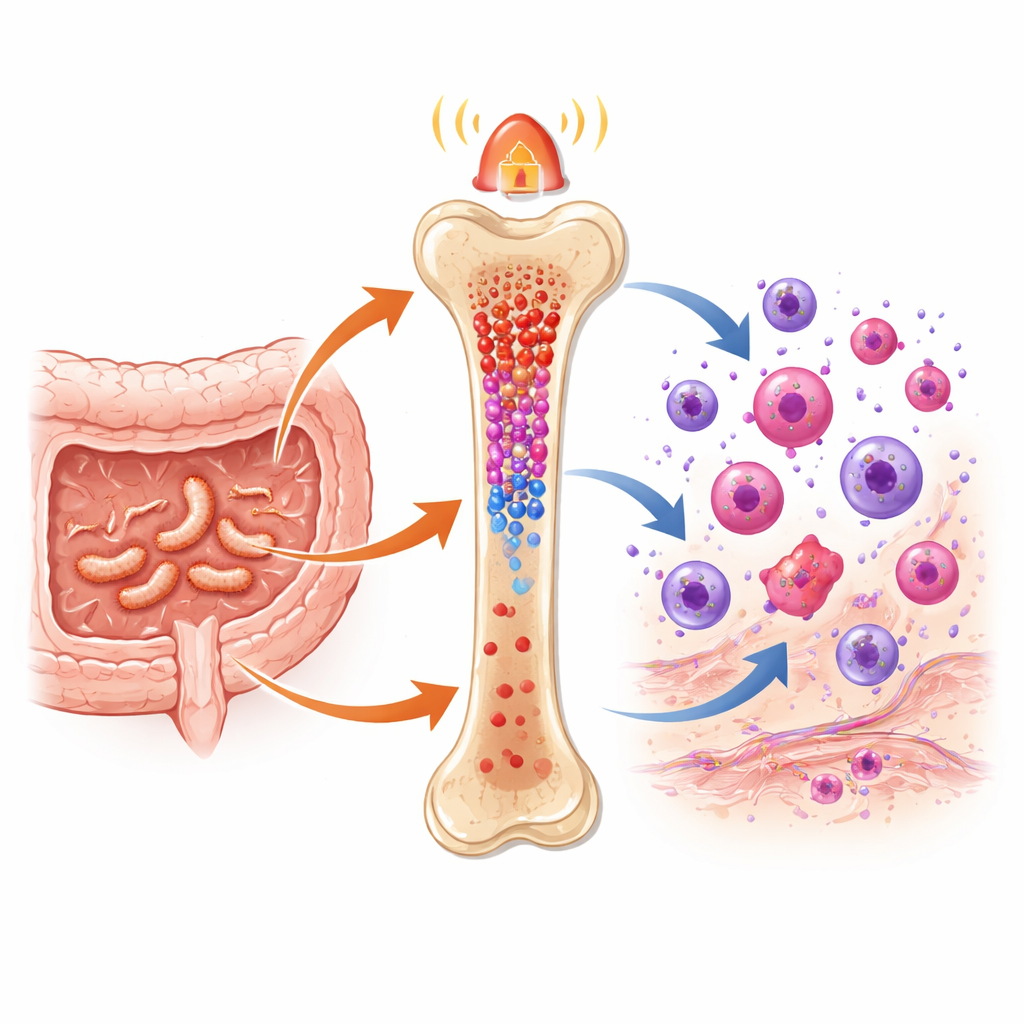
A Traffic Reroute Inside the Bone Marrow
Blood cells are born in the bone marrow from immature cells that can choose between several fates. Some become red blood cells and platelets, which carry oxygen and help clot blood. Others become myeloid cells, including basophils, eosinophils and mast cells, which are key players in type 2 immunity against parasites and in many allergic diseases. The authors focus on an early decision point: a progenitor called an EMPP can either move toward red blood cell/platelet production or toward basophil–eosinophil–mast cell (BEM) production. They show that during infection with the gut worm Heligmosomoides polygyrus, this decision becomes strongly biased toward the BEM route.
An Alarm Signal that Changes Cell Destiny
Worm infection damages tissues and triggers release of alarm molecules called alarmins. One of these, the protein IL‑33, builds up in the bone marrow. The team found that mouse progenitor cells carry the receptor for IL‑33 and respond directly to it. When mice were infected with worms or given IL‑33 alone, levels of IL‑33 rose in bone marrow fluid, and EMPPs shifted away from making red blood cells and platelets toward making myeloid colonies rich in basophils and eosinophils. The same treatment in a humanized mouse model pushed human progenitors in the same direction. This shows that IL‑33 acts as a body‑wide distress signal that tells the bone marrow, “we need more parasite‑fighting cells now.”
The Molecular Switch: A Helper Protein Called LMO4
Diving deeper, the researchers asked which genes change inside EMPPs when IL‑33 is present. One stood out: Lmo4, which encodes a small helper protein that does not bind DNA itself but modifies how master regulators work. LMO4 partners with a crucial blood regulator called GATA2. Under normal conditions GATA2, together with another helper, FOG1, supports red blood cell and platelet development. The study shows that IL‑33 makes EMPPs increase LMO4 levels, and LMO4 then binds GATA2 in a way that pushes FOG1 aside. Using genome‑wide DNA‑binding maps, the authors reveal that this swap causes GATA2 to move off red blood cell genes and onto BEM‑related genes, effectively re‑wiring the genetic program of the progenitor cell.
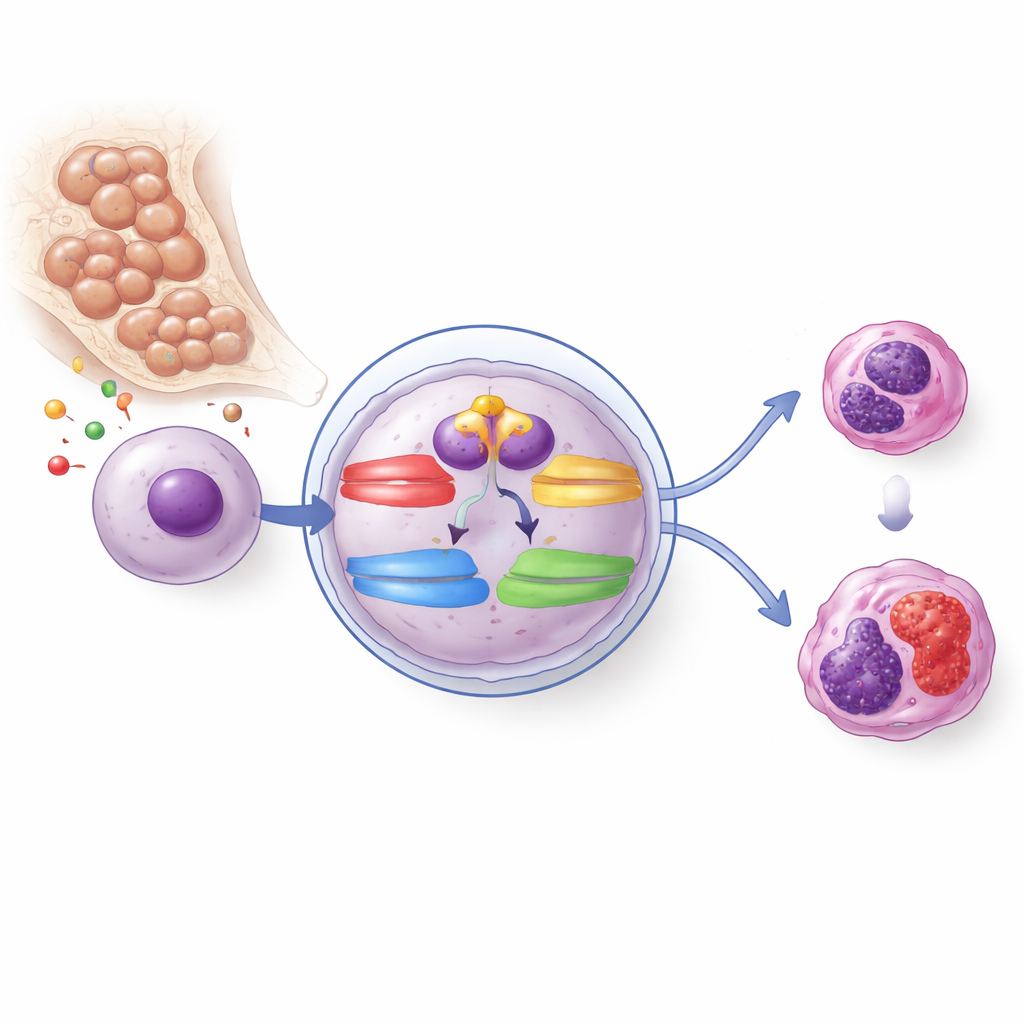
Proving the Role of the Switch in Mice and Humans
To test whether LMO4 is not just associated with this shift but actually drives it, the authors artificially increased LMO4 in mouse progenitor cells. This forced cells that normally make red blood cells and platelets to instead generate basophils and eosinophils, both in cell culture and after transplantation into mice. Conversely, when they reduced LMO4 or removed the IL‑33 receptor, the myeloid bias disappeared. They also studied mice carrying a precise mutation in GATA2 that blocks its ability to bind LMO4 but leaves other partners intact. These mutant mice had fewer basophils and eosinophils, more red blood cell–type progenitors, and were significantly worse at controlling worm infections. Similar IL‑33‑driven upregulation of LMO4 and expansion of BEM‑like progenitors was observed with human cells, suggesting an evolutionarily conserved mechanism.
What This Means for Infection and Allergy
Taken together, the work identifies an elegant molecular lever that the body pulls during parasite infection. Damage in the gut releases IL‑33, which travels to the bone marrow and boosts LMO4 in early progenitors. LMO4 then reshapes how GATA2 sits on DNA, drawing it away from red blood cell genes and toward genes that create basophils, eosinophils and mast cells. The result is a burst of type 2 myelopoiesis: rapid production of the very cells best equipped to combat worms. Because the same cells often drive asthma and allergic disease, targeting the LMO4–GATA2 interaction or the IL‑33–LMO4 pathway could one day offer a way to dial type 2 inflammation up or down without shutting down the entire immune system.
Citation: Fagnan, A., Di Genua, C., Meng, Y. et al. A mechanism to initiate emergency type 2 myelopoiesis. Nature 653, 212–220 (2026). https://doi.org/10.1038/s41586-026-10256-6
Keywords: type 2 immunity, bone marrow progenitors, IL-33 signaling, basophils and eosinophils, helminth infection