Clear Sky Science · en
Composable neural emulators accelerate thermoelectric generator design
Turning Waste Heat into Useful Power
Every day, enormous amounts of heat from car engines, industrial plants and even home appliances simply drift away into the air. Thermoelectric generators offer a way to capture some of that wasted warmth and turn it directly into electricity, without any moving parts. But designing these devices is surprisingly tricky: tiny changes in shape, size and material layout can make the difference between a so-so gadget and a power plant on a chip. This study shows how a tailored artificial intelligence system, called TEGNet, can act as an ultra-fast "emulator" for these devices, allowing engineers to try out thousands of design ideas on a computer in the time it once took to test just one.
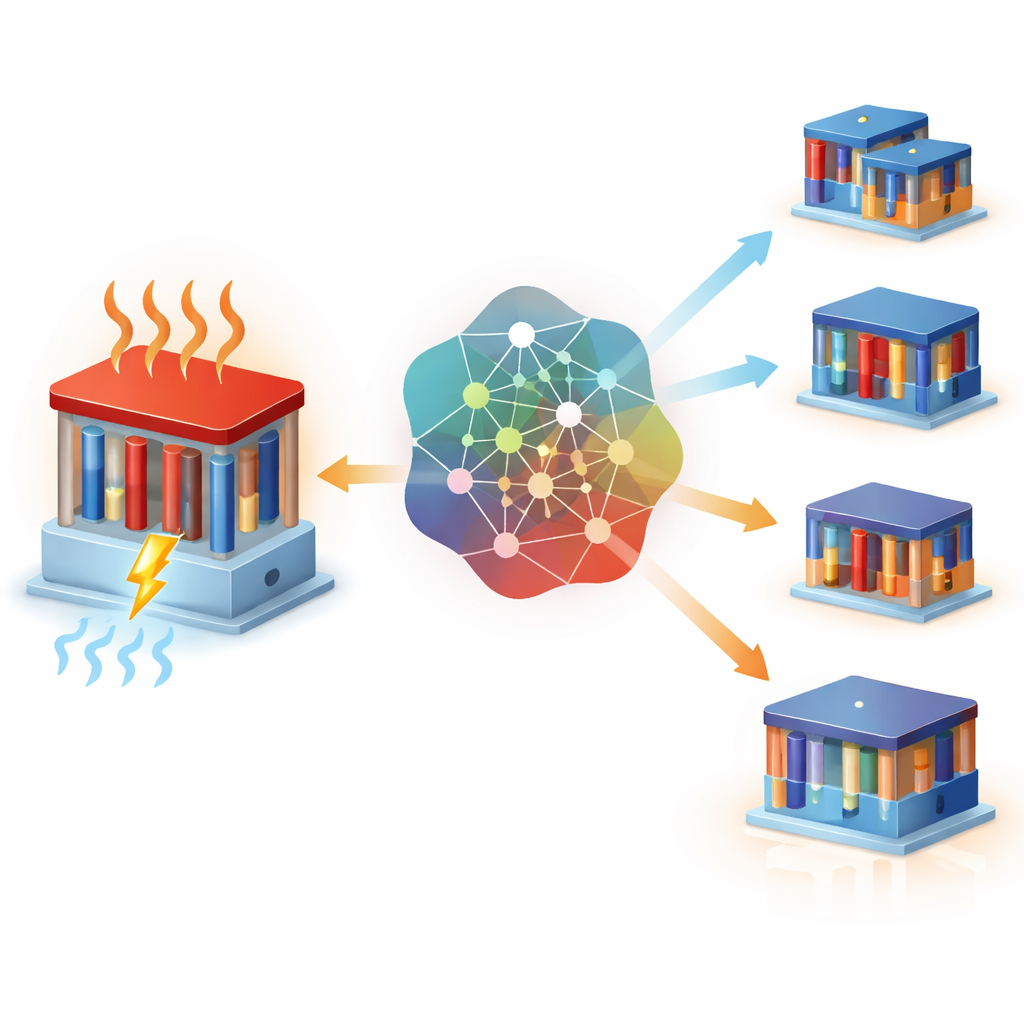
Why Thermoelectric Devices Are Hard to Design
A thermoelectric generator is built from many small solid pillars, or “legs,” clamped between a hot side and a cold side. When one end is hotter than the other, an electric voltage appears, and if you connect the legs in the right way, they form a useful power source. The catch is that each material responds differently to temperature, and the legs must carry both electric current and heat at the same time. To get high efficiency, designers must choose compatible materials, decide how long and thick each leg should be, and arrange different materials in clever combinations. Traditionally, this requires solving complicated physics equations on a computer for each new design, a process that can take hours per case and quickly becomes unmanageable when materials and shapes are varied together.
Teaching a Neural Network to Imitate Physics
The researchers built TEGNet as a streamlined neural network that learns to mimic those heavy-duty physics simulations. Instead of directly solving the underlying equations every time, TEGNet takes a few key inputs—the size of the thermoelectric leg, the temperatures at the hot and cold sides and the electrical current—and instantly predicts two crucial outputs: the voltage produced and the heat flowing through the device. To train it, the team first generated reference data using a commercial finite-element solver, then let TEGNet learn the patterns. With about 1,200 carefully chosen examples for a given material, TEGNet reached better than 99.9% agreement with the original solver while running about ten thousand times faster. Once trained, it can be reused again and again without needing to revisit the expensive simulations.
Building Complex Devices from Simple Blocks
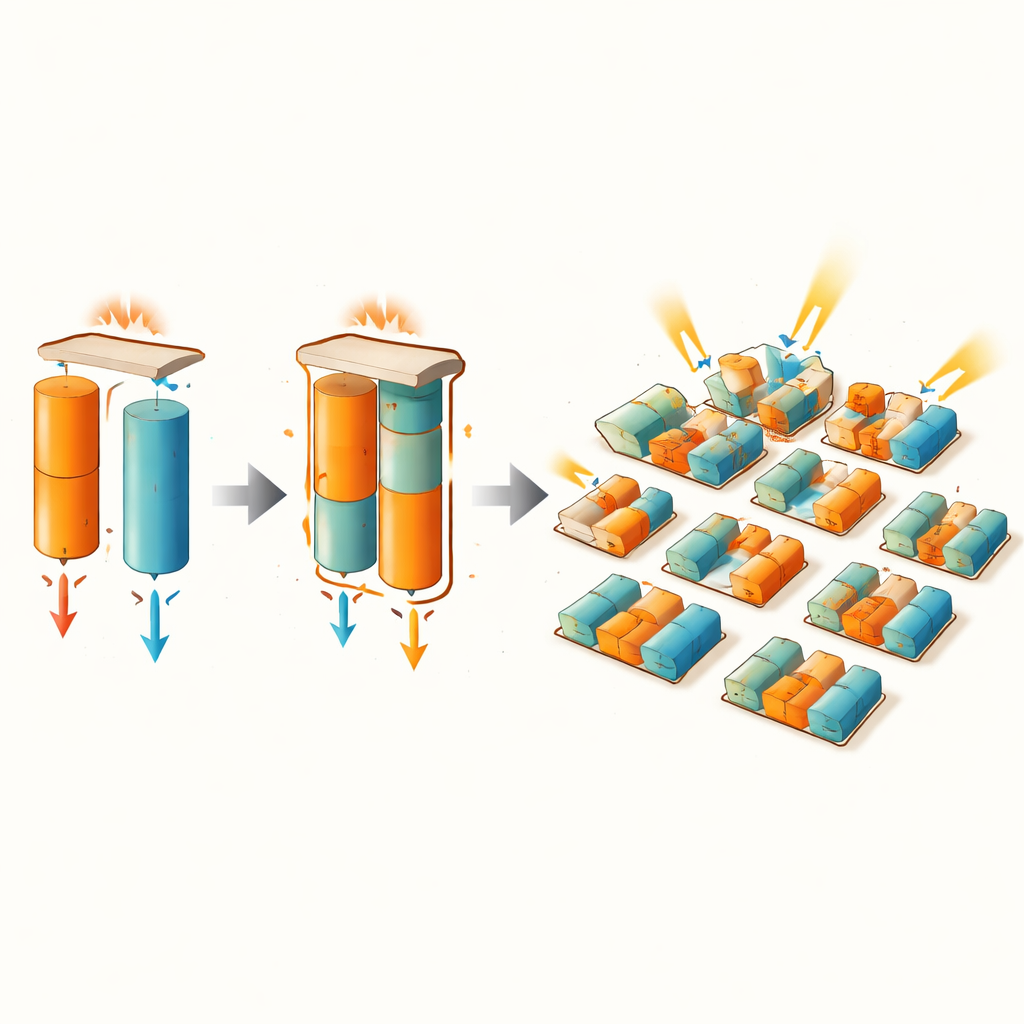
The real power of TEGNet comes from the way it can be “composed” to handle more complicated devices. In practical generators, different materials may be stacked in a single leg to cover a wide temperature range, or paired as negative and positive legs in a repeating pattern. Because all of these parts share the same current, the authors can combine several material-specific TEGNet models like building blocks: individual legs are predicted separately, then their voltages and heat flows are stitched together using basic energy and circuit rules. With this approach, the team rapidly explored designs in which high-performance materials such as MgAgSb, Bi–Sb–Te alloys and magnesium-based compounds were segmented and paired in many possible ways, something that would be very slow with conventional tools.
From Screened Designs to Working Hardware
Guided by TEGNet’s predictions, the researchers built and tested real thermoelectric generators to verify that the AI-driven designs perform as expected. For a generator using a segmented leg made of MgAgSb joined to a Bi–Sb–Te material, they achieved a conversion efficiency of 9.3%, placing it among the leading devices of its kind. In another case, they used the emulator to tune the relative cross-sectional areas of n-type and p-type legs made from magnesium-based compounds, discovering that the optimum design departs from the usual “equal area” rule of thumb. The resulting paired device reached 8.7% efficiency near 600 K and compared favourably with other state-of-the-art modules that harvest low-grade heat.
What This Means for Future Energy Devices
To a non-specialist, the main message is that AI can now stand in for slow physics simulations when designing complex energy devices, without sacrificing accuracy. TEGNet does not replace fundamental research on new materials, nor does it capture every mechanical and time-dependent detail inside a generator. Instead, it acts as a highly accurate shortcut for exploring the huge space of possible device layouts and material combinations. By collapsing days of computational work into seconds, this approach can help researchers move more quickly from promising thermoelectric materials to practical modules that convert waste heat into useful electricity, pushing solid-state power generation closer to widespread application.
Citation: Li, A., Wu, X., Wang, L. et al. Composable neural emulators accelerate thermoelectric generator design. Nature 652, 643–649 (2026). https://doi.org/10.1038/s41586-026-10223-1
Keywords: thermoelectric generators, waste heat recovery, neural network emulator, device design optimization, energy harvesting