Clear Sky Science · en
A membrane-bound nuclease directly cleaves phage DNA during genome injection
How bacteria fight viruses at the doorstep
Viruses that infect bacteria, called phages, are everywhere on Earth and constantly threaten microbial life. This study reveals a new way that bacteria can stop these invaders at the very moment they try to slip their genetic material into the cell. Understanding this microscopic battle not only deepens our picture of immunity in simple organisms, it also expands the toolbox researchers may one day use to control harmful bacteria or design virus-based therapies.
A new guardian on the cell surface
The researchers focus on a defense system in Escherichia coli nicknamed SNIPE, short for “surface-associated nuclease inhibiting phage entry.” SNIPE protects cells from infection by phage lambda and many related viruses. Unlike well known bacterial defenses that patrol the interior of the cell and recognize specific DNA sequences or chemical tags, SNIPE is anchored in the cell’s inner membrane. There it waits at the boundary between the outside world and the bacterial interior, poised to intercept foreign genetic material as it arrives.
Cutting viral DNA during entry
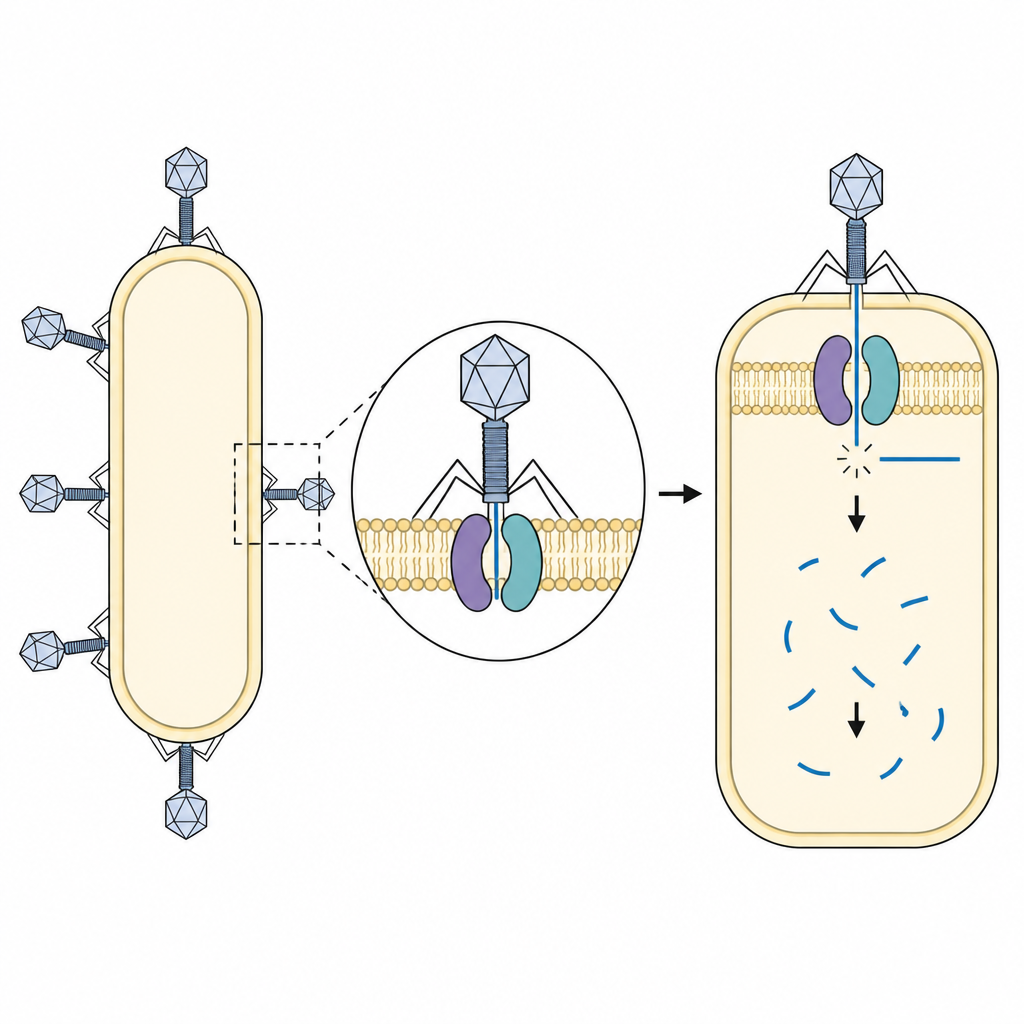
To see what SNIPE does in action, the team followed phage DNA as it entered cells using fluorescent tags and classic radioactive tracing methods. In normal cells, incoming phage DNA appears as clear spots, quickly multiplies, and eventually causes the host to burst. In cells with SNIPE, these DNA spots almost never form and the cells remain intact. When the viral DNA was labeled with radioactive phosphorus, it showed up as a long band corresponding to the intact phage genome in unprotected cells. In cells carrying SNIPE, that band was replaced by a smear of much smaller fragments, revealing that the viral DNA is chopped into pieces right after it starts to enter. A disabled version of SNIPE lacking cutting activity no longer produced this fragment pattern, confirming that its built-in “molecular scissors” are essential.
Staying safe from friendly DNA
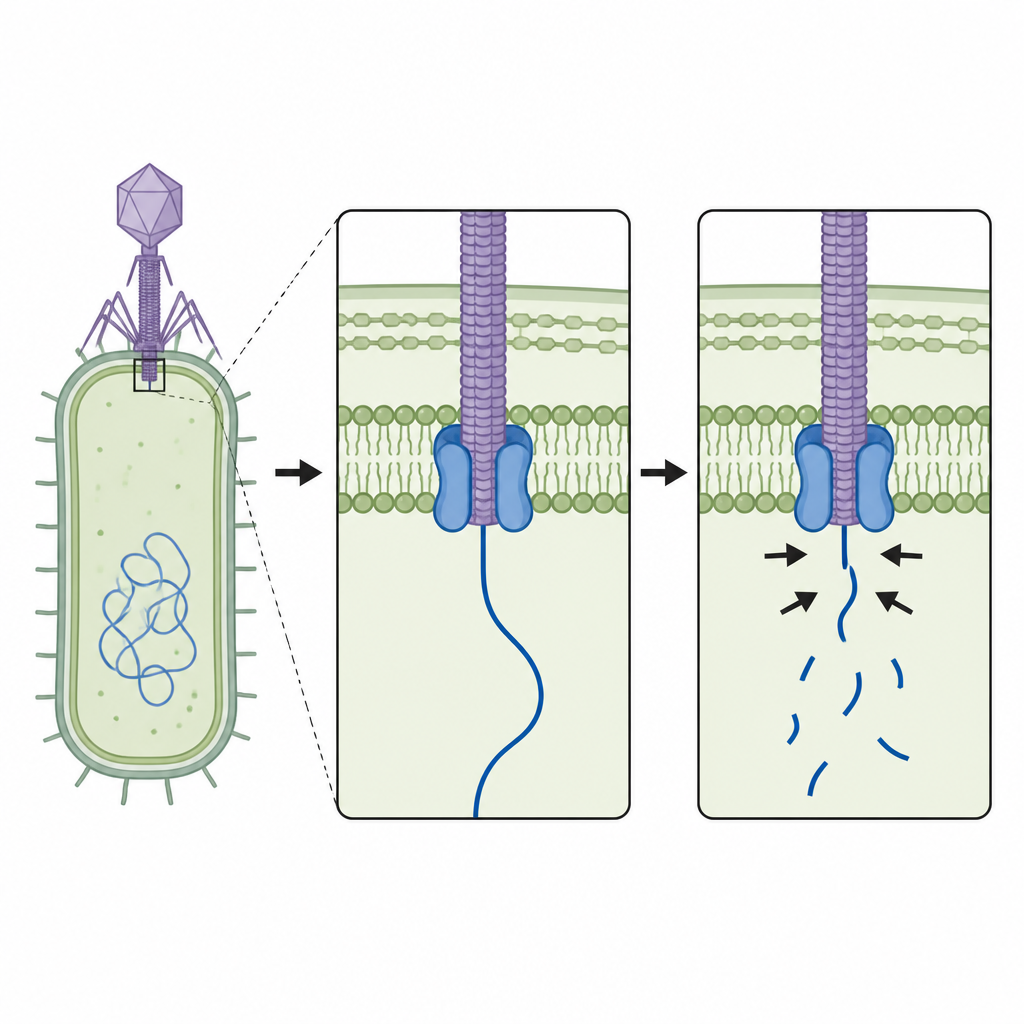
SNIPE must avoid harming its own host while aggressively degrading viral DNA. Structural predictions and genetic experiments show that the protein has three main parts: a short segment that tethers it in the inner membrane, a central domain that grabs DNA, and a tail end that performs the cutting. When the membrane anchor was removed, SNIPE drifted into the interior and became toxic, slicing host DNA. Keeping SNIPE fixed in the membrane appears to hold its activity in check, preventing accidental attacks on the cell’s own chromosome, even when that chromosome occasionally touches the membrane. This arrangement lets SNIPE remain ready for incoming phage genomes while sparing normal cellular DNA.
Locking onto the viral injection machinery
How does SNIPE know where viral DNA will appear? The study shows that it clusters around proteins involved in pulling phage DNA across the membrane. For phage lambda, this includes a host sugar transporter complex called ManYZ and a long viral tail component known as the tape measure protein. Using proximity-labeling techniques, the authors found that SNIPE sits near ManYZ even before infection and associates with the tape measure protein during genome injection. Many related phages that rely on ManYZ for entry are highly sensitive to SNIPE, while those that use other routes are less affected. For some viruses that do not depend on ManYZ, SNIPE can still offer protection by interacting directly, though more weakly, with their tape measure proteins, and targeted mutations in SNIPE or the viral tail can strengthen or weaken this interaction.
Variations on a common defensive theme
Looking across bacterial species, the researchers identified hundreds of SNIPE-like proteins. These relatives consistently keep the same cutting domain but vary widely in their membrane-facing and DNA-grabbing regions. Many carry one or two membrane-spanning segments, or other modules that latch onto cellular membranes, suggesting that SNIPE-style systems are broadly used to patrol entry points. The central DNA-binding domain typically preserves a positively charged surface that likely contacts genetic material, while the surface that faces viral tail proteins shows more variation, hinting that different bacteria tune SNIPE to recognize the specific phages they encounter in their natural environments.
Why this boundary defense matters
Overall, the work uncovers a previously unknown strategy for telling friend from foe: instead of reading the sequence or chemical markings of DNA, SNIPE simply attacks at a particular place and time, right where and when viral genomes cross the membrane. By wiring a DNA-cutting enzyme to the machinery that brings phage DNA into the cell, bacteria can destroy the invader before it fully arrives, while leaving established DNA inside the cell untouched. This entry-focused defense adds to a growing picture of immune systems that target the earliest steps of infection, highlighting the cell boundary as one of the most vulnerable stages in the life cycle of viruses.
Citation: Saxton, D.S., DeWeirdt, P.C., Doering, C.R. et al. A membrane-bound nuclease directly cleaves phage DNA during genome injection. Nature 653, 861–869 (2026). https://doi.org/10.1038/s41586-026-10207-1
Keywords: bacteriophage, bacterial immunity, phage defense, membrane protein, nuclease