Clear Sky Science · en
Fossil isotope evidence for trophic simplification on modern Caribbean reefs
Why Reef Food Chains Matter to Us
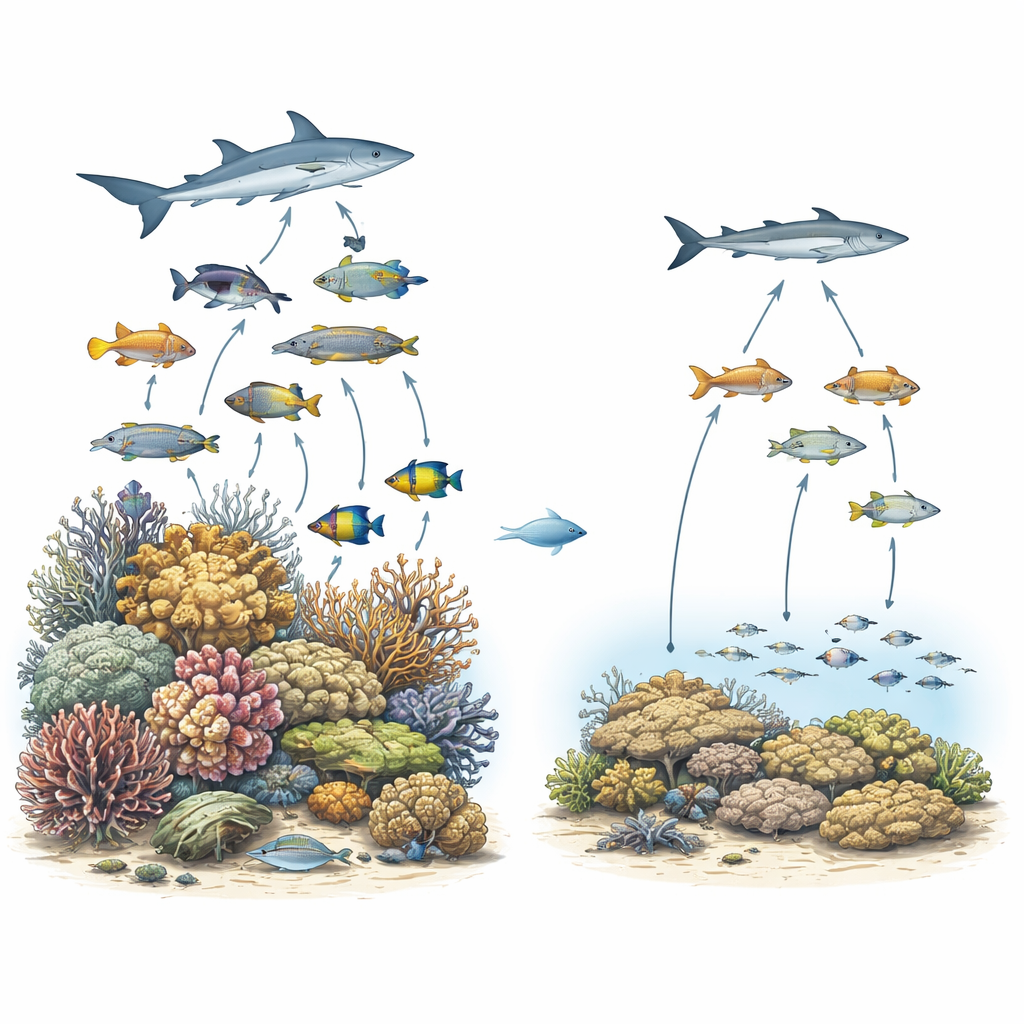
Coral reefs are sometimes called the rainforests of the sea. They shelter a quarter of all marine species and help protect the coasts and feed the roughly one billion people who live nearby. This study asks a deceptively simple question with big consequences: how has human activity changed who eats whom on Caribbean reefs? By reading chemical traces locked inside tiny fish ear stones and coral skeletons, the authors reconstruct ancient food webs from 7,000 years ago and compare them with today’s reefs, revealing that modern food chains are shorter and less varied—signs of an ecosystem that may be more fragile than it appears.
Peering Into Ancient Reefs
To look back in time, the researchers took advantage of two unusual record keepers buried in reef sediments in Panama and the Dominican Republic. One is the skeletons of common branching corals, which capture the chemical signature of nutrients at the base of the food web. The other is fish otoliths—tiny ear stones that grow throughout a fish’s life and are preserved long after it dies. Each otolith has a family-specific shape, so scientists can tell whether it came from small bottom-dwelling gobies, schooling silversides, nocturnal cardinalfish or larger grunts. By comparing modern otoliths with those from mid-Holocene fossil reefs, the team could see how feeding roles changed long before written records or systematic surveys existed.
Chemical Clues to Who Eats What
The key tool in this work is nitrogen isotopes, different forms of the element nitrogen that accumulate in predictable ways as energy moves up the food chain. Animals higher up the ladder carry slightly more of the heavier isotope, so the ratio recorded in otolith-bound proteins acts like a built-in gauge of trophic level. Coral skeletons, in turn, reflect the nitrogen signature of the water and plankton at the bottom of the web, allowing the scientists to check whether background conditions had shifted over thousands of years. They found that the baseline signal in corals stayed broadly similar between fossil and modern reefs in both regions, meaning that differences in the fish records mainly reflect changes in diet and food-web structure rather than changes in ocean chemistry.
From Rich Menus to Simple Diets
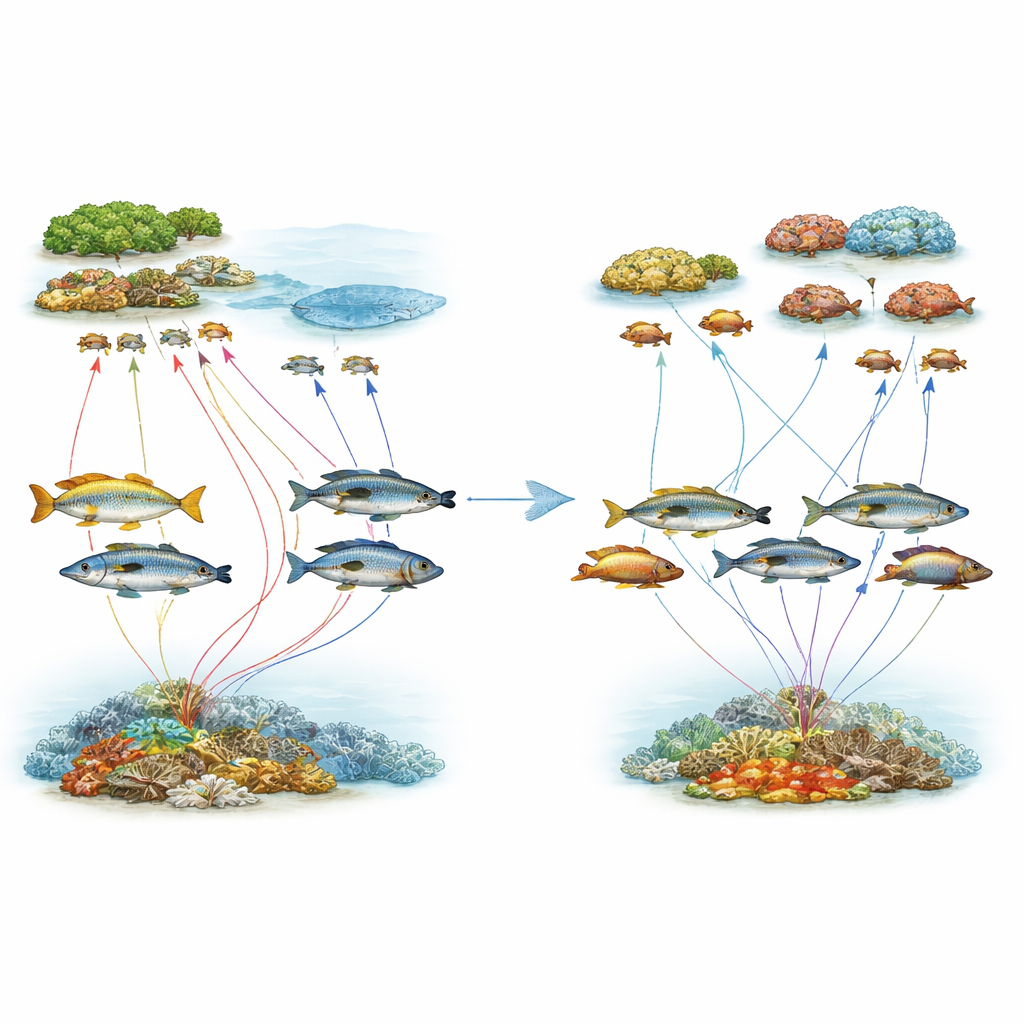
When the team compared fossil and modern otoliths, several patterns emerged. On ancient reefs, grunts and cardinalfish fed at relatively high positions in the food chain, while gobies and silversides occupied lower rungs, matching what is known from modern stomach-content studies. Today, however, higher-level fishes in the Dominican Republic—and more subtly in Panama—tend to occupy lower trophic positions, suggesting they now eat smaller or fewer-step prey. At the same time, the spread of nitrogen values within each fish family has shrunk markedly, especially for gobies, silversides and grunts. This narrowing means individual fish within a given family are eating more similar diets than they once did, implying a loss of dietary specialization and a shift toward more generalist, "whatever is left" feeding.
Shorter Food Chains Across the Reef
Looking at the community as a whole, the authors calculated metrics that describe the shape of the food web. One is food-chain length—the range between the lowest and highest trophic positions. Both in Panama and the Dominican Republic, modern food chains among these common fishes are roughly 60–70 percent shorter than they were 7,000 years ago. Another is the overall spread of nitrogen values across all individuals, which reflects the diversity of energy pathways running through the reef. Modern reefs show compressed, tightly clustered distributions compared with the broad, multi-peaked patterns of the fossil communities. In other words, both the extremes of the food web and the variety of routes linking them have been trimmed back over time.
What a Simpler Food Web Means
For non-specialists, the message is stark but clear. Ancient Caribbean reefs supported long, intricate food chains in which different fish families and even individual fish within a family followed distinct feeding paths. Modern human impacts—overfishing, coral loss, habitat fragmentation and the disappearance of mangroves and other connected habitats—have shortened those chains and squeezed fish into more uniform diets. While the total amount of fish on some reefs may still look healthy, the hidden architecture of who eats what has been simplified. Theory and experience from other ecosystems suggest that when an ecosystem relies on fewer, more similar energy pathways, it becomes less able to absorb shocks such as storms, heat waves or further species loss. This study’s fossil-to-modern comparison shows that Caribbean reefs have already lost a great deal of their trophic complexity, leaving them more vulnerable to collapse just as pressures from climate change and human use continue to mount.
Citation: Lueders-Dumont, J.A., O’Dea, A., Dillon, E.M. et al. Fossil isotope evidence for trophic simplification on modern Caribbean reefs. Nature 651, 967–973 (2026). https://doi.org/10.1038/s41586-025-10077-z
Keywords: coral reefs, food webs, Caribbean fish, stable isotopes, ecosystem resilience