Clear Sky Science · en
Holistic motor control of zebra finch song syllable sequences
Why bird song reveals secrets of skilled movement
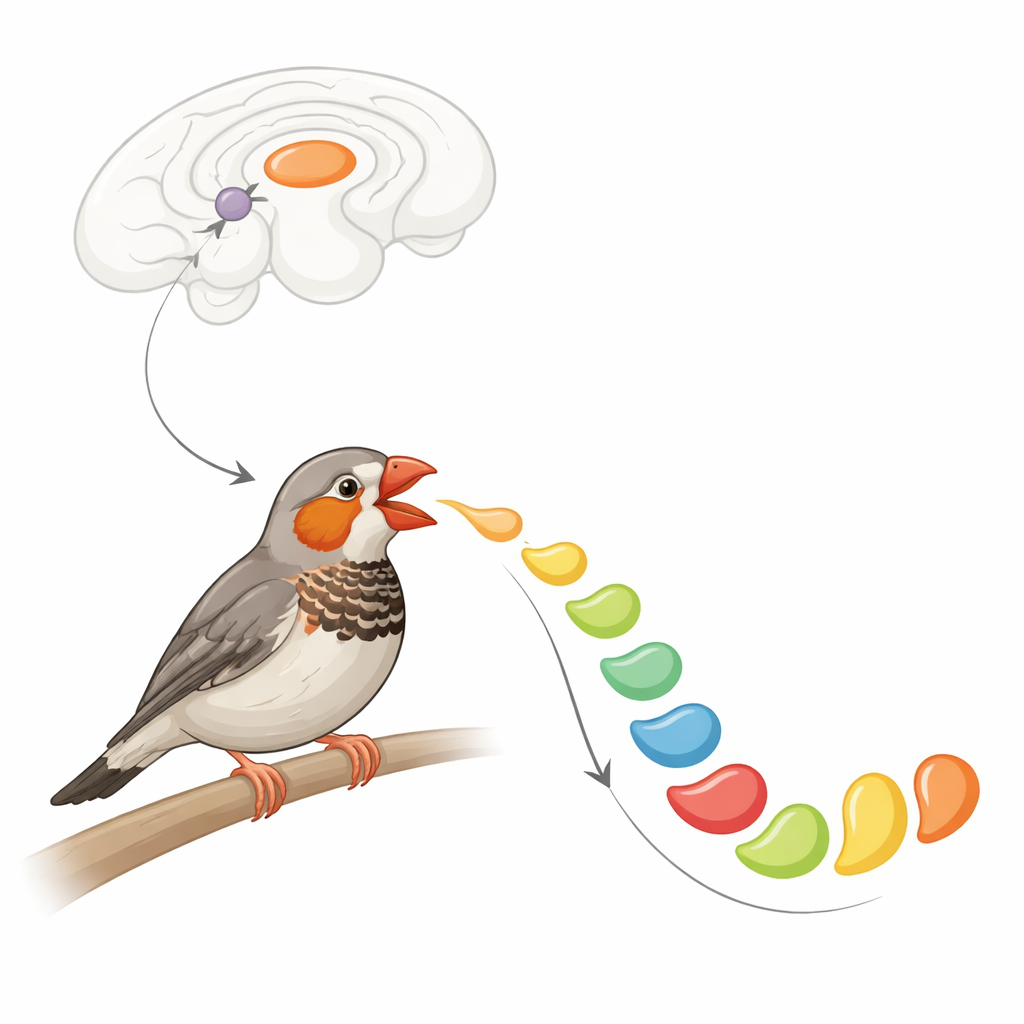
Anyone who has heard a zebra finch sing knows how remarkably precise and repeatable its courtship song is. Each male produces a personal tune made of syllables strung together in the same order dozens of times a day. This study asks a deceptively simple question with far-reaching implications: once a song is learned, how does the brain reliably produce the entire sequence from start to finish? By answering this in birds, the authors shed light on how any brain—avian or human—might stitch together well-practiced actions like speaking, playing piano, or swinging a tennis racket.
A single brain hub drives the whole tune
The work centers on a region in the songbird brain called HVC, long suspected to act like a clock for song timing. The researchers used modern tools to gently activate or silence specific sets of neurons while adult zebra finches sang freely. When they briefly excited neurons within HVC during a song, the current syllable was cut off almost instantly and the bird’s respiratory pattern shifted within a few dozen milliseconds. What happened next was striking: after this interruption, the bird nearly always jumped back to the start of its song and began the motif again, as if a record had skipped to the first track. This reset could be triggered at virtually any point in the song, suggesting that HVC contains a complete internal program for the full syllable sequence rather than a collection of separately controlled fragments.
Starting the song versus steering it
HVC does not operate in isolation: it receives input from a thalamic region called Uva and from several higher brain centers that process sound and guide learning. Earlier studies proposed that such inputs might instruct each step of the song, cueing transitions from one syllable to the next. The new experiments challenge that view. When the team selectively stimulated Uva’s projections into HVC, or directly activated Uva cells that send messages to HVC, the ongoing song continued normally. In contrast, broad, non-specific stimulation of surrounding thalamic tissue did truncate song—but it also produced whole-body orienting responses, implying that earlier electrical studies had inadvertently startled the birds rather than precisely steering song transitions. Carefully targeted lesions and long-term silencing of Uva showed a different, more subtle role: birds with weakened Uva input struggled to initiate motifs and to chain many motifs into a bout, yet once a motif began it unfolded with its usual structure. Uva, the authors conclude, is essential to open the gate for song but not to guide the syllable-by-syllable progression.
Independence from other “helper” regions
Adult songbirds also receive input to HVC from several forebrain regions involved in hearing and practicing song during development. The authors probed these pathways by stimulating their axon endings in HVC and by surgically removing these nuclei in adulthood. Despite clear increases in HVC activity when these inputs were optically stimulated, neither short bursts nor one-second-long stimulations altered the acoustic details or order of the song. Even when multiple input regions were lesioned together, birds temporarily sang more poorly but soon recovered their normal motif and could still string syllables in the correct order. This indicates that, once learning is complete, the main excitatory inputs to HVC are not required to run the mature song program.
A local circuit that generates and restarts sequences
Next, the authors asked whether the pattern generator resides solely within HVC or is shared with its downstream targets. They stimulated two major output stations: a motor region that sends commands to the vocal organs, and a basal ganglia area linked to variability and learning. Stimulating the basal ganglia node had little effect on song structure. Stimulating the motor region quickly cut off syllables, but birds were less likely to restart the motif and, when they did, they did so more slowly than after HVC stimulation. This timing mismatch supports the idea that HVC, not its outputs, houses the core pattern generator. Within HVC, there are two main types of projection neurons. Activating either type caused abrupt truncation and rapid motif restart, but one class, which also talks to the basal ganglia, produced restart dynamics that most closely matched broad HVC stimulation. Detailed measurements in brain slices revealed that these two neuron types form a tightly interlinked network, with both excitatory and inhibitory connections, capable of relaying activity in a chain-like fashion.
From detailed circuits to a simple working model
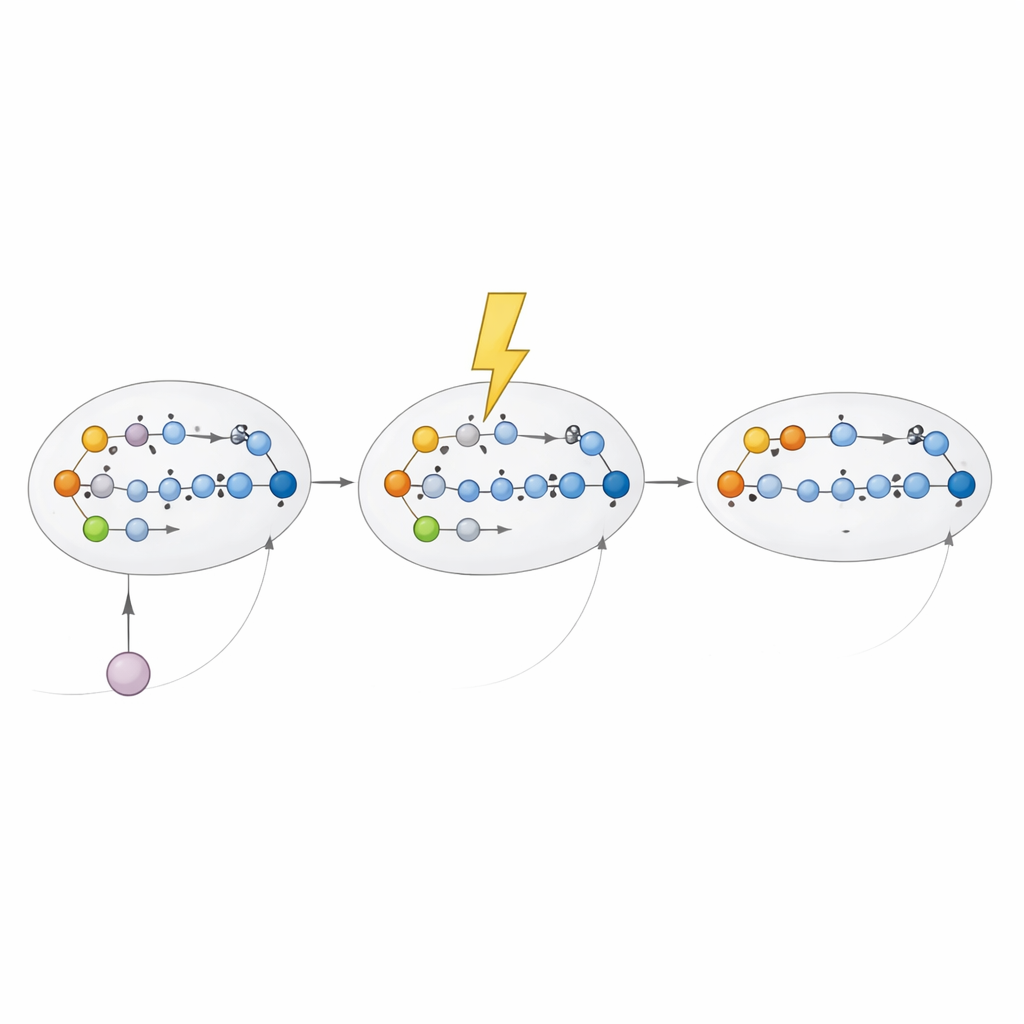
To see if such a network could, in principle, generate song-like sequences and restarts, the researchers built a computational model inspired by their connectivity data. In the model, excitatory neurons form a ring-like chain inside HVC, flanked by local and global inhibitory cells. A brief input, mimicking Uva activity, kicks off a “bump” of activity that travels along the chain, representing the unfolding song. Strong artificial excitation, analogous to the optogenetic pulses used in the birds, temporarily overwhelms the network and shuts down the bump, mimicking syllable truncation. As inhibition relaxes, a special set of “peri-song” neurons at the chain’s start is freed to fire again, automatically restarting the sequence from the beginning. When the modelers weakened connections from the basal-ganglia-projecting HVC neurons, the simulated sequence became prone to premature stops followed by restarts—precisely what was seen when these neurons had their synapses silenced in real birds.
What this means for skilled actions
Taken together, the experiments and modeling paint a picture of zebra finch song as a holistic motor behavior controlled by a self-contained sequence generator in HVC. Thalamic input is needed to launch each run of the motif and perhaps to keep the two hemispheres in sync, but once started, the local HVC circuit can carry the bird smoothly through all of its syllables without continuous outside guidance. This suggests that, after intensive practice, the brain can fuse individual movement “chunks” into a single, robust program that can be reset and replayed much like a track on a music player. Understanding how this happens in birds may help explain how humans achieve the effortless flow of well-learned skills, from speaking fluently to playing complex pieces of music.
Citation: Trusel, M., Zuo, J., Alam, D.H. et al. Holistic motor control of zebra finch song syllable sequences. Nature 652, 157–166 (2026). https://doi.org/10.1038/s41586-025-10069-z
Keywords: birdsong, motor sequences, neural circuits, pattern generation, vocal learning