Clear Sky Science · en
Evidence for odd-parity superconductivity underpinned by antiferromagnetism in heavy-fermion metal YbRh2Si2
A strange metal that becomes a special superconductor
Most superconductors already sound exotic: they conduct electricity with no resistance when cooled to very low temperatures. But an even rarer family, called topological superconductors, could one day provide building blocks for robust quantum technologies. In this study, researchers explore an unusual heavy metal compound, YbRh2Si2, cooled to a few thousandths of a degree above absolute zero, and find evidence that it hosts a rare kind of superconductivity that is closely tied to its internal magnetism.
Why this material is unusual
YbRh2Si2 belongs to a class of materials known as heavy fermion metals, where electrons behave as if they are hundreds of times heavier than usual because of strong interactions. At very low temperatures, this compound develops a delicate form of antiferromagnetism, in which neighboring atomic moments line up in opposite directions. Earlier measurements hinted that superconductivity appears in this strange environment, but the nature of the pairing that enables resistance-free flow of current remained unclear, and the superconducting signals were faint and sample dependent.
Listening to electric currents at ultra-low temperatures
To uncover what is happening, the team developed an ultra-sensitive way to measure the electrical response of tiny single crystals at temperatures below 10 millikelvin. They used a superconducting quantum interference device, or SQUID, to probe the complex electrical impedance, which captures both resistance and inductive effects as temperature and magnetic field are varied. These measurements revealed sharp boundaries where regions inside each sample switch between normal and superconducting behavior, allowing the researchers to map out multiple superconducting states as a function of magnetic field applied either within the crystal planes or along the crystal axis. 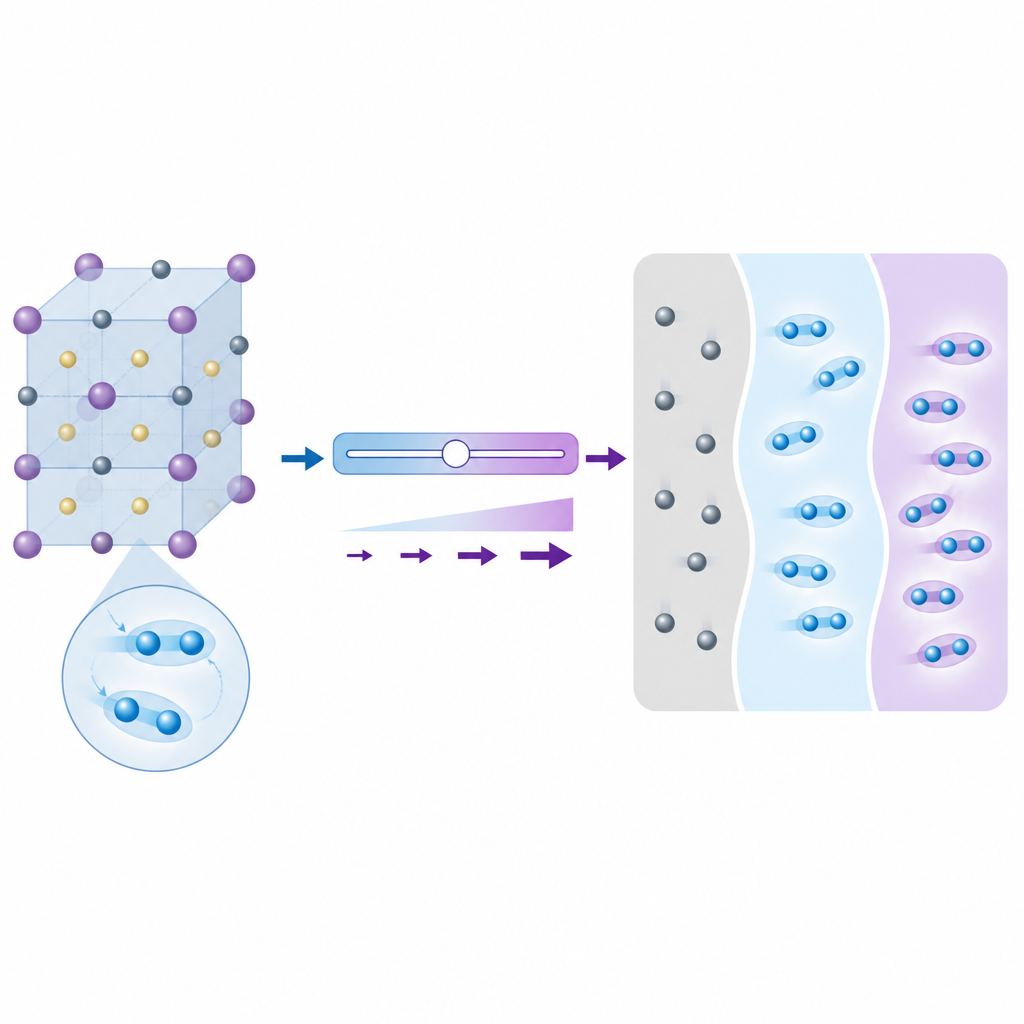
Magnetism as both helper and gatekeeper
The resulting phase diagrams show that superconductivity in YbRh2Si2 is only stable when the material is magnetically ordered. When the main antiferromagnetic state, called AFM1, is destroyed by an applied magnetic field, superconductivity also vanishes abruptly. At even lower temperatures, a second magnetic pattern appears, involving both electronic and nuclear spins arranged in a wave-like pattern. Strikingly, the onset of this electro-nuclear spin density wave produces a sudden boost in the superconducting response, seen as a drop in the kinetic inductance of the electrons and a rise in the field scale at which superconductivity is destroyed.
Clues to the type of superconducting pairs
By tracking how the critical temperature depends on magnetic field, the researchers could determine when superconductivity is limited by the magnetic alignment of electron spins, a restriction known as the Pauli limit. Some superconducting regions in the samples follow this limit for fields applied in the plane of the crystal, while others survive far beyond it. This selective behavior strongly suggests that the Cooper pairs are in a spin-triplet state, where spins align rather than oppose one another. The pattern of field dependence points in particular to a so-called helical state, a kind of topological superconducting phase that is insensitive to fields along the crystal axis but sensitive to fields within the plane.
How a magnetic wave strengthens the pairs
To explain the sudden strengthening of superconductivity when the electro-nuclear magnetic order appears, the authors propose that the helical superconducting state couples to a companion pattern called a pair density wave. In this picture, the magnetic wave diffracts the electron pairs, creating a spatially modulated partner state that lowers the energy of the system and effectively deepens the superconducting gap. Regions of the crystal that already host the helical state see it reinforced, while other regions are tipped into superconductivity exactly at the temperature where the electro-nuclear order sets in. 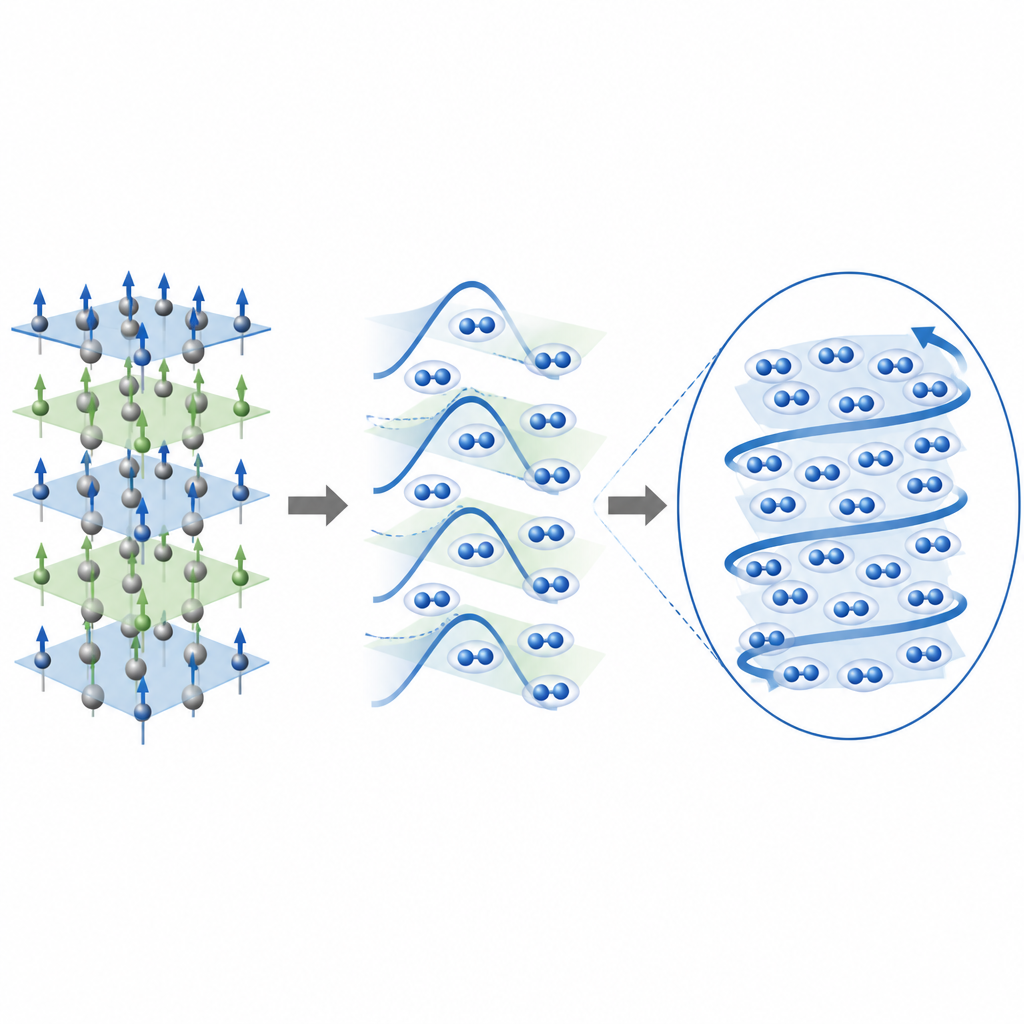
What this means for future quantum materials
Taken together, the experiments provide strong evidence that YbRh2Si2 hosts odd-parity, spin-triplet superconductivity whose existence and strength are controlled by two intertwined types of antiferromagnetic order. One of the superconducting phases fits the profile of a topological helical state, a close cousin of phases long studied in superfluid helium-3. Although the superconductivity is currently fragile and spatially non-uniform, the material offers a rare, tunable platform where magnetism and topological pairing can be studied side by side, with the prospect that improved sample control could one day make it a practical host for exotic quantum states.
Citation: Levitin, L.V., Knapp, J., Knappová, P. et al. Evidence for odd-parity superconductivity underpinned by antiferromagnetism in heavy-fermion metal YbRh2Si2. Nat. Phys. 22, 713–719 (2026). https://doi.org/10.1038/s41567-026-03247-x
Keywords: topological superconductivity, spin-triplet pairing, heavy-fermion metal, antiferromagnetism, pair density wave