Clear Sky Science · en
Noise-induced shallow circuits and the absence of barren plateaus
Why noisy quantum chips still matter
Quantum computers promise to solve certain problems far faster than ordinary machines, but today’s devices are fragile and noisy. This work asks a simple question with big practical consequences: what can realistic, imperfect quantum chips actually do before full error correction arrives? By analysing how noise reshapes the behaviour of typical quantum circuits, the authors show that many ambitious near‑term algorithms quietly collapse to the power of much shallower circuits, which can often be mimicked on a classical computer.
Deep circuits that behave like shallow ones
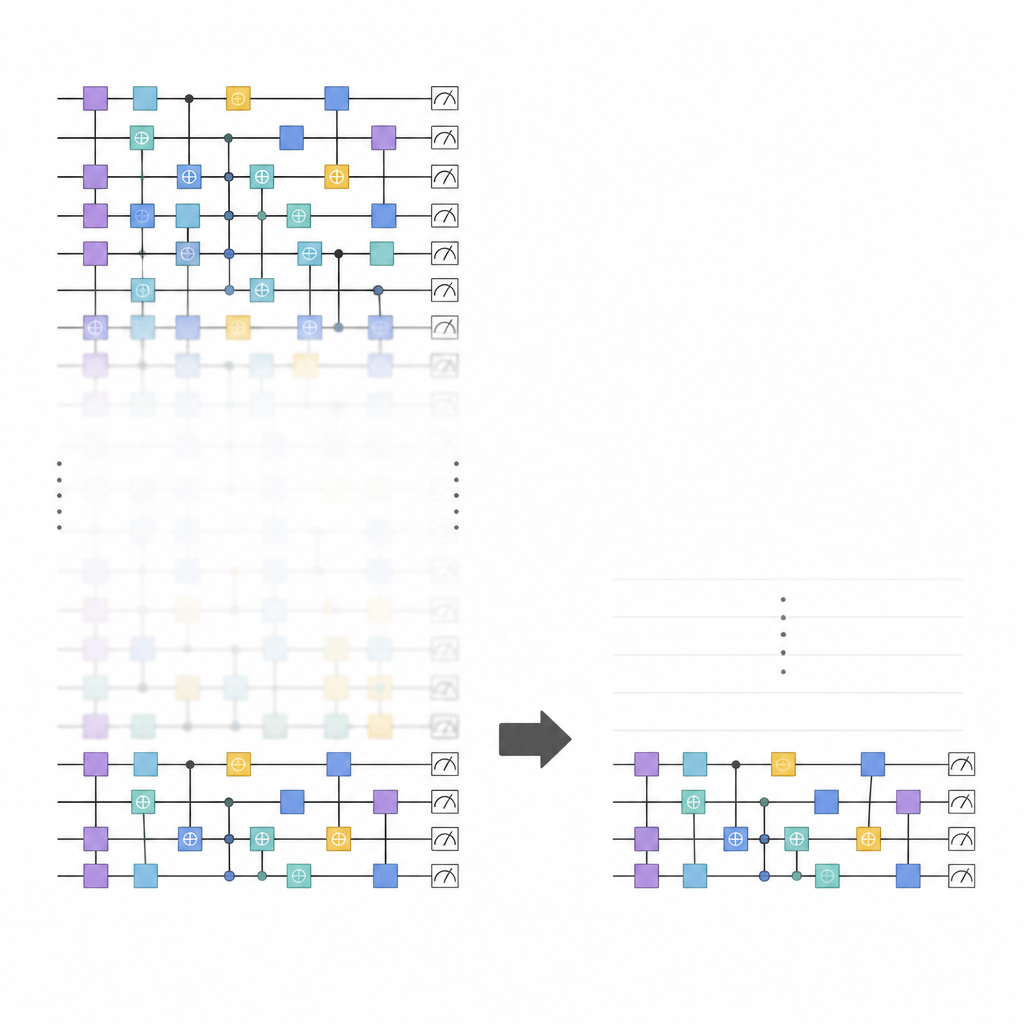
Modern quantum algorithms often rely on running very deep circuits, stacking layer upon layer of quantum gates on many qubits. In theory, more layers allow more complex quantum behaviour. But as soon as each qubit is exposed to realistic local noise, most of those layers effectively stop mattering for the quantities that physicists and algorithm designers usually care about: expectation values of observables, such as average energies or magnetizations. The authors prove that, for typical random circuits, the influence of any gate on such expectation values shrinks exponentially the further it is from the final layer. In practice, only about a logarithmic number of layers in the system size still contribute meaningfully.
Noise that prevents flat training landscapes
Variational quantum algorithms and quantum machine learning methods are trained by adjusting many gate parameters to minimize a cost function built from observable averages. A major concern is the emergence of barren plateaus, where the cost landscape becomes almost perfectly flat and gradients nearly vanish, making training unworkable. Earlier studies showed that certain kinds of “balanced” noise can trigger these plateaus. Here, the authors look instead at more realistic “unbalanced” noise that tends to push qubits toward particular states. Under this type of noise they find that, for cost functions made of local observables, the landscape does not flatten out: the spread of cost values stays sizeable and gradients remain of reasonable size, no matter how deep the circuit is.
But only the last layers are really trainable
This lack of barren plateaus might sound like good news for quantum machine learning, but there is a twist. The same noise that keeps gradients alive also makes almost all of them irrelevant. The authors show that parameters sitting deep inside the circuit have a vanishing effect on local observables; the useful gradient information lives almost entirely in the last few layers, whose number again grows only logarithmically with the system size. In other words, a very deep noisy variational circuit behaves, for training purposes, like a much shallower one: most of its adjustable gates are effectively frozen out by noise.
Classical computers keep up more easily
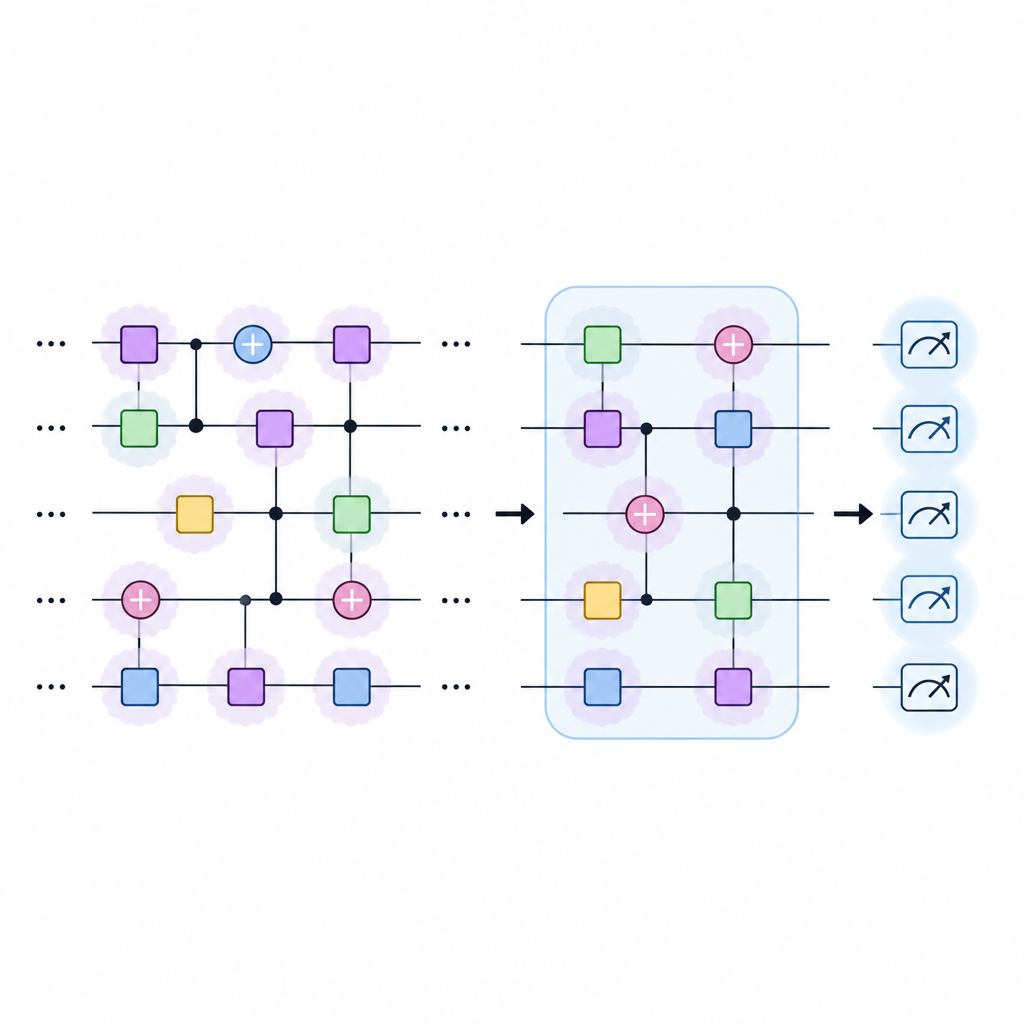
Once deep noisy circuits act like shallow ones, they become much easier to imitate with classical algorithms. The authors use their effective depth picture to design classical procedures that estimate the same observable averages to a fixed target accuracy, with high success probability, for almost any circuit architecture. By focusing on the influence region of local observables and exploiting how noise suppresses complex multi‑qubit patterns, they show that classical runtimes can remain efficient even when the underlying quantum circuits are extremely deep. For many practical accuracy goals this holds across a wide range of architectures, from one‑dimensional chains to fully connected layouts.
What this means for near‑term quantum advantage
For tasks built around estimating expectation values, such as many proposed variational algorithms and quantum machine learning schemes, these results paint a sobering picture. In typical situations, noisy quantum circuits with realistic, possibly unbalanced noise do not offer substantially more power than carefully chosen shallow circuits that classical computers can often handle. Although specially engineered circuit designs can still make clever use of noise to go beyond this limit, such cases are the exception rather than the rule. For the average noisy device, noise itself compresses quantum computations into a shallow, classically approachable form.
Citation: Mele, A.A., Angrisani, A., Ghosh, S. et al. Noise-induced shallow circuits and the absence of barren plateaus. Nat. Phys. 22, 751–756 (2026). https://doi.org/10.1038/s41567-026-03245-z
Keywords: quantum noise, noisy quantum circuits, variational quantum algorithms, classical simulation, barren plateaus