Clear Sky Science · en
Laser-induced nucleation of magnetic hopfions
Knotted whirlpools in tiny magnets
Imagine tying a knot in an invisible field inside a solid piece of metal and then making that knot appear with a flash of light. This study shows how physicists can create and observe such knots in the magnetic patterns of a crystal using ultrafast laser pulses. These three dimensional loops, called hopfions, behave like tiny particles and could one day store or process information in ways that ordinary electronics cannot.
Why twisted magnetic loops matter
In certain magnetic materials, the direction of magnetization does not just point up or down but can twist smoothly through space, forming whirlpools and spirals. Two dimensional whirlpools known as skyrmions have already attracted attention as candidates for future data storage because they are small, mobile, and robust. Hopfions are their fully three dimensional cousins: closed loops of twisted magnetization that are linked to themselves, a bit like smoke rings woven into a surrounding spiral pattern. Theory has long suggested that isolated hopfions could exist on their own, but experiments had only seen more complex versions tied to skyrmion strings, and producing free standing hopfions under controlled conditions remained an open challenge.
Writing knots with light
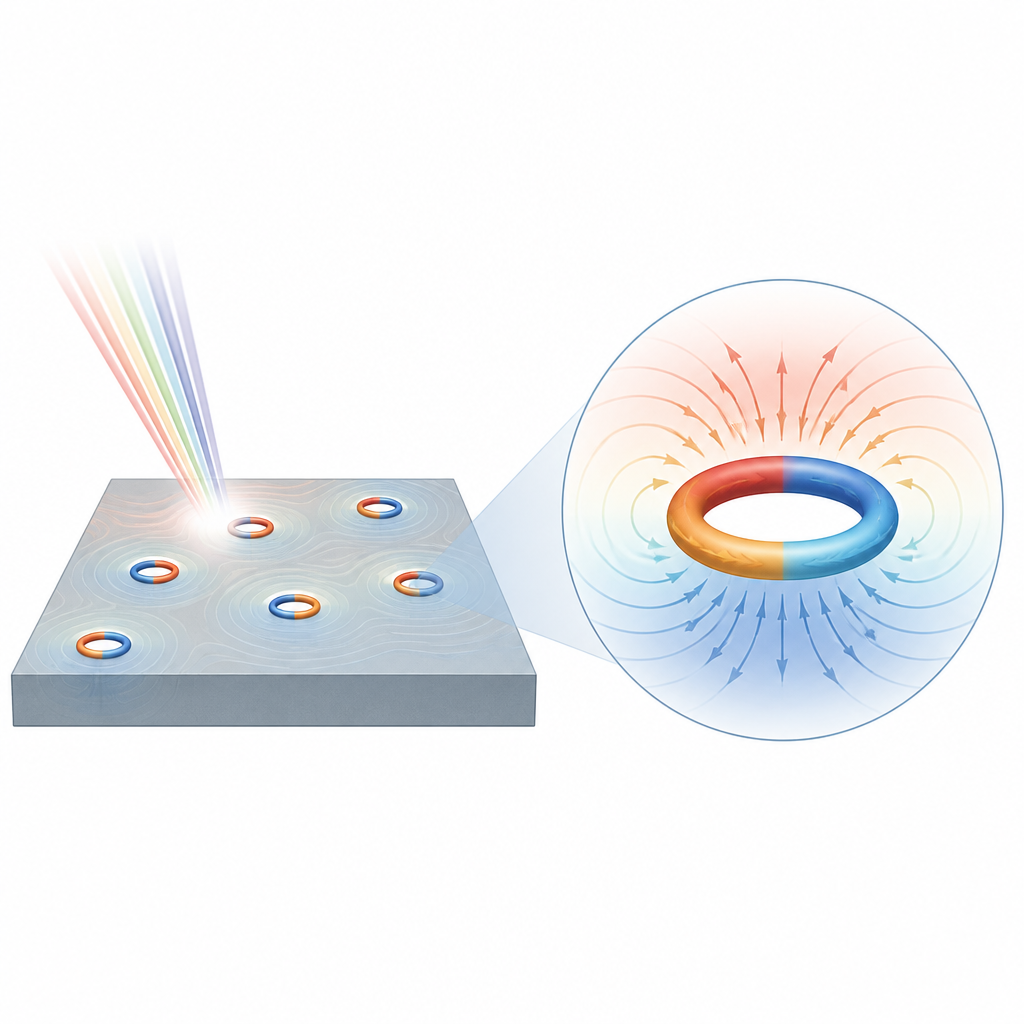
The researchers tackled this challenge in thin plates of a chiral magnet called FeGe, a crystal where competing forces naturally favor twisted magnetic states. They placed the plates in a transmission electron microscope equipped with an ultrafast laser. Single femtosecond laser pulses, each lasting less than a trillionth of a second, briefly heated and disturbed the magnetic order without any physical contact. By tuning the laser energy and the strength of a gentle magnetic field applied perpendicular to the plate, the team mapped out which combinations produced different magnetic textures. Above a certain laser fluence, and at relatively low external fields, the pulses reliably generated a rich mixture of patterns, including skyrmions, antiskyrmions, hopfion rings linked to strings, and crucially, isolated hopfions sitting in a helical background.
Seeing and classifying the hidden shapes
Because hopfions are buried inside the material, identifying them requires indirect imaging. The team used Lorentz transmission electron microscopy and off axis electron holography to measure how electron waves bend as they pass through the magnetic field inside the crystal. These measurements produce characteristic bright and dark spots that change with the tilt of the sample. By comparing full tilt series and detailed line profiles with micromagnetic simulations, the authors showed that the observed contrast matches the complex three dimensional structure expected for a hopfion and cannot be explained by skyrmions, antiskyrmions, or other candidates. In parallel, they developed a more flexible mathematical description of hopfions that works under realistic boundary conditions, proving that these objects still carry a well defined topological charge even when the surrounding magnetization is not perfectly uniform.
How the laser helps knots to form
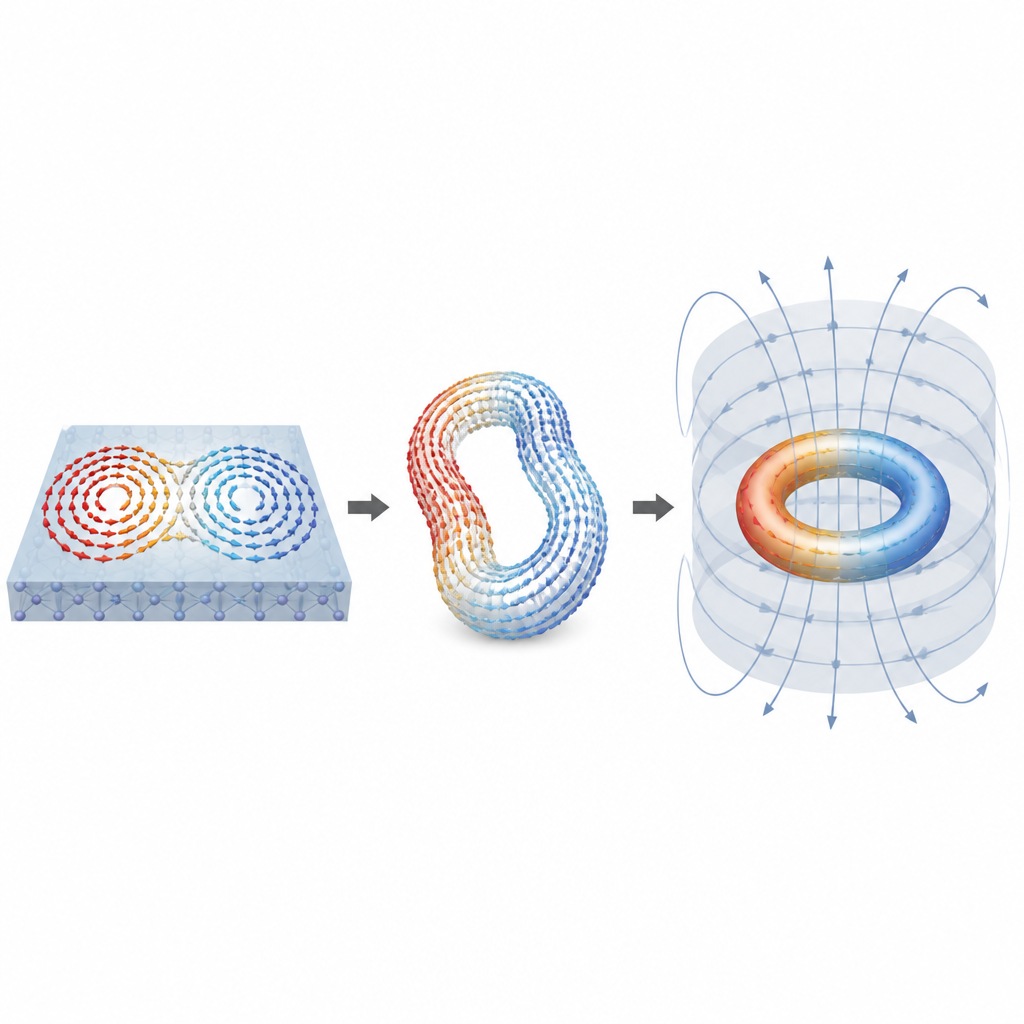
To understand how such intricate loops can appear so quickly, the team calculated energy landscapes that connect different magnetic states. Their simulations suggest that a hopfion most likely forms when a skyrmion and an antiskyrmion, two whirlpools with opposite sense of rotation, merge into a single three dimensional loop. The energy barrier for this merger is lower than the barrier for the hopfion to disappear again, which explains why hopfions, once created, can persist over a wide range of magnetic fields and for long times. The calculations also show that damaged surface layers created during sample preparation can actually help to confine hopfions, broadening the thickness range over which they are stable.
Knots as building blocks for future devices
The authors demonstrate that hopfions can exist alone, in pairs, or in combination with other magnetic textures, and that they survive even without any applied magnetic field. This contact free, light based method for creating three dimensional magnetic knots in extended crystals opens a new route to designing devices that use topology rather than charge to encode information. While practical applications remain distant, the work establishes hopfions as real, controllable objects and provides a toolbox for exploring how such knotted structures can be written, moved, and erased inside solid materials.
Citation: Chen, X., Yang, D., Li, Z. et al. Laser-induced nucleation of magnetic hopfions. Nat. Phys. 22, 736–744 (2026). https://doi.org/10.1038/s41567-026-03236-0
Keywords: magnetic hopfions, topological magnetism, ultrafast laser pulses, skyrmions, spintronics