Clear Sky Science · en
Squeezing, trisqueezing and quadsqueezing in a hybrid oscillator–spin system
Shaping the smallest vibrations
At the heart of modern physics and technology lie tiny vibrations, from the light in optical fibers to the motion of atoms in a crystal. Being able to sculpt these vibrations at will opens doors to sharper sensors, new forms of quantum computers and tools for simulating complex materials. This work shows how to take a familiar quantum system, a trapped atomic ion, and use it in a clever way to create unusually shaped vibrational states that are hard for classical computers to mimic.
From simple vibrations to sculpted noise
Physicists often describe vibrations using the idea of a quantum harmonic oscillator, which captures everything from electromagnetic waves to molecular motion. In the simplest case, these vibrations behave like gentle ripples described by so called Gaussian shapes, and standard devices can generate and control them well. A well known example is “squeezing,” where the random noise in one property of the vibration is reduced at the cost of increased noise in a complementary property. Squeezed states already help instruments such as gravitational wave detectors listen for faint signals buried in quantum noise. But to go beyond what classical hardware can easily simulate, researchers need vibrations that are shaped in more exotic, non-Gaussian ways.
Using a quantum spin as a control knob
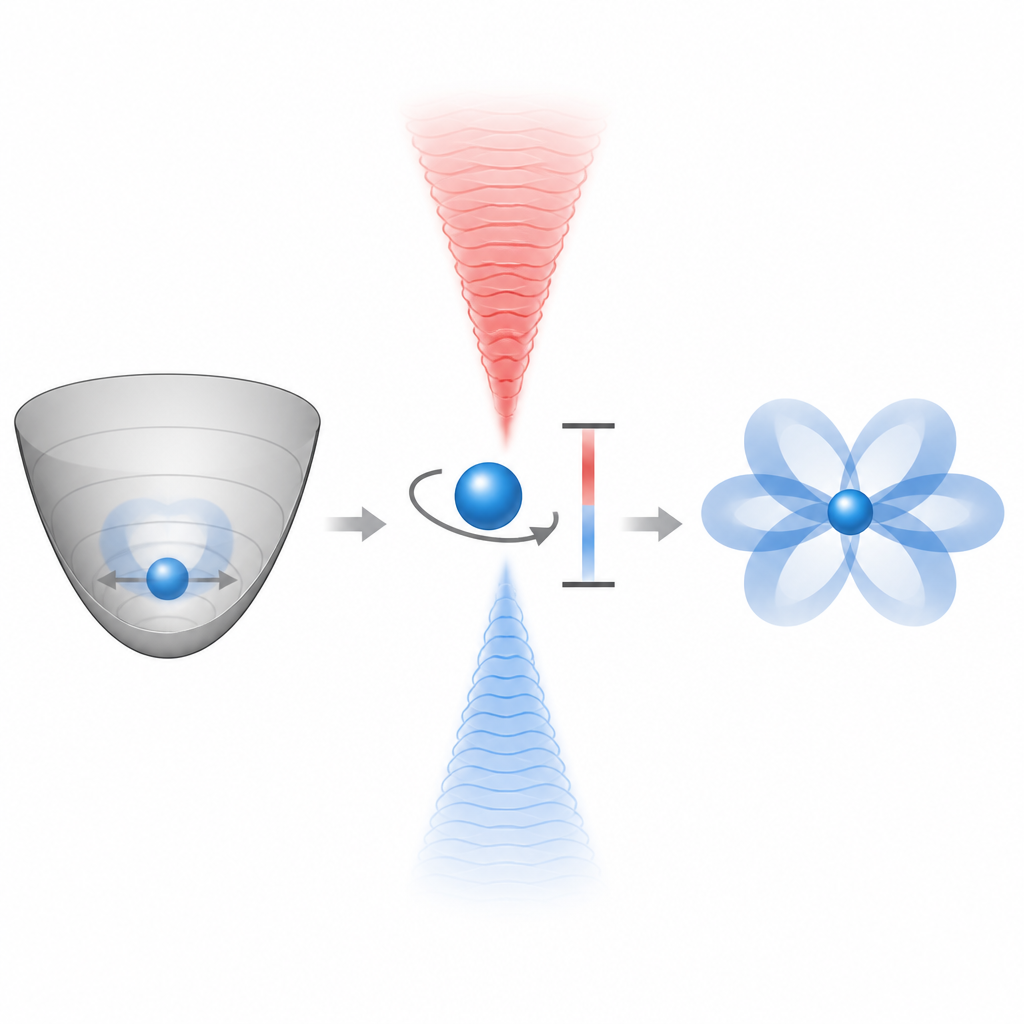
Directly creating strong higher order effects in an oscillator, such as those needed for more exotic squeezing, is usually slow and technically demanding. The required interactions tend to get weaker and weaker as their order increases, and custom engineered devices are often needed. The Oxford team takes a different route by using a hybrid system: a single charged atom in a trap, where its motion along one axis acts as the oscillator and two of its internal energy levels act as a quantum “spin.” Instead of forcing the motion itself to behave nonlinearly, they apply two carefully chosen laser driven forces that each couple the spin linearly to the motion. Because these forces pull on the motion in different spin directions and do not commute, their combined effect mimics much stronger nonlinear behavior in the motion.
Dialing in different kinds of squeezing
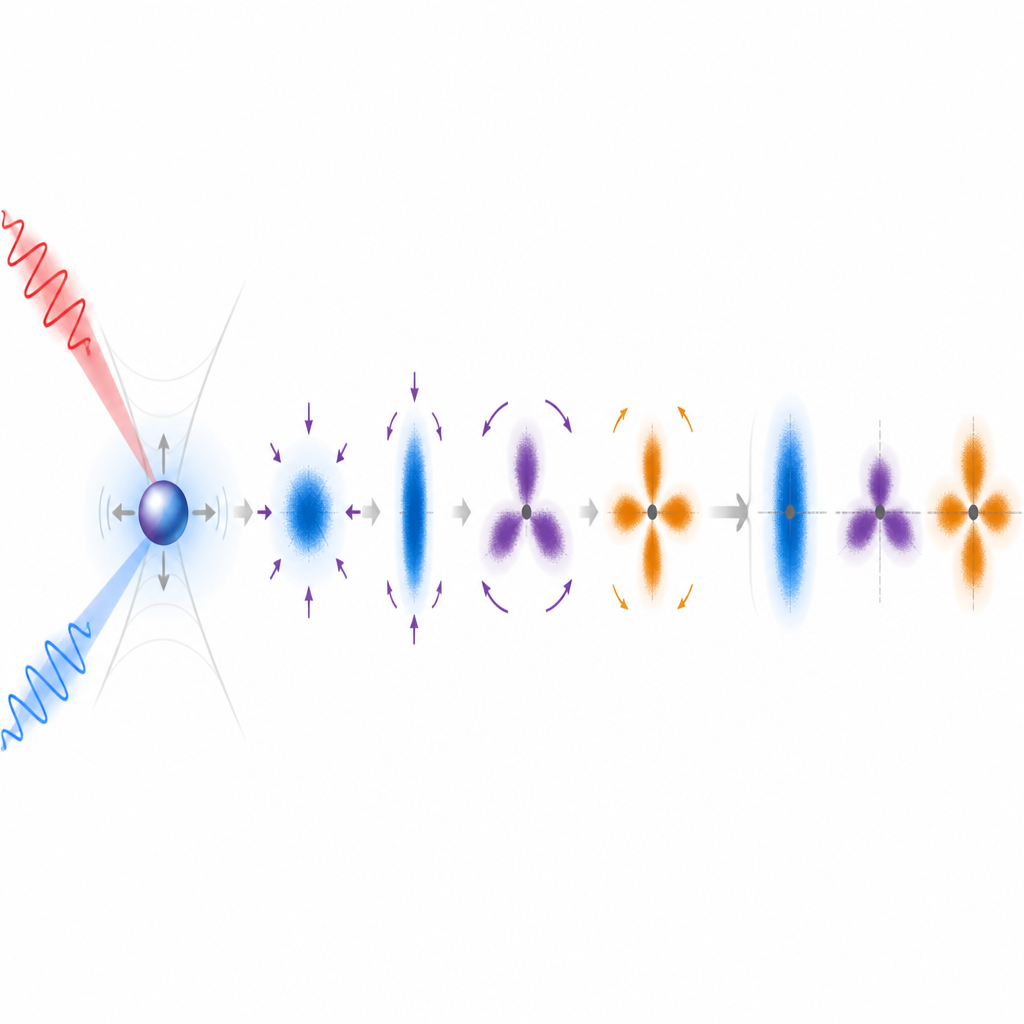
By tuning the frequency offsets and phases of the two spin dependent forces, the researchers can select which kind of nonlinear interaction they generate. With one choice they obtain ordinary squeezing, which reshapes the quantum noise into an elongated oval in phase space. With slightly different settings, the same hardware produces “trisqueezing” and “quadsqueezing,” higher order versions that carve the motion into three and four lobed patterns. The team verifies these states in detail by reconstructing their Wigner functions, a way to visualize the full quantum state of the oscillator. These reconstructions clearly show departures from simple Gaussian shapes, confirming that the new states inhabit a more complex quantum regime that is valuable for continuous variable quantum computation.
Faster routes to exotic quantum motion
A key advantage of this method is speed. Because the nonlinear behavior is built from strong, readily available linear couplings, the effective fourth order interaction that produces quadsqueezing is more than one hundred times stronger than the direct approach at the same laser power. That means the desired states can be created well before unwanted noise and decoherence have time to destroy them. The scheme is also flexible: in principle there is no fundamental limit to how high an interaction order can be engineered, and the same idea can be adapted to other platforms where spins and oscillators are coupled, such as superconducting circuits or defects in diamond.
New tools for quantum technologies
In simple terms, this work shows how to turn a single trapped ion into a versatile laboratory for sculpting quantum vibrations of many shapes, from gently squeezed to highly intricate patterns. These non standard vibrational states are promising ingredients for future quantum computers that process information stored in continuous variables, for sensitive measurements that push noise limits and for simulations of complex systems where bosons play a central role. By using the ion’s spin as a control knob rather than building new hardware for each effect, the researchers provide a practical recipe for generating powerful nonlinear interactions in a wide range of quantum devices.
Citation: Băzăvan, O., Saner, S., Webb, D.J. et al. Squeezing, trisqueezing and quadsqueezing in a hybrid oscillator–spin system. Nat. Phys. 22, 757–762 (2026). https://doi.org/10.1038/s41567-026-03222-6
Keywords: trapped ions, quantum squeezing, non-Gaussian states, hybrid quantum systems, continuous variable quantum computing