Clear Sky Science · en
Quantum ground-state cooling of two librational modes of a nanorotor
Freezing Tiny Rotors in Their Tracks
Nanoscale objects never really sit still: they jitter, spin and wobble because of thermal motion. This restless behavior usually drowns out delicate quantum effects. In this work, researchers show they can almost completely freeze the wobbling of a tiny “nanorotor” made from silica spheres, pushing its motion down to the quietest state allowed by quantum mechanics. Mastering this kind of control opens doors to exquisitely sensitive torque sensors and to table‑top tests of how far quantum physics extends toward everyday‑scale objects.
Why Rotating Nanoparticles Matter
Most previous experiments that tame motion at the quantum level have focused on objects that move back and forth along a line, like miniature springs or cantilevers. Rotational motion is richer: a spinning or wobbling object can explore angles in a closed loop, leading to phenomena with no direct counterpart in linear motion, such as quantum tunneling between different orientations and interference between distinct rotational paths. If scientists can cool and control tiny rotors well enough, they could create massive quantum superpositions and use them to probe ideas such as wave‑function collapse or elusive dark matter, and to build torque sensors that detect unimaginably small twists.
Holding and Cooling a Nanoscopic Dumbbell
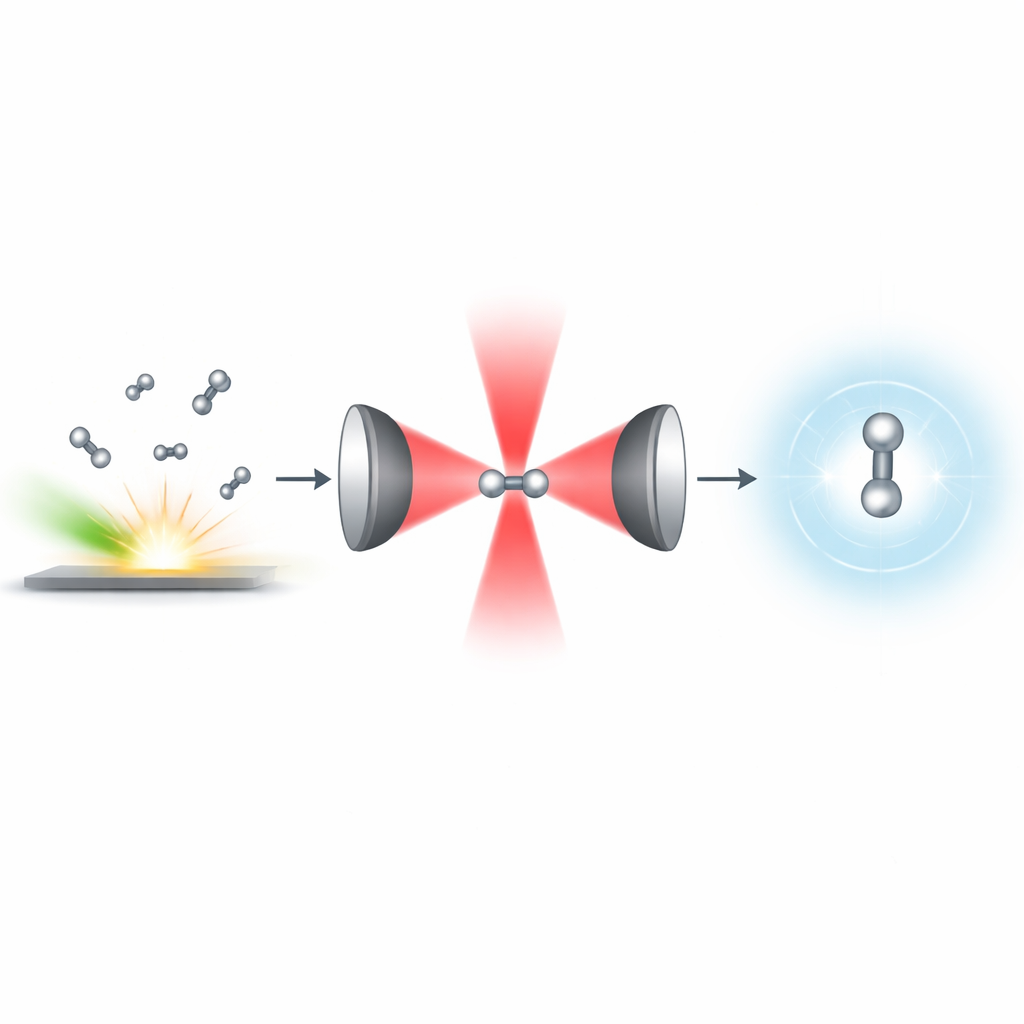
The team works with nanorotors assembled from two or more silica spheres, forming shapes like dumbbells and trimers a few hundred nanometers across. They first launch these particles from a coated surface using short laser pulses, a refined “laser‑induced desorption” technique that works efficiently even in a vacuum chamber. Once airborne at low pressure, a tightly focused infrared laser beam acts as an optical tweezer, grabbing a single nanorotor and suspending it in mid‑air. Because the particle’s polarizability is slightly different along its various axes, the polarization of the trapping light tends to align the dumbbell, turning its rotational motion into small oscillations—librations—around a preferred orientation.
Using Light Itself as a Fridge
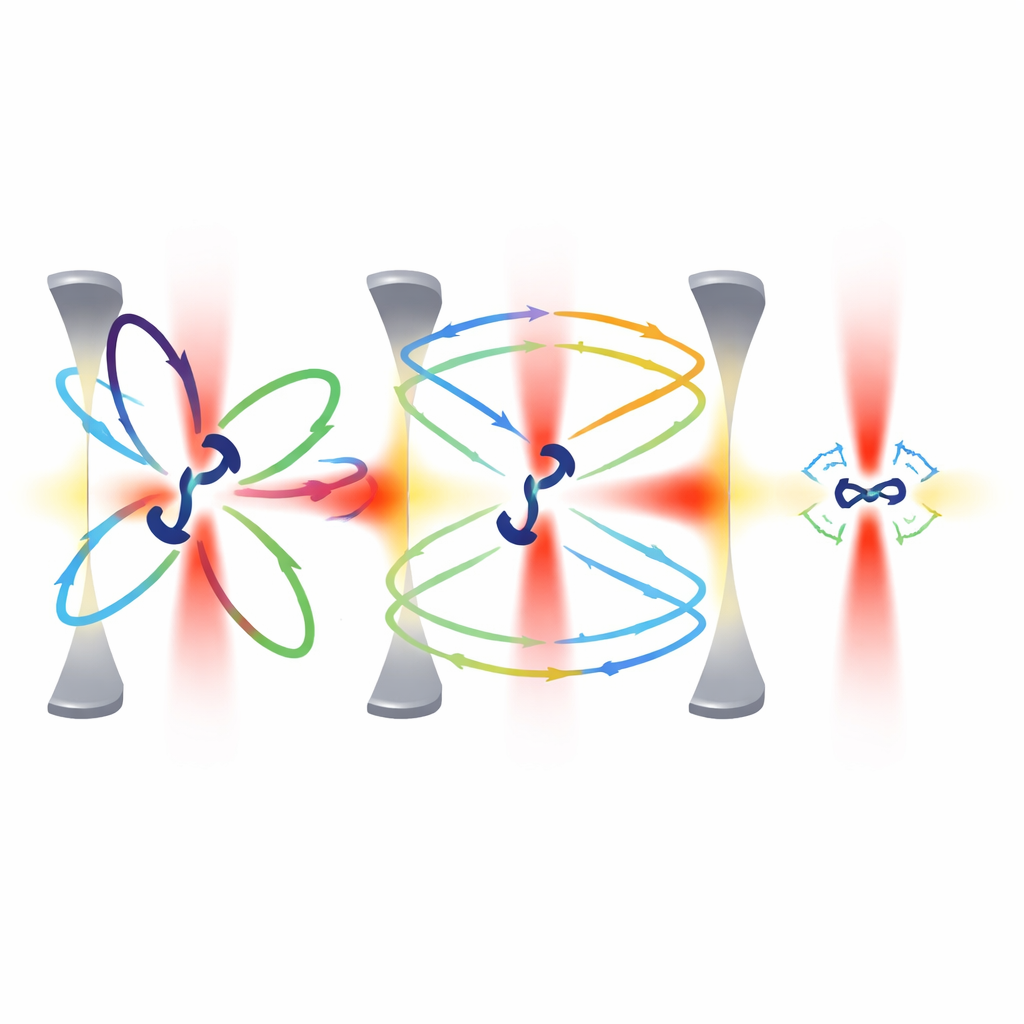
To cool these librations, the trapped nanorotor is placed inside a high‑finesse optical cavity formed by two highly reflective mirrors. Light from the trapping beam is coherently scattered by the particle into specific cavity modes. By carefully tuning the frequency of the cavity relative to the tweezer light, the researchers make it more likely that scattering events remove one quantum of rotational energy at a time than add one. Each such “anti‑Stokes” event transfers a tiny amount of mechanical energy from the rocking motion of the nanorotor into the light field, which then escapes the cavity. With the cavity aligned so that two orthogonal polarizations couple separately to two distinct librational motions, the setup can address and cool each wobbling direction individually.
Reaching the Quantum Quiet Limit
By monitoring the scattered light with sensitive heterodyne detection, the team performs a kind of sideband thermometry, reading out how many quanta of librational motion remain. For a cluster of smaller spheres, they cool one librational mode to an average of about one‑fifth of a quantum of excitation, corresponding to an effective temperature of only a few tens of microkelvin and an angular uncertainty of roughly 17 microradians—just above the unavoidable quantum zero‑point spread. For a larger dumbbell, they extend the method to cool two perpendicular librational modes at once, reaching occupations near a single quantum in each. This means the orientation of the nano‑dumbbell is defined with a precision of better than 20 microradians in both directions, remarkably close to the ultimate quantum limit. They also demonstrate that, thanks to their improved loading scheme, they can repeat this procedure for several freshly trapped nanorotors within a single day.
What This Quantum Control Enables Next
Cooling two rotational degrees of freedom so close to their quantum ground states effectively pins a nanorotor in space with nearly minimal possible uncertainty. This capability is a key prerequisite for more ambitious experiments, such as letting a well‑aligned rotor evolve freely to form and recombine rotational quantum wave packets—an angular analogue of the classic double‑slit experiment. It also paves the way for torque sensors sensitive enough to probe new physics and for future studies using lighter or even biological nanorotors, like viruses, whose rotational quantum behavior could be explored within realistic laboratory setups.
Citation: Troyer, S., Fechtel, F., Hummer, L. et al. Quantum ground-state cooling of two librational modes of a nanorotor. Nat. Phys. 22, 584–590 (2026). https://doi.org/10.1038/s41567-026-03219-1
Keywords: levitated optomechanics, nanorotor cooling, quantum ground state, optical cavity, torque sensing