Clear Sky Science · en
Origin of strange metallicity in a d-orbital kagome metal
Metal That Refuses to Behave
Most metals in our daily lives follow well-understood rules: as they cool down, their electrical resistance drops in a predictable way. But a growing class of "strange metals" breaks these rules, showing unusual behavior that hints at entirely new kinds of quantum matter. This article explores one such material, a finely engineered metal made of nickel and indium with a special triangular pattern called a kagome lattice. By peering at its electrons atom by atom, the researchers uncover how this curious geometry gives rise to a metal that seems to live on the edge of order and chaos.
A Lattice of Triangles and a Curious Flat Highway
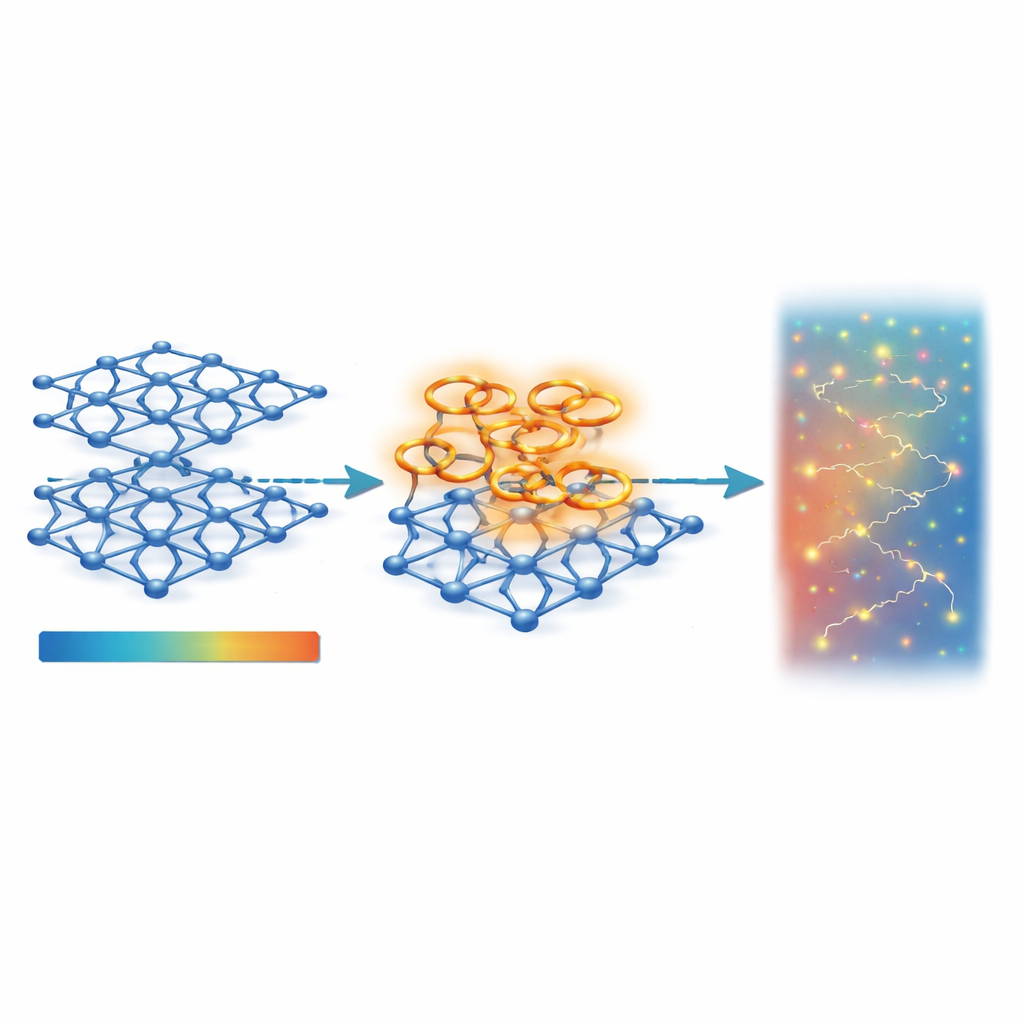
Ni3In, the material at the heart of this study, arranges its nickel atoms in stacked layers of corner-sharing triangles, like a woven mesh. This kagome pattern forces some of the electrons into a "flat band," an energy range where they effectively lose their ability to move freely. In such flat bands, even modest repulsion between electrons can dominate their behavior, setting the stage for strong correlations. Earlier experiments had already shown that Ni3In behaves like a strange metal: its electrical resistance varies almost linearly with temperature over a wide range, defying the standard theory that works for ordinary metals. Yet the microscopic origin of this behavior was unknown.
Zooming In with an Atomic-Scale Microscope
To tackle this puzzle, the team grew ultra-thin Ni3In films and examined them using scanning tunnelling microscopy, a technique that can map the local electronic structure with atomic precision. By measuring how easily electrons tunnel between a sharp tip and the sample at different energies, they obtained a detailed fingerprint of the states near the metal’s surface. Right around the energy where the flat band should sit, they observed a distinctive peak-and-dip structure centered at zero bias—an energy signature reminiscent of heavy-fermion metals, a class of materials where slow, heavy-like electrons emerge from interactions with localized magnetic moments. But unlike classic heavy-fermion systems, Ni3In has no deep f-electron core states to provide such local moments, raising a fundamental question: where do these heavy, strongly interacting electrons come from?
Hidden Molecules Inside the Metal
The answer lies in the way electrons combine across the kagome lattice. Because of the triangular geometry, electrons on neighboring nickel atoms can interfere destructively, cancelling one another’s motion in carefully arranged patterns. The researchers describe these patterns as compact molecular orbitals: tightly bound clusters of electronic states spread over a handful of atoms. These clusters behave much like artificial atomic orbitals, effectively creating localized "moments" within a sea of otherwise mobile electrons. By constructing super-resolved images of the electronic wavefunction across a single unit cell, the team showed that the intensity of the flat-band peak is concentrated on nickel sites in just the way predicted for these molecular orbitals, and that its width is narrowed by strong electron–electron repulsion.
When Local Clusters Meet Roaming Electrons
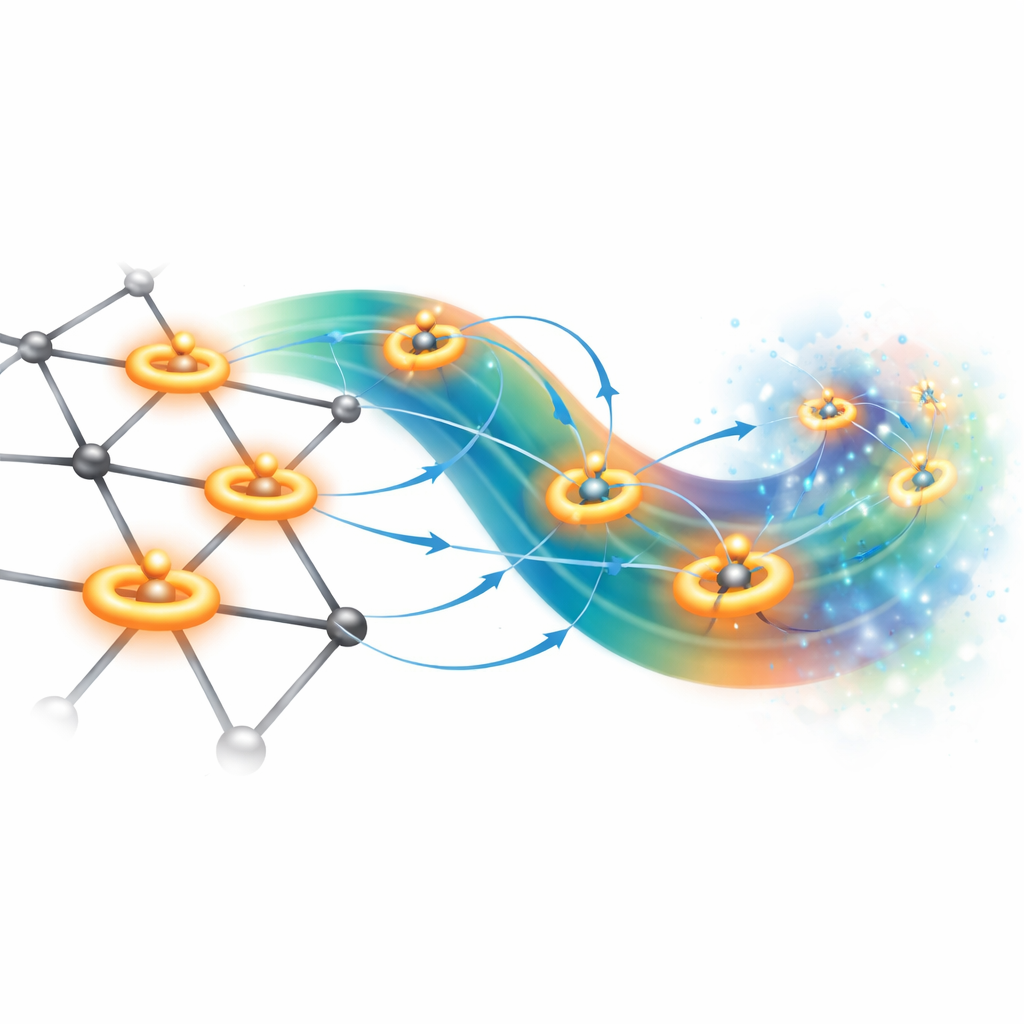
Strange metallicity arises when these localized clusters do not simply sit still but strongly interact with more mobile electrons from other bands, including Dirac-like bands that form ring-shaped pockets in momentum space. The team tracked this interaction using quasiparticle interference patterns, ripples in the electronic density created when electrons scatter from tiny imperfections. They found that scattering among the itinerant bands is strongly suppressed exactly at the energy of the flat band, but only in the temperature regime where the metal behaves strangely. At lower temperatures, when the system looks more like a conventional heavy Fermi liquid, this suppression disappears. This suggests that, in the strange-metal state, the electron-like quasiparticles themselves lose coherence across the entire Fermi surface because of intense fluctuations tied to the localized molecular orbitals.
Why This Matters for Future Quantum Materials
Taken together, the results reveal that Ni3In hosts an emergent set of local moments built not from traditional atomic f electrons, but from geometry-driven molecular orbitals in a d-electron kagome metal. These localized clusters couple to wider, more dispersive bands in a way that mirrors the classic heavy-fermion mechanism, placing Ni3In on an analogous phase diagram controlled by quantum fluctuations. This shows that very different microscopic building blocks—rare-earth atoms in one case, engineered flat bands in another—can lead to the same type of strange metallic behavior. The work suggests a general recipe: start with a flat, topological band in a carefully designed lattice, allow strong interactions to localize part of the electrons, and let them hybridize with more mobile states. Such systems may not only host strange metals but could also be fertile ground for exotic superconductivity and other unconventional quantum phases.
Citation: Souza, J.C., Haim, M., Gupta, A. et al. Origin of strange metallicity in a d-orbital kagome metal. Nat. Phys. 22, 541–549 (2026). https://doi.org/10.1038/s41567-026-03216-4
Keywords: strange metal, kagome lattice, flat band, heavy fermion, quantum criticality