Clear Sky Science · en
Cavity-enhanced spectroscopy in the deep cryogenic regime for quantum sensing and metrology
Listening to Atoms in the Cold
Many of the technologies we rely on—from GPS timing to climate monitoring—depend on knowing physical quantities like temperature and pressure with extreme precision. This article describes a new instrument that listens to the faint fingerprints of hydrogen molecules using laser light inside an ultra-cold chamber. By cooling both the gas and the surrounding optics to just a few degrees above absolute zero, the researchers show how to make cleaner, sharper measurements that test quantum theory and redefine how key measurement units can be realized.
A Light Trap in a Deep Freeze
At the heart of the work is a device called a high-finesse optical cavity, essentially a pair of very good mirrors facing each other so that light bounces back and forth many thousands of times. The team has built a version of this cavity that operates at about 4 kelvin, far colder than liquid nitrogen and similar to deep space. Unusually, not only the hydrogen gas but the entire cavity—mirrors, spacer, actuators, and vacuum chamber—is cooled uniformly. Heavy copper blocks, thermal shields at intermediate temperatures, and flexible links isolate the cavity from vibrations and temperature fluctuations coming from the cryocooler and the outside lab. This design keeps the gas at nearly perfect thermal equilibrium, so its behavior can be read from the light with very little distortion. 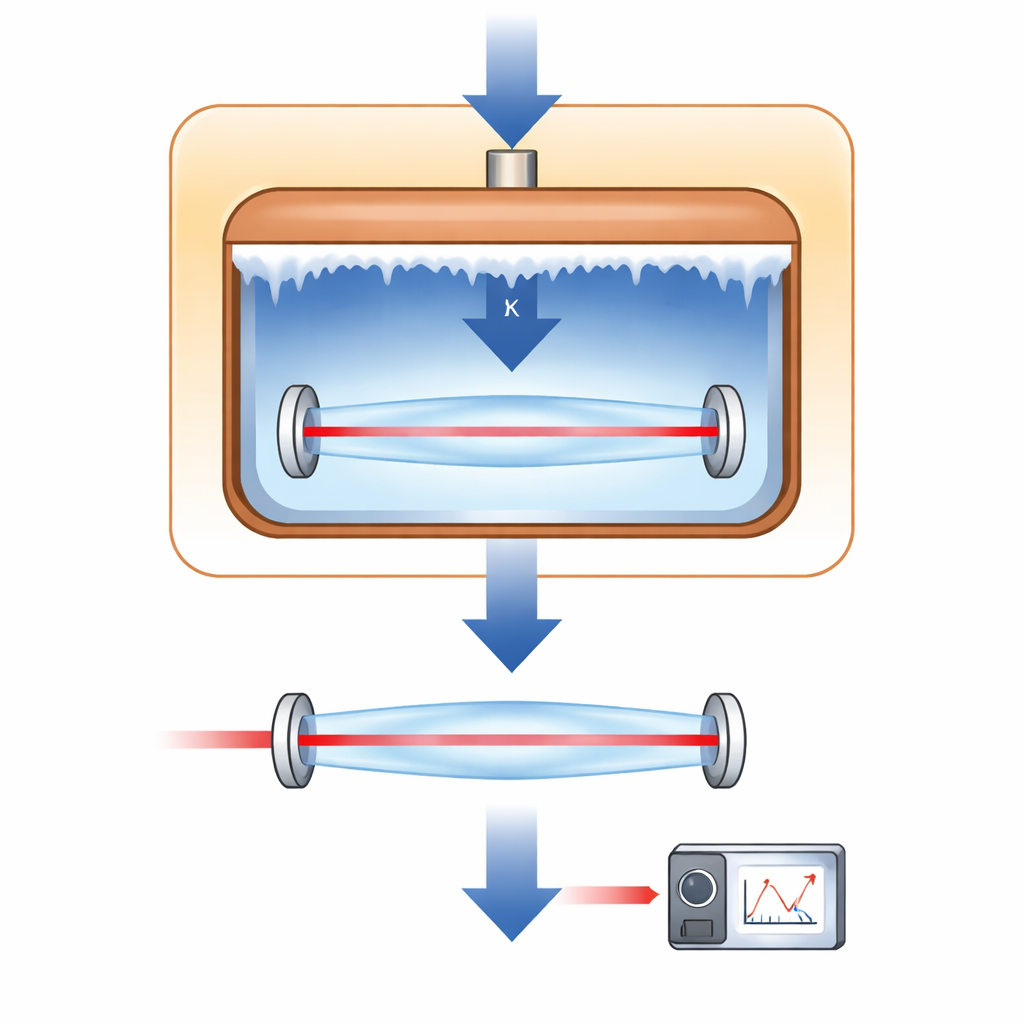
Sharper Lines from Colder Molecules
When laser light passes through hydrogen in the cavity, specific colors are absorbed according to the molecule’s internal motions. At room temperature, thermal motion smears these absorption lines into broad features. At 7.8 kelvin, the molecules move more slowly and all settle into the lowest rotational state, which makes the observed line over six times narrower and almost fifty times taller than at room temperature. Using a specially designed laser system in the infrared, the authors measure a particular transition of hydrogen with a precision that surpasses previous experiments by three orders of magnitude. Their result agrees with state-of-the-art quantum calculations to about one part in ten billion, providing one of the strictest checks yet of quantum electrodynamics for a four-particle system.
Turning Light into Temperature, Density, and Pressure
The same spectra also act as a kind of optical ruler for basic measurement units. The width of the absorption line is controlled by the random motion of the molecules and therefore by the temperature. Because the relationship between thermal motion and line width is known from fundamental constants, measuring this width directly yields the gas temperature without needing a conventional thermometer. Likewise, the total area under the absorption line reveals how many hydrogen molecules occupy the cavity. By combining these two optical measurements with the equation of state for a dilute gas, the researchers obtain pressure as well. In the challenging range from about 5 to 8 kelvin, they achieve uncertainties far better than previous data, effectively realizing primary standards of kelvin, mole-per-cubic-meter, and pascal using only light and universal constants.
Mapping Hydrogen’s Phases and Tracking Spin Twins
Armed with optically determined temperature, density, and pressure, the team traces a portion of the phase diagram of hydrogen—showing where it is a gas, liquid, or solid—over more than three orders of magnitude in pressure. Their results substantially refine older measurements in the same low-temperature region and set the stage for a purely optical determination of hydrogen’s triple point, a key reference used to calibrate cryogenic sensors. The instrument also tracks the slow conversion between hydrogen’s two nuclear spin forms, called ortho and para, as the gas sits on copper surfaces inside the chamber. By monitoring how the absorption signal evolves over days, they extract a conversion time of about 32 hours, information that matters for hydrogen storage technologies and for understanding processes in space and on cold surfaces.
New Avenues for Ultra-Precise Sensing
By proving that a high-performance optical cavity can operate reliably at deep-cryogenic temperatures with a fully thermalized gas, the authors open a new frontier for precision measurements. Future upgrades, such as faster scanning methods and purely frequency-based techniques, should further sharpen the spectra and extend the range of conditions that can be explored. Beyond simple hydrogen, the platform promises to tackle weakly bound molecular complexes, cold large molecules relevant for chemistry and astrophysics, and delicate collision effects that only appear at very low energies. In everyday terms, this work shows how carefully controlled cold and light can redefine some of our most basic measurement tools while simultaneously stress-testing the foundations of quantum theory. 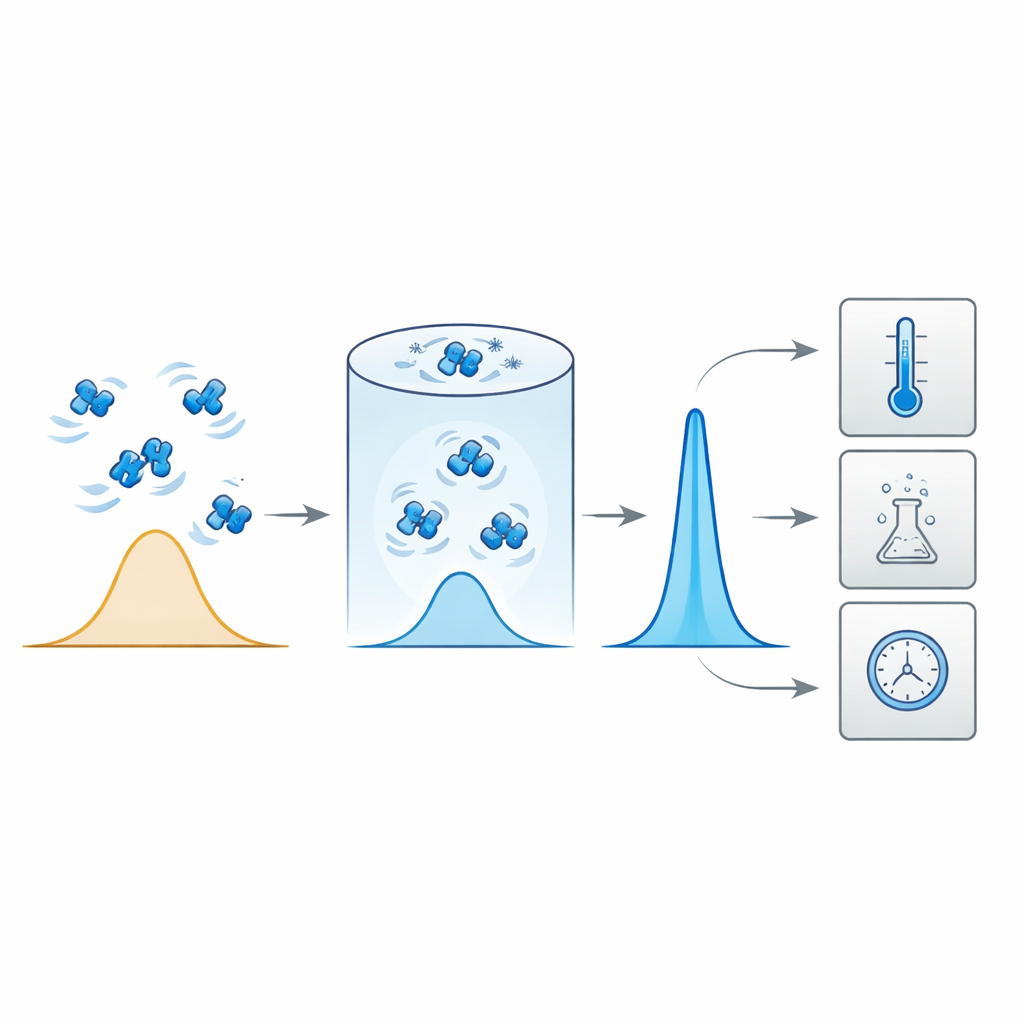
Citation: Stankiewicz, K., Makowski, M., Słowiński, M. et al. Cavity-enhanced spectroscopy in the deep cryogenic regime for quantum sensing and metrology. Nat. Phys. 22, 637–643 (2026). https://doi.org/10.1038/s41567-026-03204-8
Keywords: cryogenic spectroscopy, optical cavity, molecular hydrogen, quantum metrology, SI unit standards