Clear Sky Science · en
Asymptotic quantification of entanglement with a single copy
Why caring about hidden quantum links matters
Quantum entanglement—mysterious connections between particles—is the fuel behind future technologies such as ultra-secure communication and powerful quantum computers. But there is a practical roadblock: not only is entanglement fragile and noisy in the lab, it is also extremely hard to quantify in a way that tells engineers how well their devices will perform. This paper shows that two seemingly different tasks—checking whether entanglement is really present and cleaning it up for use—are in fact governed by the same simple number that can be computed from just a single sample of the state.
Two big jobs: checking and cleaning
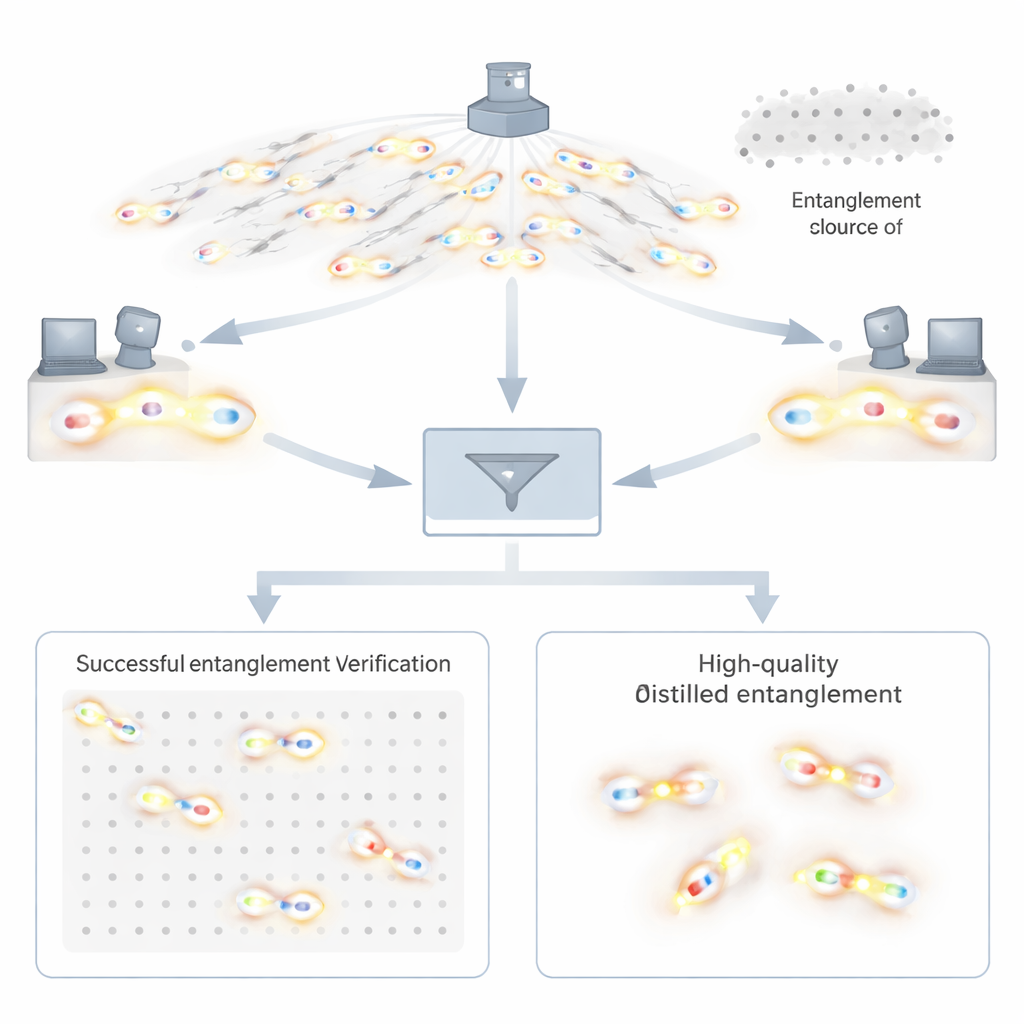
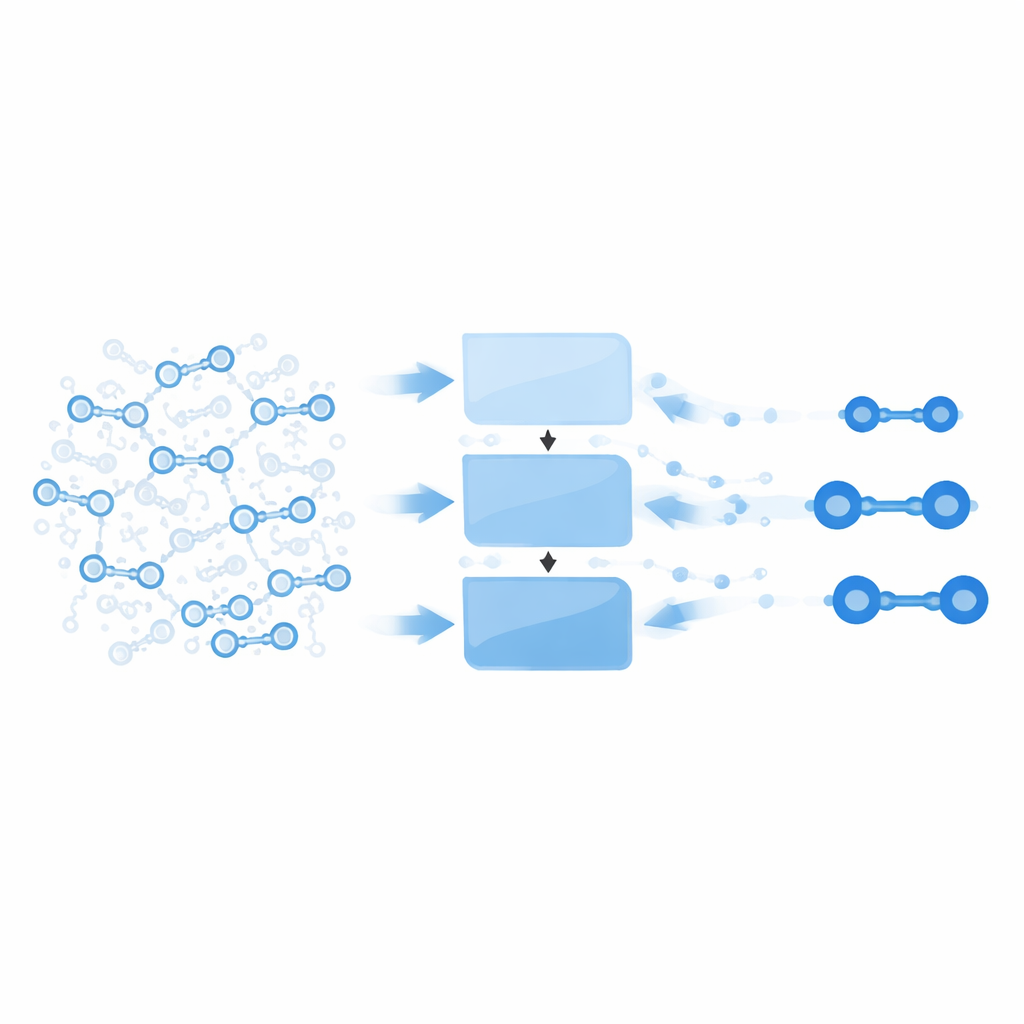
When experimentalists build a source that is supposed to create entangled particles for two users, often called Alice and Bob, they need to know if the device is actually doing its job. Entanglement testing is the task of deciding, from many uses of the device, whether it is producing a specific entangled state or only ordinary, unentangled states. Any test can make two kinds of mistakes: declaring the source faulty when it works, or declaring it working when it fails. Meanwhile, a second key task, entanglement distillation, tries to turn many copies of a noisy, imperfectly entangled state into fewer copies of a very clean, maximally entangled one that can serve as a high-grade resource for quantum communication and computation.
From counting copies to tracking errors
Traditionally, researchers judged distillation protocols by how many high-quality entangled pairs they could extract per noisy input pair in the limit of infinitely many copies. This “yield” point of view leads almost inevitably to complicated formulas that depend on what happens as you use more and more copies at once. In most cases, those formulas are so hard to evaluate that they are of little practical use. The authors propose a shift in perspective: instead of asking “how many good pairs do we get per input?” they ask “how fast can we make the chance of failure drop as we use more inputs?” In other words, the central figure of merit becomes the error exponent—the rate at which the probability that the protocol is wrong shrinks as more copies of the state are processed.
A surprising equivalence between testing and distilling
To make this new viewpoint precise, the authors work in a flexible mathematical framework where the allowed operations may never create entanglement from unentangled states. Within this setting, they prove that the error exponent for entanglement distillation is exactly the same as the error exponent for a particular kind of entanglement test: the rate at which the probability of wrongly rejecting a genuinely entangled source can be forced to decay, while keeping the opposite error small. This result ties together a process that produces high-quality entanglement with one that merely detects it. By unifying these two tasks, the problem of benchmarking distillation becomes an instance of a more general question in information theory about how well we can distinguish different sources from many repeated uses.
A single-copy quantity that controls asymptotic behavior
The heart of the paper is a new "generalized quantum Sanov’s theorem"—named after a classic result in statistics about rare events—that solves this discrimination problem even when one of the possibilities is not a single state but the entire set of all unentangled states. The authors show that the optimal error exponent is given by a quantity called the reverse relative entropy of entanglement. Despite its technical name, its key feature is simple: unlike most entanglement measures that describe performance in the many-copy limit, this one can be computed from just a single copy of the state. There is no need to take awkward limits over larger and larger collections of systems. Yet the same number still exactly captures how quickly testing and distillation can be made reliable when many copies are available.
What this means for real quantum devices
In practice, physical systems rarely allow perfect, zero-error extraction of entanglement; noise and imperfections are unavoidable. In this realistic regime, the reverse relative entropy becomes a well-behaved benchmark for noisy states that experimentalists can in principle compute or estimate. It tells them, in a single figure, how sharply they can make the odds of a wrong verdict or a faulty distilled pair fall as they scale up their experiments. More broadly, the work demonstrates that by focusing on how quickly errors vanish, instead of how much entanglement can be squeezed out in the ideal limit, one can obtain clean, single-letter characterizations of deeply asymptotic quantum processes. This insight opens a path to similarly simple benchmarks in other areas of quantum information where many-copy effects have so far obscured the fundamental limits.
Citation: Lami, L., Berta, M. & Regula, B. Asymptotic quantification of entanglement with a single copy. Nat. Phys. 22, 439–445 (2026). https://doi.org/10.1038/s41567-026-03182-x
Keywords: quantum entanglement, entanglement distillation, quantum hypothesis testing, quantum information theory, error exponents