Clear Sky Science · en
Topological Kondo insulator in MoTe2/WSe2 moiré bilayers
Electrons, Edges and a New Kind of Insulator
Modern electronics relies on materials that either conduct electricity or block it, but quantum physics allows stranger possibilities. In some exotic substances, the interior acts like an electrical brick while the outer rim behaves like a perfect wire. This article reports the first convincing evidence of such a state, called a two-dimensional topological Kondo insulator, engineered in an ultra-thin stack of semiconductors. Beyond its fundamental interest, this work showcases a highly tunable platform where researchers can dial in and study complex quantum phases that could one day underpin low-power electronics or fault-tolerant quantum devices.
Building a Quantum Playground from Two Sheets
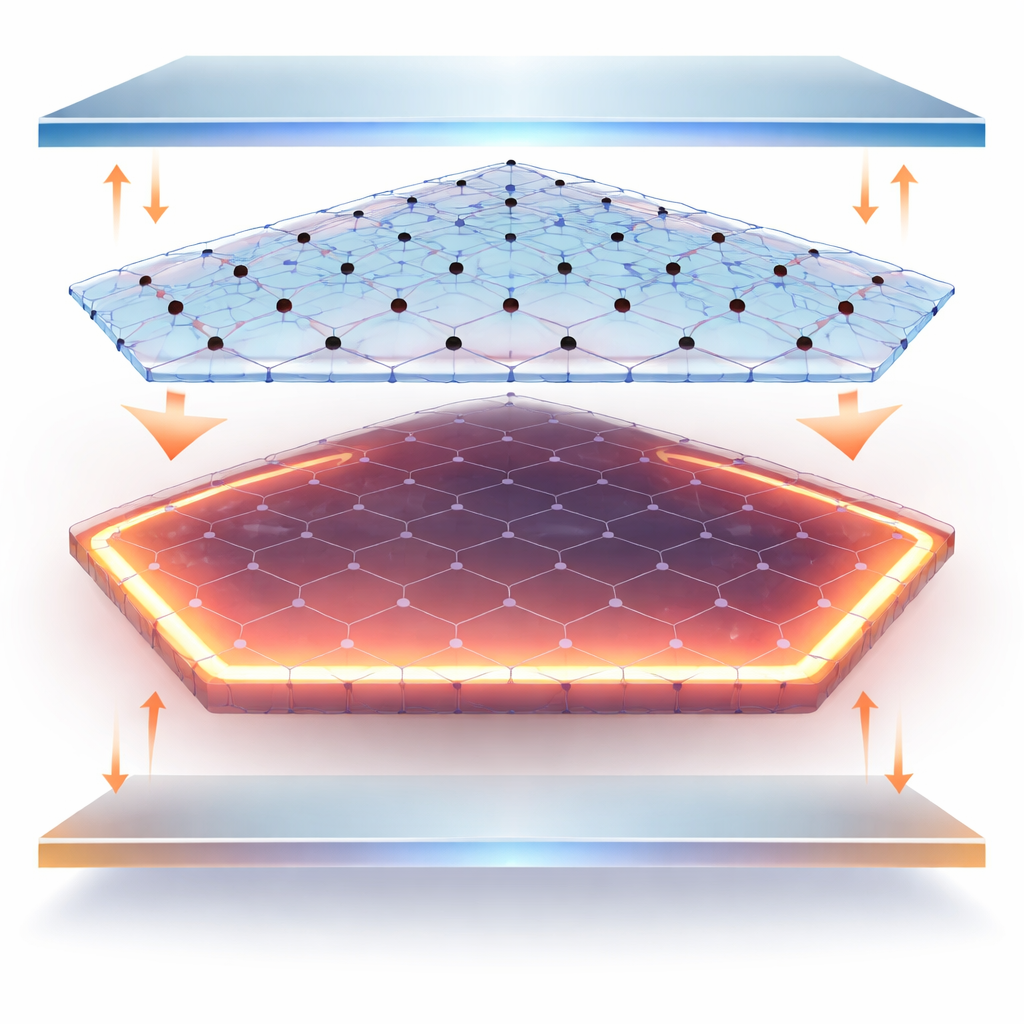
The authors construct their quantum material by stacking single-atom-thick layers of two different semiconductors, MoTe2 and WSe2, with their crystal axes carefully aligned. Because the two lattices do not quite match in spacing, a larger repeating pattern called a moiré superlattice emerges, with a period of about 5 nanometres. In this landscape, electrons in the MoTe2 layer become heavy and localized, acting like an ordered array of tiny magnetic moments, while electrons in the WSe2 layer remain lighter and mobile. By applying voltages to metal gates above and below the bilayer, the team independently controls the total number of charges and the electric field across the layers, effectively programming how strongly and in what pattern the two electronic species interact.
From Ordinary Insulator to Kondo Lattice
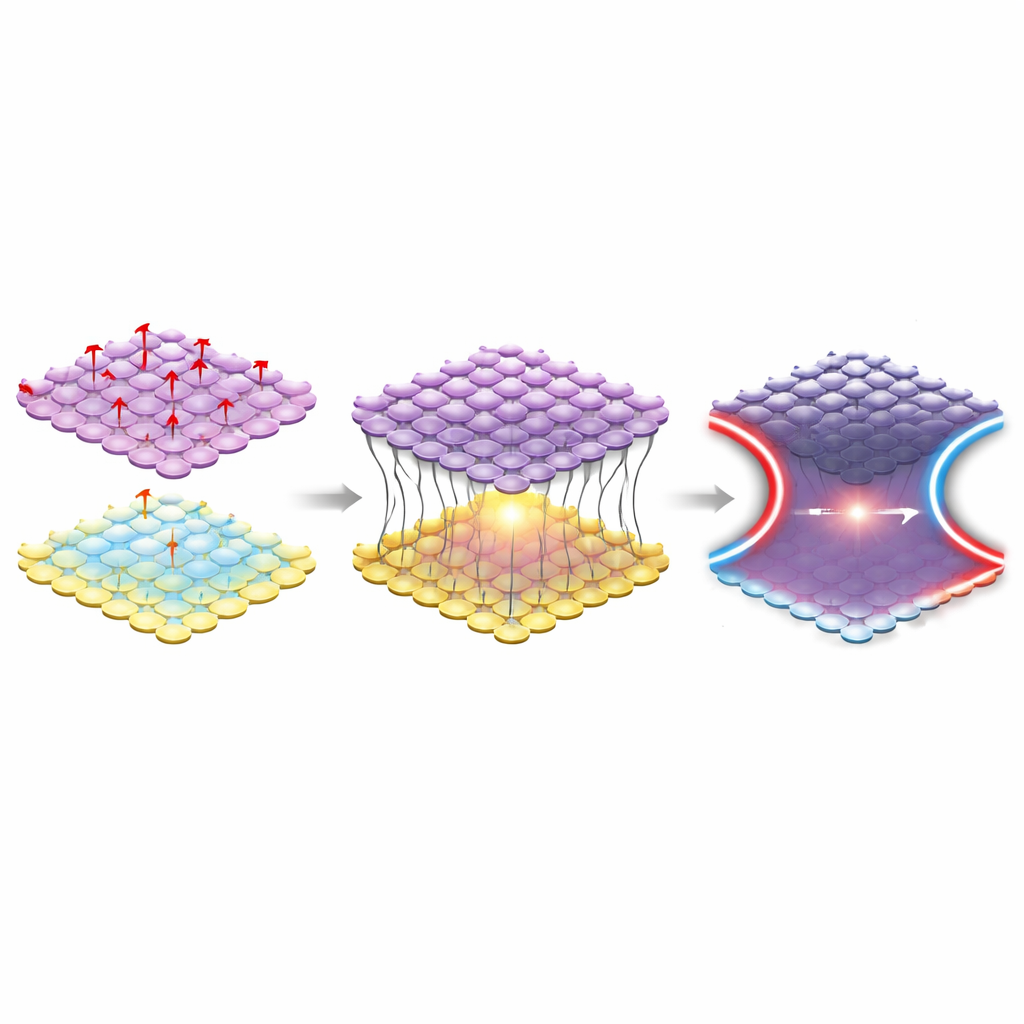
The central idea is to realize in this artificial crystal a long-studied theoretical model in which mobile electrons wander through a lattice of localized spins and can temporarily form bound pairs with them. When these "Kondo" pairings happen coherently across the lattice, the electronic band structure reshapes, opening an energy gap in the bulk. Earlier work on the same material system had already revealed heavy-electron behavior and several topological phases. Here, by pushing to higher electric fields and carefully chosen charge fillings, the researchers reach the special regime where each moiré site in MoTe2 is occupied by one localized hole, and the WSe2 band is close to half-filled. In this configuration, a chiral form of the interlayer coupling is expected to produce not just a conventional Kondo insulator, but a topological one with robust edge channels.
Probing the Hidden Interior and Busy Edges
To uncover the nature of the state, the team performs a battery of transport measurements in devices patterned into Hall-bar geometries. In a "local" setup, they monitor the usual longitudinal resistance as temperature and charge density are varied. At the target fillings, the resistance behaves like that of a metal at high temperature but rises sharply below about 20 kelvin, then saturates near a value known from theory for a single pair of edge channels—hinting that only the sample boundary conducts. A "bulk" geometry, designed to suppress edge contributions, instead shows resistance that climbs exponentially as the temperature is lowered, the hallmark of an insulating interior. Complementary compressibility measurements, using tiny capacitance changes to sense how easily extra charge can be added, reveal a clear gap of roughly 1 millielectronvolt, confirming that the bulk is gapped even though current can still flow.
Edges Protected by Spin and Destroyed by Field
True topological edge states should be robust yet vulnerable in very specific ways. The researchers therefore examine how their state responds to magnetic fields applied either perpendicular or parallel to the layers. They find that modest perpendicular fields leave the resistance largely unchanged until a high threshold, beyond which the localized moments and mobile holes become fully polarized and the special state collapses into a more ordinary metal. In contrast, even relatively small in-plane fields strongly increase the resistance, in both local and non-local measurements that are sensitive to edge paths. This directional sensitivity matches the expectation for "helical" edge channels whose opposite directions of motion are tied to opposite spin orientations; disturbing that spin locking with an in-plane field enables backscattering and ruins the near-quantized conductance.
A Switchable Landscape of Quantum Phases
By scanning the electric field and total filling, the authors map out a rich phase diagram around two holes per moiré cell. At lower fields the system behaves as an ordinary band insulator. Increasing the field first produces a different topological phase, a "mixed-valence" insulator with signs of strong one-dimensional interactions along the edges. Pushing the field further smoothly transforms this state into the Kondo-driven topological insulator without closing the bulk gap, indicating a continuous crossover between band-inversion and interaction-driven mechanisms. Taken together, the results show that MoTe2/WSe2 moiré bilayers provide a highly controllable platform where the balance of band structure, electron interactions and topology can be tuned like knobs on a quantum simulator. For non-specialists, the key message is that engineers can now sculpt atomically thin materials whose edges behave as nearly perfect, spin-protected highways for electrons while the interior remains stubbornly insulating, opening new routes for exploring and perhaps exploiting exotic quantum matter.
Citation: Han, Z., Xia, Y., Xia, Z. et al. Topological Kondo insulator in MoTe2/WSe2 moiré bilayers. Nat. Phys. 22, 396–401 (2026). https://doi.org/10.1038/s41567-026-03170-1
Keywords: topological Kondo insulator, moiré bilayers, quantum spin Hall edge states, strongly correlated electrons, transition metal dichalcogenides