Clear Sky Science · en
Discontinuous transition to shear flow turbulence
Why sudden turbulence matters
From airplane wings to oil pipelines and fusion reactors, our technology quietly relies on how smoothly fluids flow. Engineers usually assume that the change from calm, orderly motion to churning turbulence happens gradually, giving room to design around it. This study overturns that comforting picture for a broad class of flows. It shows that when background forces such as curvature, heating or magnetic fields are present, the switch to turbulence can become abrupt—more like flicking a light switch than turning a dimmer knob—with big implications for safety, energy use and heat transfer.
Two familiar ways that flow turns wild
Traditionally, physicists have recognized two main routes from smooth to turbulent flow. In many situations where a body force drives the motion—say, in heated fluids that rise because they are lighter, or in rotating systems—instabilities appear one after another. The strength of the resulting motion grows smoothly as the driving is increased, in what is called a supercritical transition. In contrast, simple shear flows, such as water through a straight pipe or air over a flat plate, can become turbulent even though the basic smooth state is linearly stable. There, turbulence first appears as isolated turbulent patches embedded in otherwise calm flow. As the flow speed rises, these patches spread and merge until the entire domain is turbulent. Because the fraction of the flow that is turbulent grows continuously, this "subcritical" route has also been treated as a continuous transition, despite the jump in local intensity between calm and chaotic regions.
When background forces erase mixed states
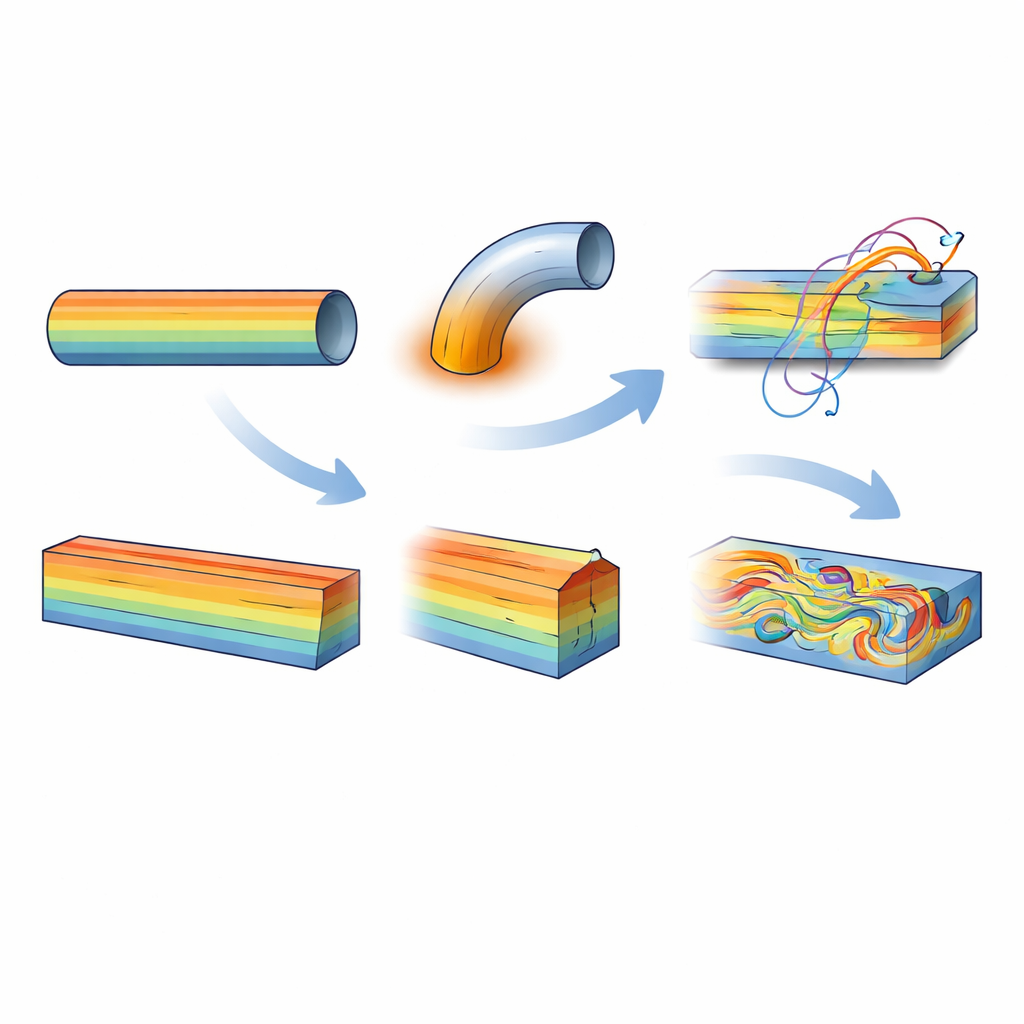
Real-world flows rarely fit neatly into one category: shear is almost always accompanied by additional forces—from pipe bends, heating or electromagnetic fields. The authors explored what happens in this more realistic setting, starting with two cases where a linear instability would eventually appear at very strong forcing, but where they stayed below that threshold. In experiments with a long helical pipe, curvature creates a centrifugal effect, and in simulations of a vertical pipe heated from the wall, buoyancy adds an upward push to the near-wall fluid. In both systems the team initialized fully turbulent flow and asked how much of the pipe remained turbulent as they changed the flow speed and observed farther downstream or at later times. Instead of a broad region where calm and turbulent segments coexist, they found that this mixed regime shrank dramatically. In heated pipes, once the system had time to settle, flows were either almost fully turbulent or completely calm, with no sustained intermediate mixtures—evidence for a discontinuous jump.
Cutting the energy lifeline of turbulence
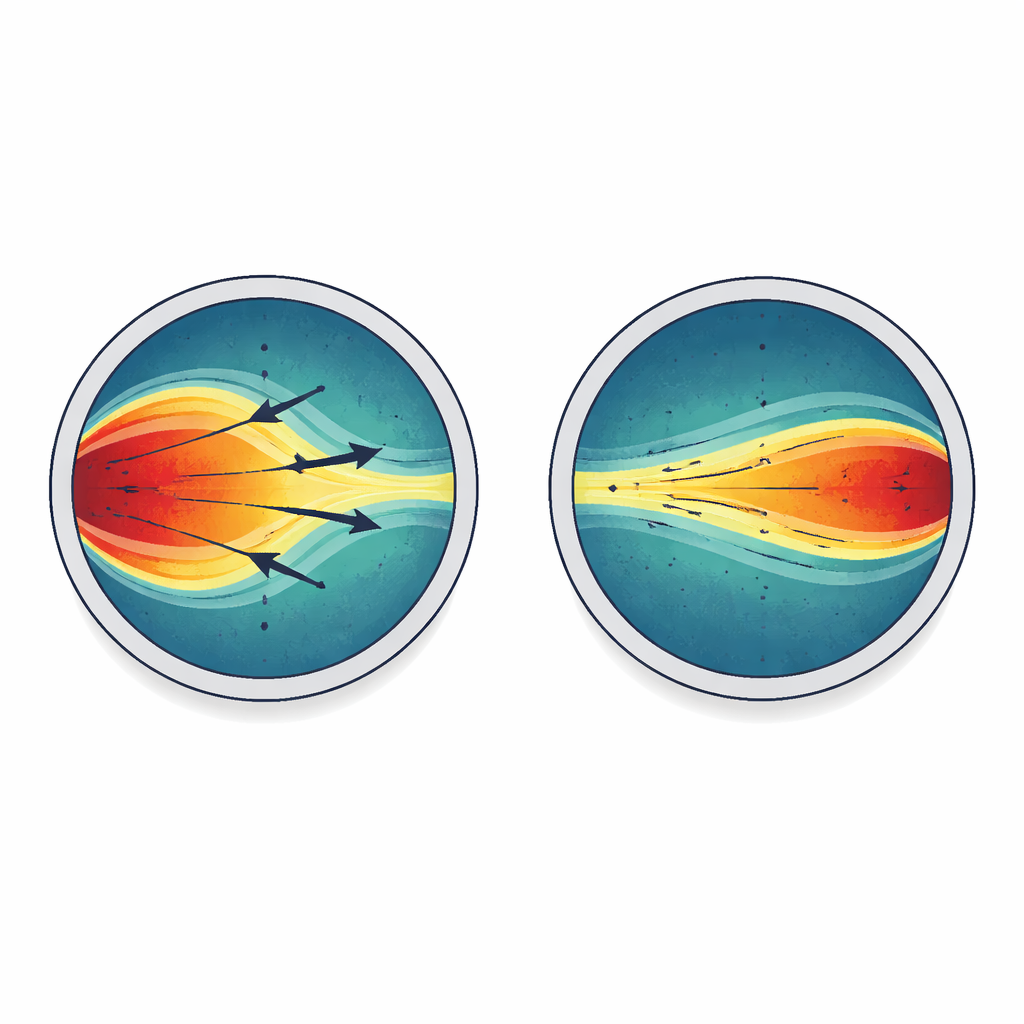
To understand why coexistence disappears, the researchers examined how much energy can flow from calm regions into turbulent ones, which is essential for keeping localized turbulent patches alive. In a straight, unforced pipe, the average speed profile of calm flow is sharply peaked in the center, while the turbulent profile is flatter. That mismatch allows energetic fluid from the calm upstream region to feed the turbulent patch at its leading edge. When body forces are added, however, they reshape both calm and turbulent profiles in similar ways. In curved and heated pipes, as well as in two designed "plug" and "parabolic" forcing schemes and in a magnetically driven channel flow, the difference between the two profiles shrinks. Direct calculations of the kinetic energy flux across the interface show that this transfer is strongly reduced—and can even reverse, with energy leaking from turbulence back into the calm region. Without a steady energy supply, isolated turbulent structures can no longer survive, and the mixed state characteristic of the classic shear-flow transition disappears.
A sharp switch with memory and metastable states
Comparing all the different types of forcing, the team plotted how the turbulent fraction depends on a reduced measure of flow strength relative to its critical value. In an ordinary straight pipe, the coexistence region where both calm and turbulent segments are found spans a wide range: the turbulent fraction gradually increases from zero to one as the flow is driven harder. Under any of the added forces, this range collapses by more than an order of magnitude. In the cases of heating and plug forcing, the turbulent fraction jumps directly from a high value to zero, signalling a discontinuous transition. Under parabolic forcing, the switch becomes extremely sharp and displays hysteresis: if the system starts out fully turbulent and the drive is slowly reduced, turbulence can persist below the point where it would ordinarily die out, forming a metastable state. A rare calm gap then acts like a seed crystal, expanding until it replaces the turbulent phase entirely. Similar behavior appears in the magnetically influenced channel, suggesting that the phenomenon is not tied to pipes alone.
What this means for flows we rely on
By systematically altering how background forces reshape the flow, this work shows that the familiar, gradual onset of turbulence in shear flows is not universal. It depends crucially on the presence of long-lived mixed states sustained by energy transfer between calm and turbulent regions. When that energy exchange is suppressed, the system reverts to the more fundamental expectation from nonlinear physics: a subcritical transition that is genuinely discontinuous. For applications ranging from cooling systems and chemical reactors to geophysical and astrophysical flows involving rotation, buoyancy or magnetic fields, this means the operating point can sit perilously close to an abrupt switch between very different transport regimes. Recognizing and predicting such sharp transitions will be essential for designing robust, efficient systems in which turbulence is either harnessed or held at bay.
Citation: Yang, B., Zhuang, Y., Yalnız, G. et al. Discontinuous transition to shear flow turbulence. Nat. Phys. 22, 424–429 (2026). https://doi.org/10.1038/s41567-025-03166-3
Keywords: turbulence transition, pipe flow, body forces, laminar-turbulent coexistence, magnetohydrodynamics