Clear Sky Science · en
Sensing with discrete time crystals
Listening to Tiny Magnetic Whispers in Time
Our everyday electronics—from smartphones to brain scanners—depend on devices that can detect faint magnetic fields. But some of the most interesting signals in nature, such as those from living tissue or exotic materials, fluctuate at awkward, hard-to-measure audio-like frequencies. This paper shows how a strange new phase of matter, a “discrete time crystal,” can be turned into an exceptionally sharp magnetic field sensor that listens for these faint whispers in a very narrow band of frequencies, all while remaining surprisingly robust to noise and imperfections.
A New Kind of Order That Ticks Like a Clock
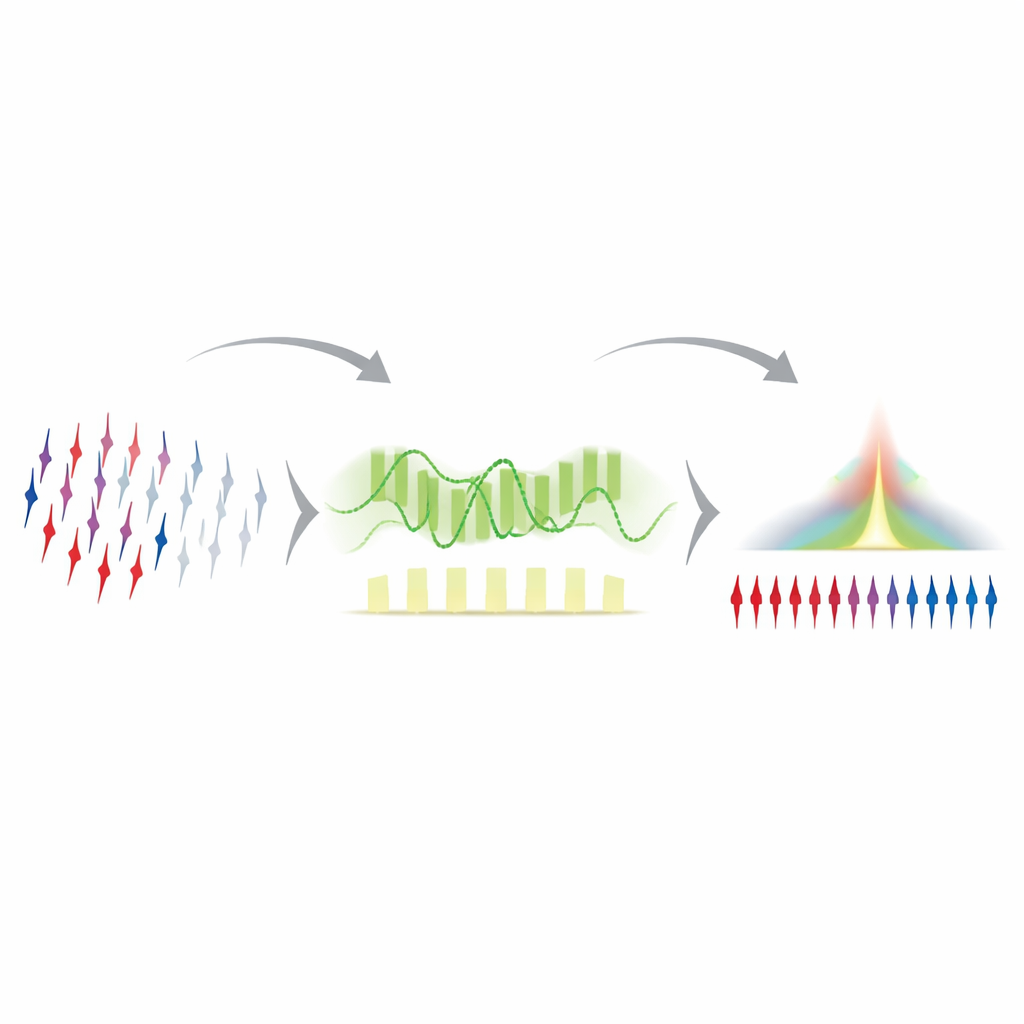
Ordinary crystals have atoms arranged in repeating patterns in space. Discrete time crystals are different: they show patterns that repeat in time. When a collection of quantum spins is driven periodically, its magnetization can begin to rhythmically flip back and forth at a rate that is a simple fraction of the driving rhythm—effectively “breaking” the uniform flow of time set by the drive. In this work, the authors use carbon-13 nuclear spins inside a diamond, strongly interacting with one another, and subject them to a carefully timed sequence of radio-frequency pulses. This produces a so-called prethermal discrete time crystal, whose orderly flipping can persist far longer than the spins’ usual decay time, even though the system is being strongly driven and is out of equilibrium.
Turning Time Order into a Magnetic Sensor
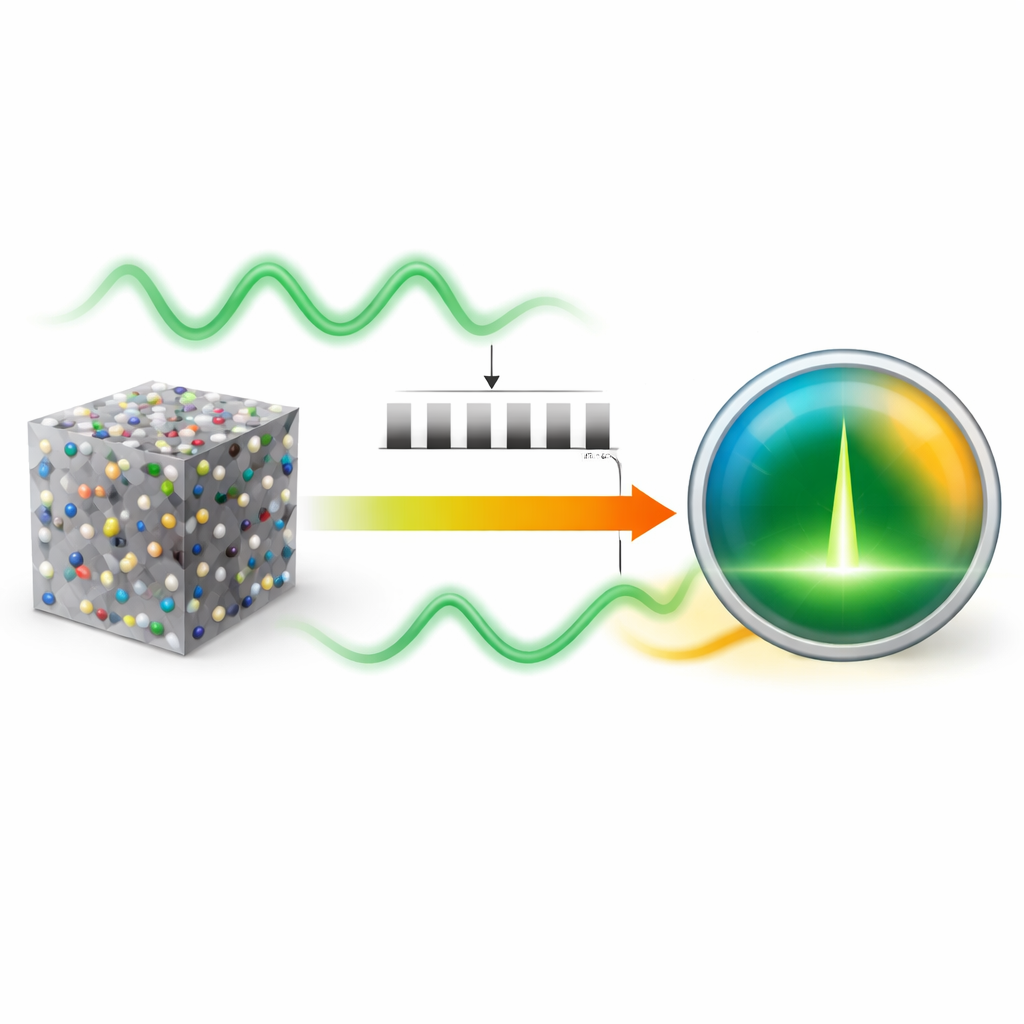
The central idea is to use this time-crystal order as the heart of a sensor for oscillating (a.c.) magnetic fields. The spins are first hyperpolarized using defects in the diamond, giving them a strong initial alignment. A two-part pulse sequence then forces their collective magnetization to switch direction every other cycle, establishing a regular temporal pattern. The authors show that when they apply an additional weak oscillating magnetic field at exactly the right frequency—matched to the time crystal’s internal rhythm—that field dramatically stabilizes the oscillations. The lifetime of the ordered flipping can increase by more than a thousand-fold, from a fraction of a second to tens of seconds, limited only by how long the time crystal itself can survive. This lifetime extension becomes the basic “signal” used for sensing.
A Razor-Sharp Ear for Specific Frequencies
Because the stabilizing effect is highly frequency selective, the time-crystal sensor responds strongly only when the external field oscillates at just the right rate. By sweeping the test field’s frequency, the researchers map out a very narrow resonance peak: the sensor’s response jumps sharply within a band as narrow as about 70 millihertz. This linewidth is set not by the usual clutter of spin–spin interactions, but directly by how long the time crystal can maintain order. In other words, interactions that usually limit sensor performance are here turned into an asset that pins down the resonance. The team also finds that the method is robust: small errors in the control pulses or variations across the sample barely affect the width of the resonance, which is crucial for realistic devices.
From Single Tones to Multi-Tone Detection
Beyond the basic scheme, the authors demonstrate that the same principle works in different flavors of time crystals and can be engineered for richer sensing tasks. They show lifetime extension in a simpler, single-axis time crystal that flips spins along one direction, though this version requires restarting the experiment for each data point. They also design a “three-tone” pulse sequence that creates two distinct resonance frequencies in the same system, enabling the sensor to pick out two separate oscillating fields at once. Across these variations, the unifying mechanism is that the added oscillating field effectively shifts the energy of the ordered state, pushing the system into a long-lived prethermal regime where the temporal pattern persists much longer than it otherwise would.
Why This Matters for Future Technology
To a non-specialist, the takeaway is that the authors have built a new kind of magnetic field sensor that relies on an exotic state of matter in time rather than in space. By cleverly syncing an external oscillating field to the internal ticking of a discrete time crystal, they can dramatically extend how long the system remains ordered and, in doing so, create an ultra-narrow, highly selective frequency filter. This approach works in a frequency range that is challenging for many existing technologies and does not require fragile, highly entangled quantum states or perfectly tuned conditions. Because the underlying ingredients—interacting spins and periodic driving—are available in many platforms, from solid-state devices to cold atoms and superconducting circuits, the concept opens a path toward robust, high-density quantum sensors that can zero in on specific time-varying signals with unprecedented precision.
Citation: Moon, L.J.I., Schindler, P.M., Smith, R.J. et al. Sensing with discrete time crystals. Nat. Phys. 22, 367–373 (2026). https://doi.org/10.1038/s41567-025-03163-6
Keywords: discrete time crystals, quantum sensing, magnetometry, nuclear spins in diamond, Floquet engineering