Clear Sky Science · en
Suppression and enhancement of bosonic stimulation by atomic interactions
Why shining light on cold atoms matters
When we cool atoms to billionths of a degree above absolute zero, they stop behaving like individual particles and start acting in unison, revealing the strange rules of quantum mechanics on a visible scale. One of those rules says that identical particles called bosons like to “bunch” together, which can boost how strongly they scatter light. This article shows that even very weak forces between such atoms can dramatically change how much light they scatter, turning this simple act of shining a laser into a highly sensitive window on the hidden internal correlations of quantum matter.
How bosons like to move together
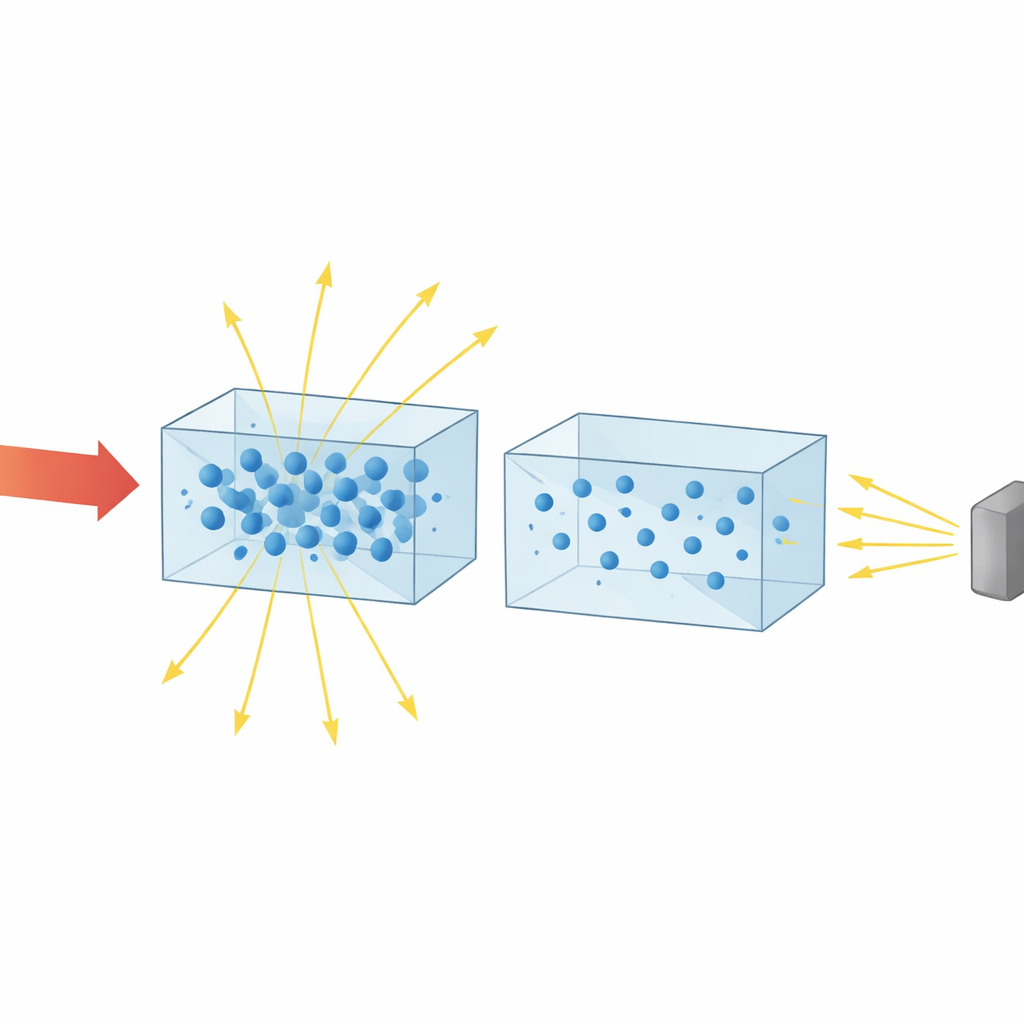
In everyday gases, shining a dim, slightly off‑color laser simply produces a number of scattered photons proportional to how many atoms are in the beam. But in an ultracold bosonic gas near the point where it would form a Bose–Einstein condensate, the quantum statistics of the atoms become important. Bosons tend to occupy the same states and to appear together, a behavior known as bunching. This makes it more likely for an atom to scatter light into a momentum state that is already occupied, enhancing the scattering rate. Traditional textbook arguments describe this enhancement entirely in terms of how many atoms populate each allowed momentum state, without paying attention to exactly how atoms are arranged relative to one another in space.
Switching on interactions in a uniform quantum gas
The researchers created a nearly uniform gas of potassium‑39 atoms confined in an optical “box” of laser light, with densities and temperatures close to the threshold for condensation. A key feature of this system is that the strength of short‑range interactions between atoms can be tuned using magnetic fields, without significantly disturbing the overall momentum distribution. They illuminated the gas with an off‑resonant laser and counted photons scattered at a fixed angle, ensuring that the probing was gentle enough not to reorganize the atoms. By comparing the observed scattering rate to that of a very dilute gas, they defined an enhancement factor that directly reflects how much bosonic bunching is present in the illuminated volume.
When weak forces undo quantum bunching
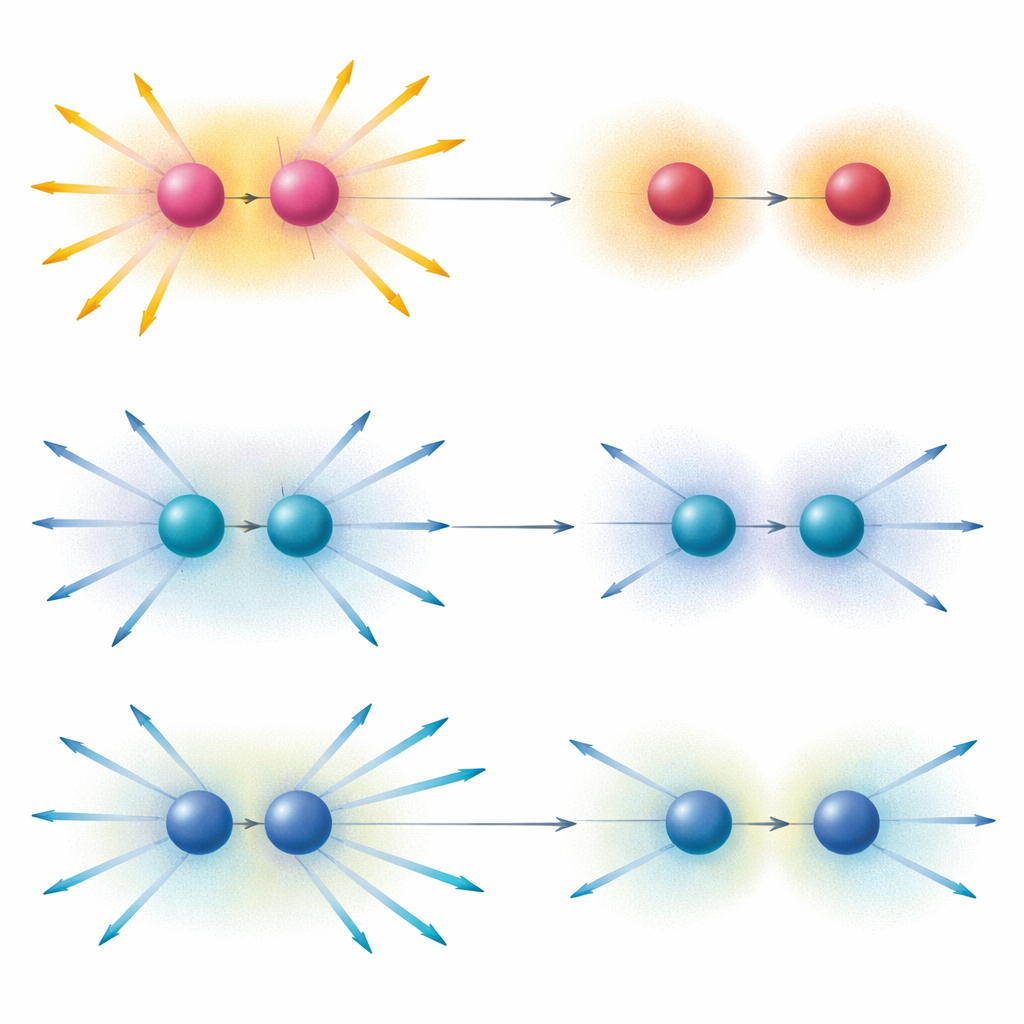
For an almost ideal gas, with interactions so small that they can be neglected, the enhancement factor increased as the gas was cooled and as the density rose, in line with standard expectations based on bosons piling into the same momentum states. However, once the interaction strength was raised—still remaining weak compared with the spacing between atoms and the size of their quantum wave packets—the picture changed qualitatively. Repulsive interactions strongly reduced the enhancement, while attractive ones increased it above the ideal‑gas value. Strikingly, these changes occurred even though the overall momentum distribution and density profile barely moved. By rapidly changing the interaction strength using magnetic tuning or fast spin flips, the team saw the scattering signal adjust within tens of microseconds, much faster than the times required for collisions to reshuffle momentum states. This shows that the light is probing very local correlations: how likely atoms are to be found near one another at a given instant.
A closer look at the hidden structure
Theoretical calculations that go beyond simple mean‑field descriptions help to explain these observations. Instead of treating the gas as a smooth quantum field, the analysis includes how a short‑range interaction distorts the joint wavefunction of atom pairs. Even a small repulsive core slightly pushes atoms apart, reducing their spatial overlap and therefore the constructive interference of the light they scatter. This effectively reduces the bosonic “bonus factor” in the scattering rate in proportion to the ratio of the interaction range to the atoms’ thermal wavelength—a ratio that is tiny but multiplied by a large numerical factor, making the scattering exquisitely sensitive to interactions. The same framework predicts that attractive forces bring atoms closer together and increase local bunching, in agreement with the enhanced scattering seen experimentally when the interaction sign is flipped.
New window on fast quantum dynamics
Because the light‑scattering signal responds on the timescale set by local decorrelation—how quickly atoms move by roughly one scattering wavelength—it can track changes in the internal structure of the gas far faster than traditional measurements of momentum distributions. Near the point of Bose–Einstein condensation, the relaxation of these correlations slows down, hinting that this technique could probe critical behavior in unprecedented detail. The study demonstrates that off‑resonant light scattering is not just a way to count atoms, but a precision probe of second‑order correlations: subtle patterns in how atoms cluster or avoid each other in space and time. To a lay reader, the main message is that a gentle flash of light on an ultracold gas can reveal how even feeble forces between particles reshape their collective quantum behavior, offering a powerful tool for exploring everything from superfluids to turbulent quantum flows.
Citation: Konstantinou, K., Zhang, Y., Wong, P.H.C. et al. Suppression and enhancement of bosonic stimulation by atomic interactions. Nat. Phys. 22, 362–366 (2026). https://doi.org/10.1038/s41567-025-03155-6
Keywords: ultracold atoms, Bose Einstein condensation, light scattering, quantum correlations, bosonic stimulation