Clear Sky Science · en
Single-atomic-ion detection with plasmon-enhanced whispering-gallery-mode microlasers
A New Way to Hear the Smallest Signals
Many of the most important events in biology and chemistry happen one atom or one molecule at a time, but our tools usually average over billions of them. This article reports a laser-based sensor so sensitive it can register the fleeting presence of a single metal ion in water. By shrinking and enhancing light inside a tiny glass bead and listening to subtle changes in its own laser tone, the system opens a path toward watching chemistry unfold one particle at a time, even inside living tissue.
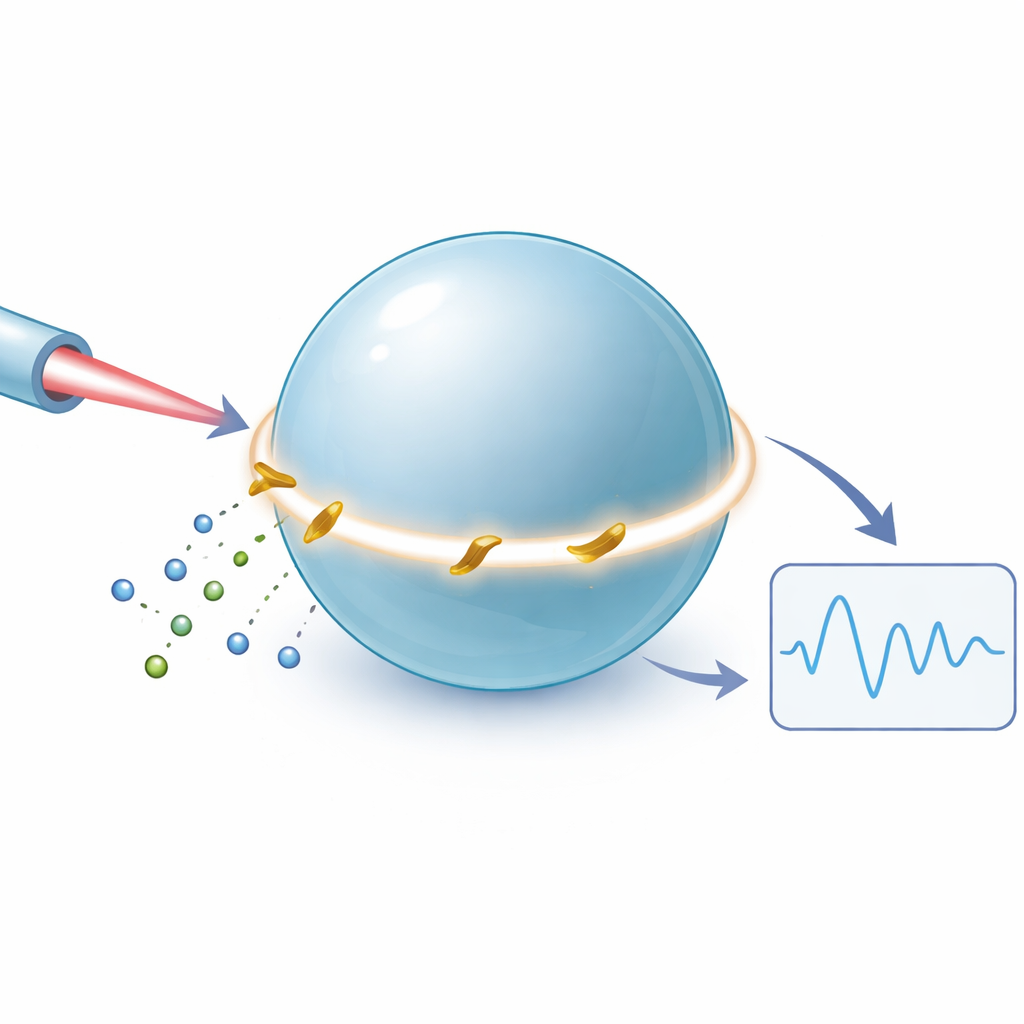
Light Whispering Around a Tiny Bead
The work builds on devices called whispering-gallery-mode microlasers. In these, light races around the edge of a microscopic glass sphere, much as sound whispers along a curved wall in a cathedral. When the surrounding environment changes, the color and frequency of the circulating light shift slightly. By doping the glass with ytterbium ions, the authors turn each sphere into a microlaser: once pumped with a separate laser beam, the sphere emits its own very pure light whose frequency is exquisitely sensitive to disturbances at its surface.
Gold Nanorods as Tiny Antennas
To boost this sensitivity far beyond previous limits, the researchers decorate the surface of the glass microsphere with gold nanorods—slender metal particles tens of nanometres long. When the circulating light brushes past a nanorod, it excites a collective motion of electrons in the metal, concentrating the electromagnetic field at the nanorod tips. This "hotspot" effect shrinks the effective volume of light by about a thousand-fold, so that a single small molecule or ion visiting the tip can noticeably tug on the light’s behavior. Although these metal structures slightly degrade the overall optical quality of the cavity, the enormous local amplification more than compensates.
Listening to a Beat Instead of Watching a Color
Rather than trying to track tiny color shifts directly, the team listens to the beat formed when two nearly identical light waves circulate in opposite directions inside the sphere. Gold nanorods cause these counter-rotating waves to couple and split into a pair of standing waves with slightly different frequencies. The interference between them produces a radio-frequency beatnote that can be measured with an electronic detector. When an ion or molecule touches a nanorod tip, it shifts the two standing waves by slightly different amounts, nudging the beatnote frequency up or down. Permanent attachments show up as step-like changes, while brief visits appear as sharp spikes. In practice, the system can resolve changes equivalent to wavelength shifts of only a few femtometres—roughly one hundred-thousandth of the diameter of a hydrogen atom.

Seeing Single Atoms Come and Go
The authors test their sensor on a neurotransmitter molecule (GABA) and on individual zinc (Zn²⁺) and cadmium (Cd²⁺) ions dissolved in water. For GABA, they observe a mix of lasting and transient events, reflecting different ways its charged groups interact with the gold surface. For the metal ions, most events are transient spikes: ions wander into the intense field near a nanorod tip, interact briefly, and then leave. Statistical analysis of thousands of spikes shows that their timing and frequency scale with ion concentration in a manner consistent with single-particle encounters. On average, a single zinc ion produces a smaller beatnote change than a cadmium ion, matching the greater ease with which cadmium’s electrons are distorted by the field. By comparing signals from multiple laser modes at once, the researchers can even infer how many nanorods are actively contributing to detection.
What This Breakthrough Means
In essence, the study demonstrates that a tiny glass laser enhanced with gold nanorods can register and time the visits of individual atomic ions in water. By concentrating light into nanoscale hotspots and reading out changes through a self-generated beatnote, the device sidesteps many sources of noise that have limited earlier sensors. The approach could be refined further and integrated onto chips, and the authors envision embedding such microlasers in living systems to track single molecules and proteins in real time. If realized, this technology would give scientists an unprecedented window into the fast, small-scale processes that underlie life and materials at their most basic level.
Citation: Vartabi Kashanian, S., Vollmer, F. Single-atomic-ion detection with plasmon-enhanced whispering-gallery-mode microlasers. Nat. Photon. 20, 404–412 (2026). https://doi.org/10.1038/s41566-026-01882-7
Keywords: single ion sensing, whispering gallery microlaser, plasmonic nanorods, label-free biosensing, nanophotonic sensors