Clear Sky Science · en
Experimental memory control in continuous-variable optical quantum reservoir computing
Teaching Light to Predict the Future
Many of today’s toughest problems, from weather forecasts to financial trends, boil down to spotting patterns in data that unfold over time. This article reports a way to harness quantum light as a kind of analog computer that “remembers” past signals and learns to predict what comes next. By carefully shaping laser pulses and measuring fragile quantum states of light, the researchers build a new kind of learning machine that could one day process data faster and more efficiently than conventional electronics.
From Neural Networks to Liquid-Like Brains
Modern machine learning often relies on deep neural networks that must be painstakingly trained by adjusting millions of internal connections. Reservoir computing offers a leaner route: instead of training the whole network, it lets a complex physical system respond to a stream of inputs and trains only a simple output layer to read those responses. The “reservoir” might be anything with rich internal dynamics and memory. In this work, the reservoir is made of light itself. The team extends reservoir computing into the quantum world, where light fields behave collectively in ways that can be both extremely sensitive and highly expressive, making them attractive for processing time-varying signals.
Building a Quantum Pool of Light
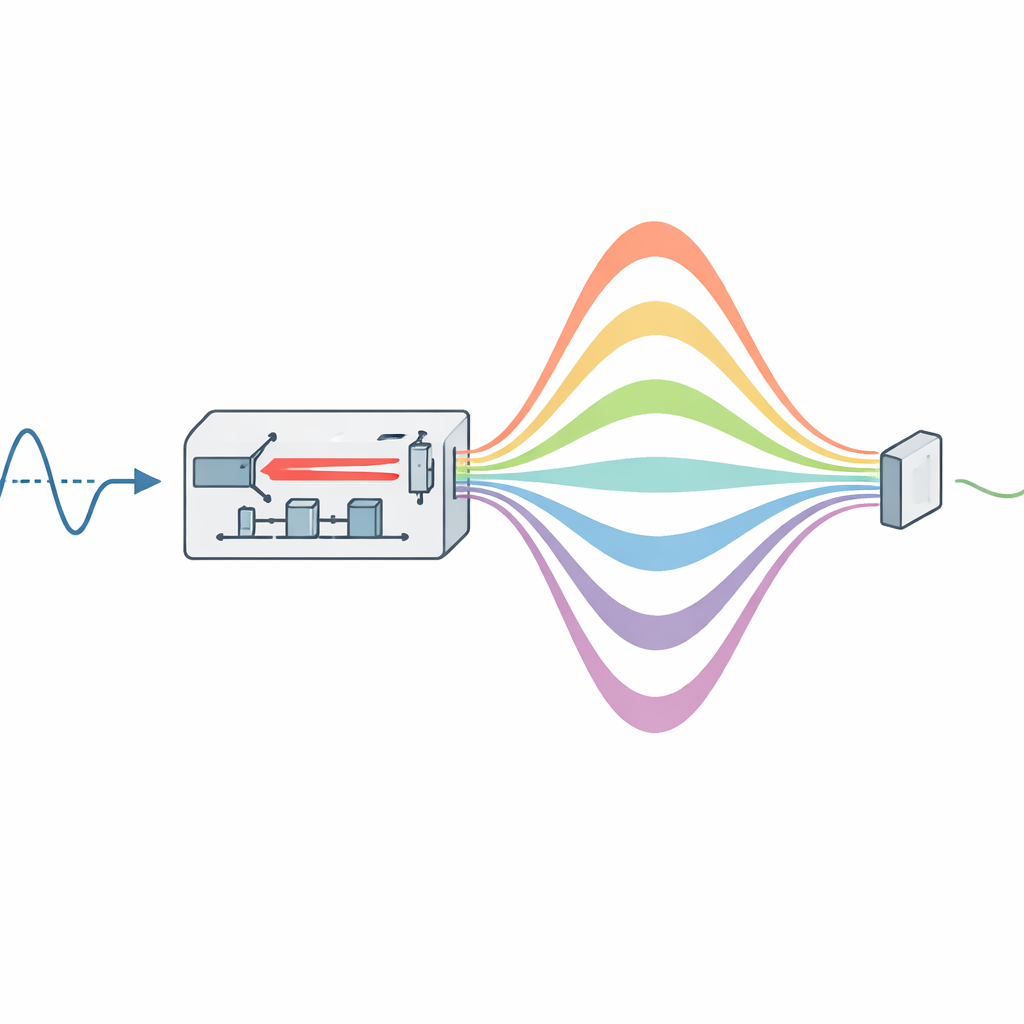
At the heart of the experiment is a laser that sends ultrashort pulses into a nonlinear crystal and waveguide. Inside, single pulses are converted into many tightly linked color and time components, forming a multimode “pool” of squeezed and entangled light. Each mode can be thought of as a node in a network, and quantum correlations act like connections between them. By shaping the spectrum and phase of the pump pulses that drive this process, the researchers can reconfigure how strongly the modes are linked. They then use a sensitive measurement technique, called homodyne detection, to read out selected combinations of these modes, effectively choosing how to view the network’s internal state.
Giving Light a Working Memory
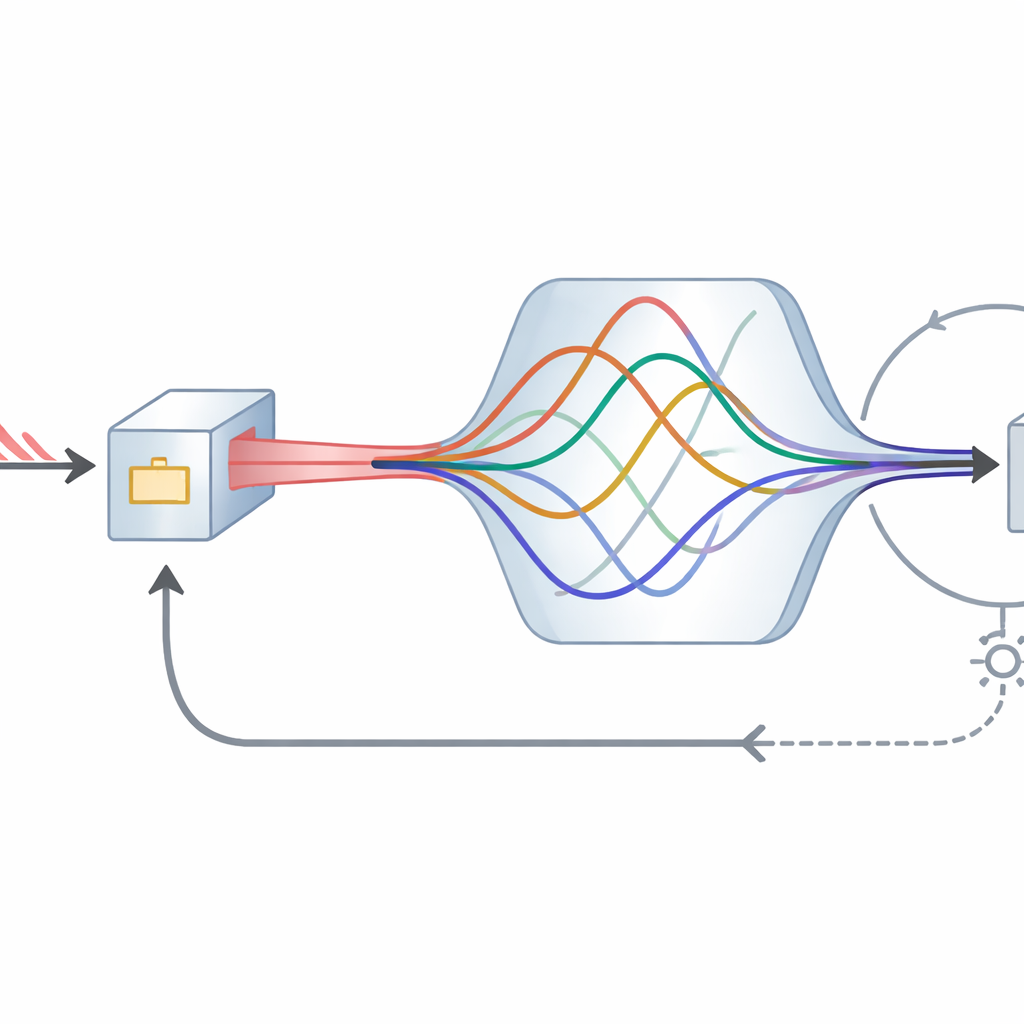
For a learning machine to handle time series, it must remember recent inputs while gradually forgetting the distant past. The team introduces controllable “fading memory” by feeding measurement results back into the optical setup in real time. An electro‑optic modulator adjusts the phase of each new pump pulse based on both the current input signal and the reservoir’s previous outputs. This feedback gently steers the quantum network without needing to rewire it. With only a few measured quantities of the light field, the system already shows a rich, nonlinear response to the phase control, which the authors map and faithfully reproduce with a detailed numerical “Digital Twin” of the experiment.
Putting the Quantum Reservoir to the Test
The researchers challenge their optical reservoir with a series of tasks that test nonlinearity and memory. In one benchmark, the system must output the exclusive‑or (XOR) of the current and previous bits in a random stream, a classic test that cannot be solved by a simple linear device. Using phase control and feedback, the reservoir reaches around 98 percent accuracy with only a modest amount of training data. They then ask it to recall inputs from several steps back and quantify how memory fades with delay, showing that performance improves when multiple copies of the reservoir are run in parallel. Pushing further, they simulate forecasting of chaotic signals, such as those generated by an electronic double‑scroll circuit, demonstrating that the quantum platform can track and predict intricate oscillations even in the presence of realistic noise.
Unlocking the Power of Many Modes
Beyond simple phase shifts, the team explores a more powerful control method: dividing the pump spectrum into several segments and independently tuning the phase of each. This “general encoding” allows different parts of the light field to carry slightly different versions of the same input, dramatically enriching the reservoir’s internal activity. As they increase the number of optical modes they measure, they see the system’s expressive power grow according to a favorable mathematical scaling law, meaning that each new mode contributes genuinely new information rather than redundant copies. With this richer encoding, the simulated reservoir can solve more demanding tasks, such as checking the parity of a sequence over longer delays and forecasting chaotic dynamics, without resorting to many separate physical copies.
Why This Matters for Future Quantum Machines
To a non‑specialist, the key message is that the authors have shown how to endow a quantum optical device with a tunable, working memory for streaming data, and how to control it using technology that operates at room temperature. Their platform already rivals more traditional learning systems on standard tests while using only inexpensive training of the final readout. Because it is built from components compatible with larger optical quantum computers, this approach offers a practical pathway toward machines where entangled light does double duty: performing both general‑purpose quantum logic and fast, on‑the‑fly analysis of time‑dependent signals.
Citation: Paparelle, I., Henaff, J., García-Beni, J. et al. Experimental memory control in continuous-variable optical quantum reservoir computing. Nat. Photon. 20, 413–420 (2026). https://doi.org/10.1038/s41566-026-01880-9
Keywords: quantum reservoir computing, photonic machine learning, time series forecasting, continuous variable quantum optics, neuromorphic photonics