Clear Sky Science · en
Ground-state exciton–polariton condensation via coherent Floquet driving
Guiding light with sound
Lasers and other light sources are the backbone of modern communication and sensing, but steering their behavior on ultrafast time scales is hard. This research shows how gentle ripples of sound at gigahertz frequencies can herd exotic light–matter particles inside a tiny chip so that they all gather in their lowest energy state and emit a regular train of sharp, ultrafast flashes of light. 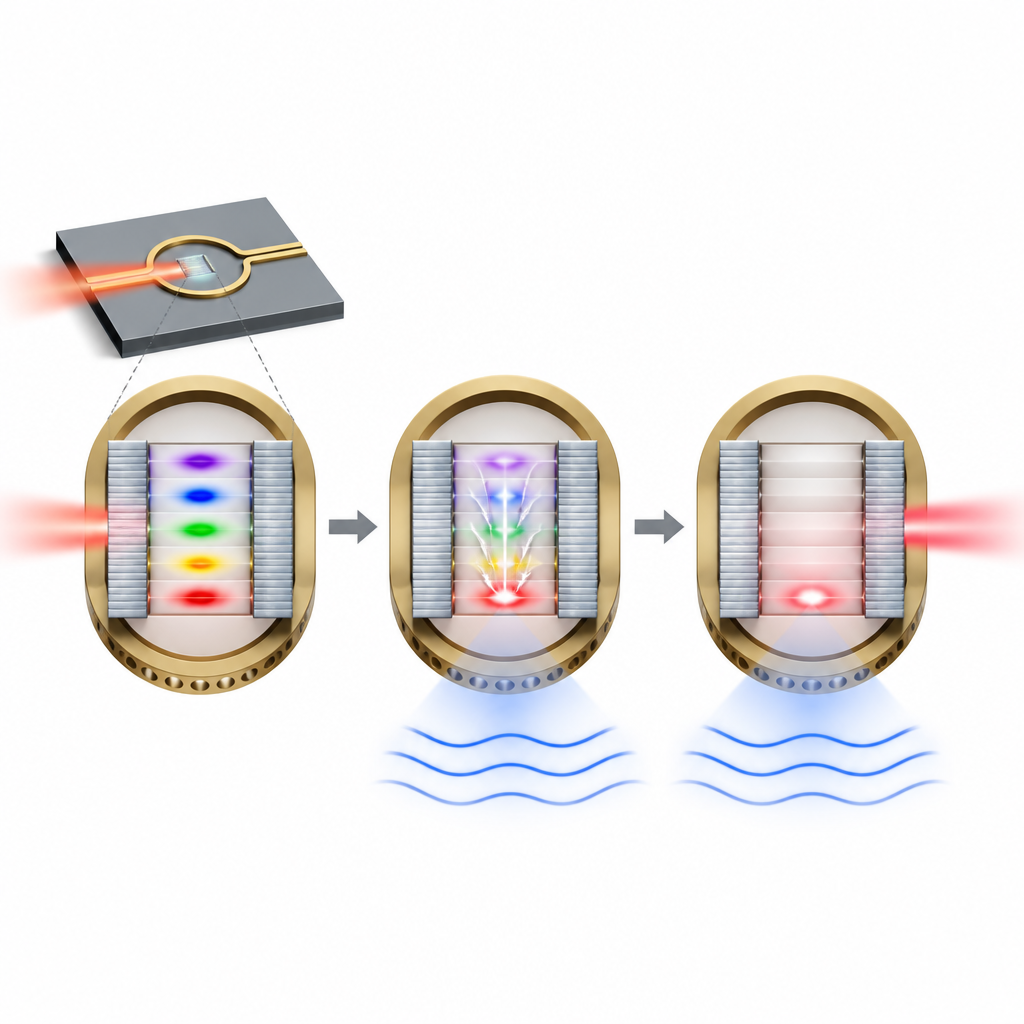
Light and matter share a tiny stage
Inside the studied device, light is trapped between highly reflective mirrors and strongly coupled to electrons in thin semiconductor layers known as quantum wells. This tight confinement makes new hybrid particles called polaritons, which behave partly like light and partly like matter. In such a trap, polaritons can form a condensate, where many particles share the same quantum state and act in unison, similar to atoms in a Bose–Einstein condensate. However, because the trap supports several confined levels, the condensate often spreads across multiple modes, producing a cluttered, multimode emission instead of a clean single color or frequency.
Using sound waves as a control knob
The authors add a new ingredient to this system: a bulk acoustic wave resonator that launches a powerful sound wave, oscillating about seven billion times per second, through the microcavity. This acoustic wave periodically squeezes and stretches the crystal, shifting the energy of the exciton part of the polaritons up and down while the photon modes remain fixed. As the exciton energy sweeps back and forth, it repeatedly crosses the energies of several confined light modes. These repeated near-crossings cause strong mixing between the exciton and different photon states in a time-periodic fashion, a form of so-called Floquet driving.
Herding particles into the lowest state
By carefully tuning the amplitude of the sound wave, the team controls how far the exciton energy swings relative to the confined modes. At low acoustic power, several levels compete, and the emission remains spread over different modes. As the acoustic modulation grows, population gradually drains from higher modes and builds up in the lowest one. When the swing is chosen so that the exciton level just reaches the lowest photon mode, nearly all polaritons are funneled into this ground state, and the device enters an almost perfectly single-mode regime. Importantly, the total number of emitted particles stays roughly constant, showing that the sound wave does not create or destroy light but redistributes it among the available levels. 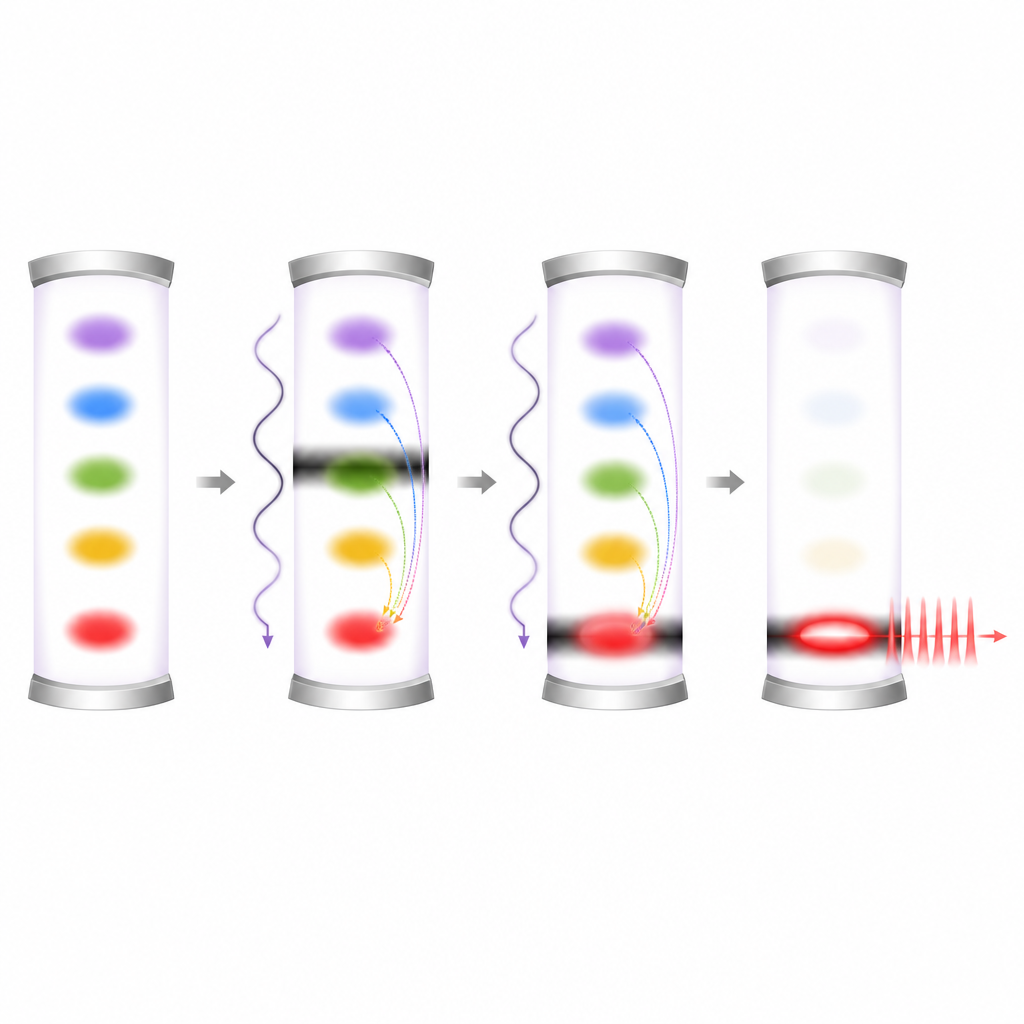
From steady glow to optical pulse train
The acoustic driving does more than pick a favorite mode; it also imprints a regular time structure on the emission. High-resolution spectra reveal a comb of very sharp peaks around each main line, spaced by the energy of a single acoustic quantum. This pattern is a hallmark of coherent time-periodic modulation. Time-correlation measurements confirm that the ground-state emission is not a steady glow but a sequence of short optical pulses, shorter than 50 picoseconds and repeated at the gigahertz rate set by the sound wave. A theoretical model that includes stimulated scattering, coherent coupling and the periodic energy sweep reproduces both the redistribution of population and the pulsed behavior.
Why this matters for future photonics
In simple terms, the study shows that a carefully engineered sound wave can act as a traffic cop for light–matter particles, steering almost all of them into the calmest, lowest-energy lane without spoiling their coherence. This acoustic control offers a flexible way to switch between multimode and single-mode behavior and to generate tunable, ultrafast pulse trains on a chip. Such capabilities are promising for future information technologies that rely on compact light sources, on-chip signal conversion between microwaves and optics, and engineered photonic materials where time-periodic driving creates new effective properties for light.
Citation: Kuznetsov, A.S., Carraro-Haddad, I., Usaj, G. et al. Ground-state exciton–polariton condensation via coherent Floquet driving. Nat. Photon. 20, 586–591 (2026). https://doi.org/10.1038/s41566-026-01855-w
Keywords: exciton polaritons, acoustic modulation, frequency comb, microcavity lasers, Floquet engineering