Clear Sky Science · en
Universal logical operations in a silicon quantum processor
Turning fragile quantum bits into reliable tools
Quantum computers promise to solve certain problems far beyond the reach of today’s machines, but their basic building blocks, known as qubits, are extremely fragile. This study shows how qubits made in silicon can be combined so that they behave more like sturdy information carriers, bringing practical quantum computing closer to technologies already used in everyday electronics.
Why building on silicon matters
Most of our classical computers run on silicon chips, so being able to build quantum hardware in the same material could make it much easier to manufacture and scale up future devices. The team works with spin qubits formed by phosphorus atoms placed with atomic precision inside a silicon crystal. These spins can hold quantum information for long times, and earlier work has shown that individual and small groups of them can be controlled with very high accuracy. What has been missing in silicon is the next step: performing full “logical” operations that actively protect information against noise.
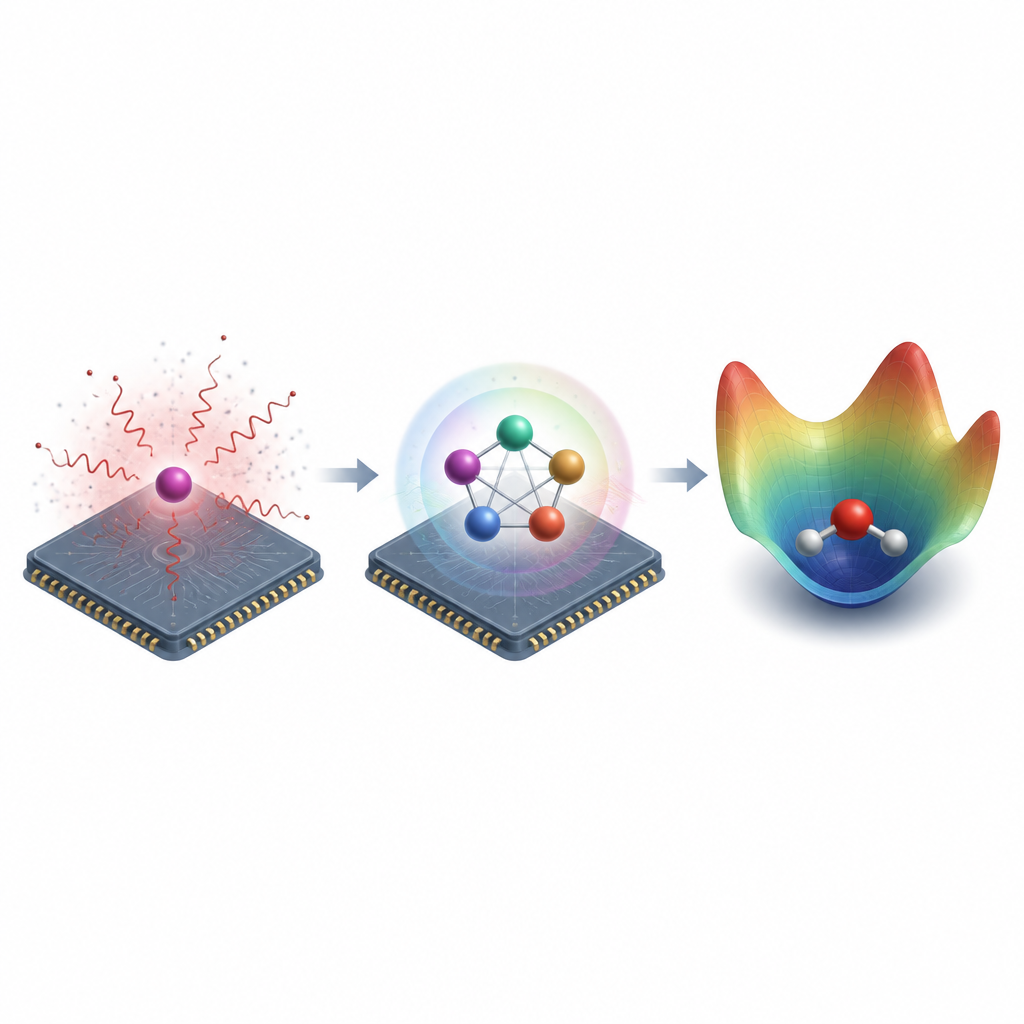
Storing one logical bit in several physical ones
The researchers use a clever scheme called the [[4, 2, 2]] code, in which four physical qubits jointly store two logical qubits, while a fifth qubit plays a supporting role. Instead of trusting any single qubit, information is spread out across all four, so that certain single-particle faults can be spotted and discarded. The device is built by carving patterns on a silicon surface with a scanning tunnelling microscope, then doping the patterned regions with phosphorus atoms to form a tight cluster of five nuclear spins that act as the qubits. By carefully calibrated magnetic pulses, the team prepares two logical states, including an entangled “Bell” pair, and shows that once data affected by detectable errors are weeded out, these logical states are reproduced with fidelities above 95%.
Keeping quantum information alive and under control
To test how robust their logical information is, the authors watch how the encoded states change over time. They track different kinds of errors and observe that flips of the quantum phase dominate over simple bit flips, a “noise bias” that theory suggests can actually make error correction more efficient. The team then demonstrates a full toolbox of logical gates: operations that flip, rotate and entangle the logical qubits without needing to decode them back to single spins. Most of these gates are realized directly with native interactions in the donor cluster. A special type of rotation, known as the T gate and essential for truly general quantum computation, is achieved indirectly by involving an extra helper qubit and using measurement outcomes to decide how the logical qubit has been rotated.
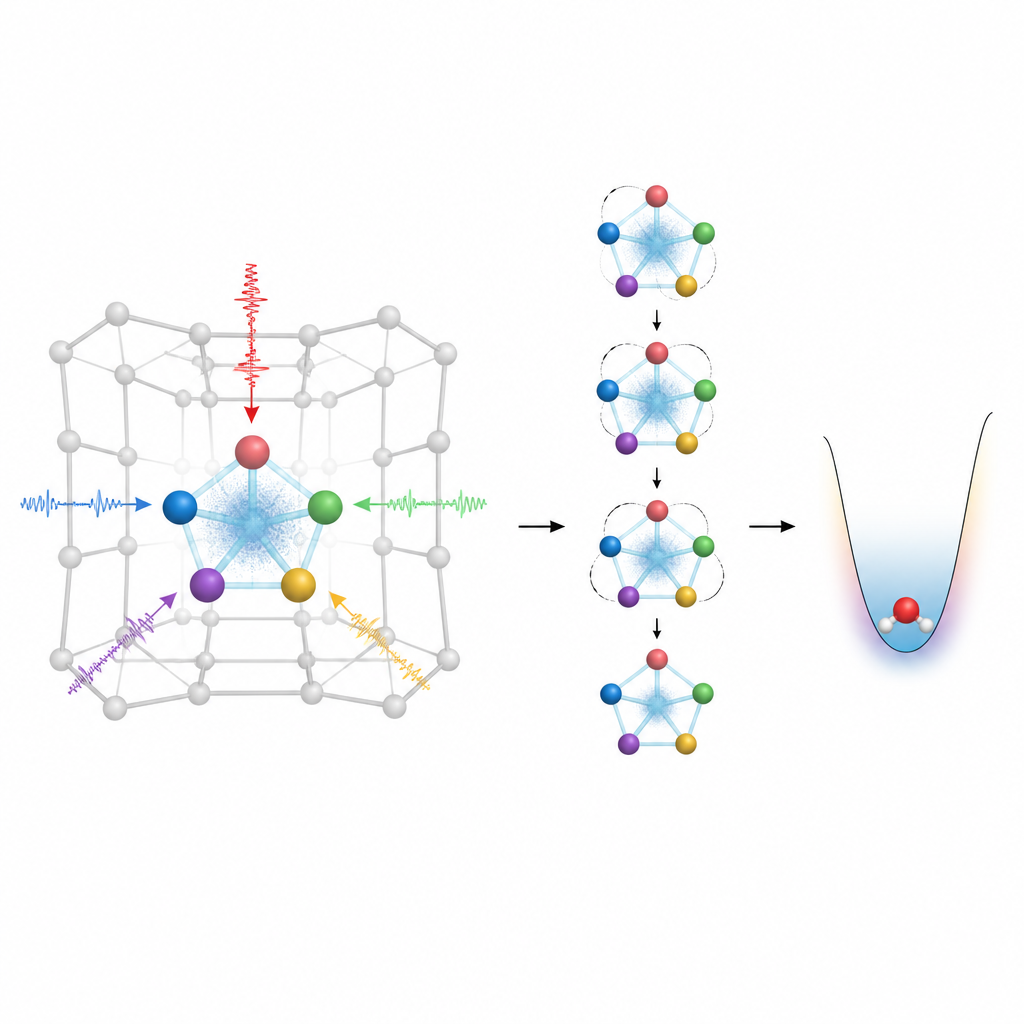
Creating special quantum fuel and testing a real algorithm
The same T-type operations also allow the team to prepare so-called “magic states,” special patterns of quantum superposition needed to run universal error-corrected algorithms. Several versions of these states are created and measured, with one variant surpassing the known quality threshold required for future purification routines. To showcase a practical use, the researchers run a small quantum chemistry calculation using a hybrid quantum–classical routine called the variational quantum eigensolver. With only two logical qubits, they approximate the ground-state energy of a water molecule as its bond angle changes, applying additional data-cleaning steps to counteract remaining noise. The resulting energy curve agrees closely with theoretical expectations, even though the underlying hardware is still relatively small.
What this means for future quantum machines
This work marks the first time universal logical operations have been shown in a silicon-based quantum processor built from donor atoms. By encoding information across several spins, detecting errors after the fact, and still successfully running a chemistry-inspired algorithm, the authors demonstrate that silicon spin qubits can move beyond isolated building blocks toward protected, programmable units. With improved fabrication to better position the donors, reduced cross-talk between control signals and larger arrays of these clusters, similar logical schemes could scale up into practical, fault-tolerant quantum computers that sit much closer to today’s chip technology.
Citation: Zhang, C., Xu, F., Zhang, S. et al. Universal logical operations in a silicon quantum processor. Nat. Nanotechnol. 21, 635–641 (2026). https://doi.org/10.1038/s41565-026-02140-1
Keywords: silicon quantum processor, logical qubits, [[4, 2, 2]] code, fault tolerant quantum computing, quantum chemistry