Clear Sky Science · en
Hybrid antiferroelectric–ferroelectric domain walls in noncollinear antipolar oxides
Walls of electricity in a solid crystal
Most of the devices we use, from phone chargers to electric cars, rely on materials that respond in clever ways to electric fields. This study explores a newly discovered behavior inside a particular crystal, where invisible “walls” just a few atoms wide act as tiny, two-dimensional systems with unusual electrical and mechanical properties. Understanding and controlling these walls could open paths to compact energy devices and new kinds of electronics that work at the scale of billionths of a meter.
Why opposite electric shifts can be useful
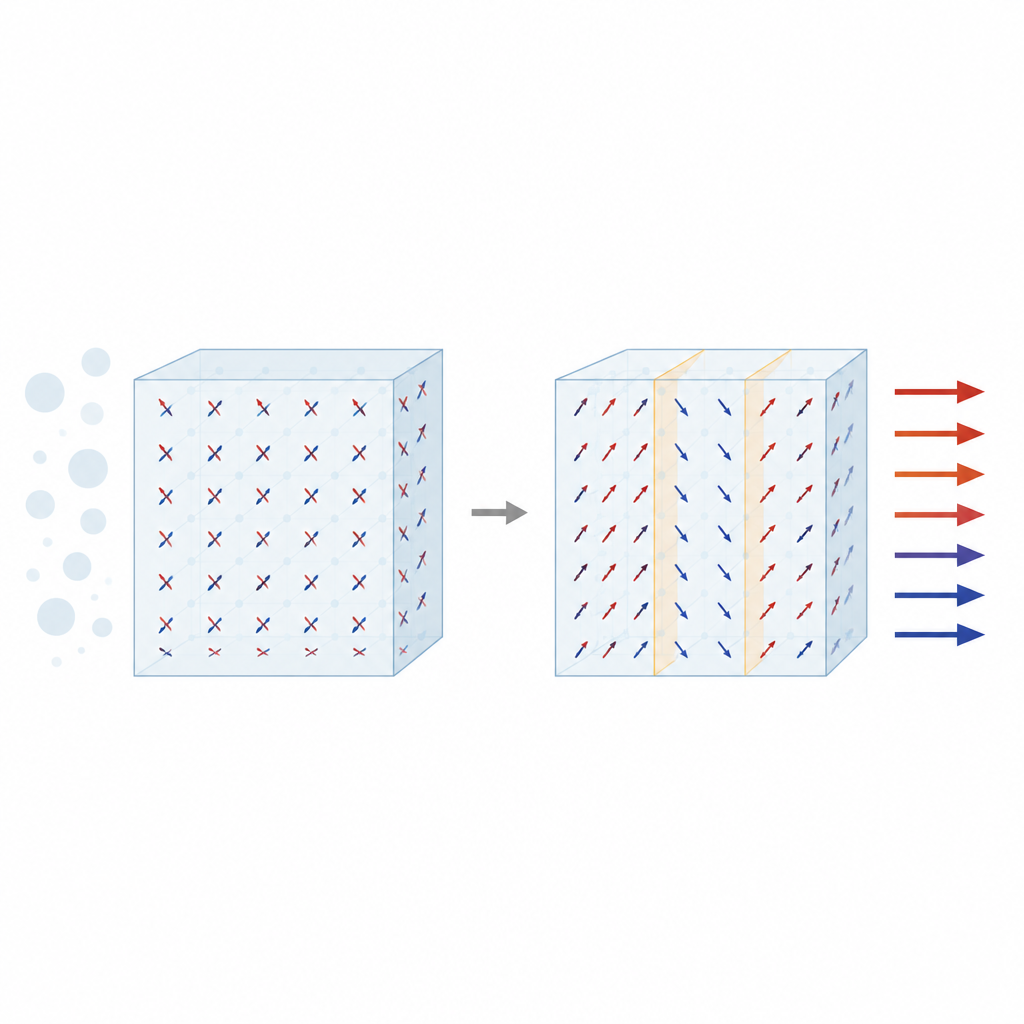
In many well-known materials, electric dipoles inside the crystal all tend to point in roughly the same direction when an electric field is applied. In antiferroelectrics, by contrast, neighboring dipoles point in opposite directions, so the overall polarization cancels out. This canceling behavior was once seen as a disadvantage, but it turns out to be attractive for energy storage and cooling technologies. The crystal examined here, a potassium niobate borate compound, does something more subtle: its dipoles are not perfectly opposite but slightly canted. That small tilt breaks the symmetry of the crystal in a special way, allowing antiferroelectric, ferroelectric and mechanical responses to coexist and interact.
A crystal that mixes two characters at once
Using quantum mechanical calculations and symmetry analysis, the authors show that the main driving force in this material is an antipolar pattern, where local dipoles alternate along one direction. Because of the crystal’s threefold symmetry at high temperature, this pattern cannot line up in a simple straight fashion. Instead, the arrangement becomes noncollinear, meaning the dipoles tilt away from being perfectly opposite. This tilt quietly turns on a weaker, secondary polar mode and a slight structural distortion. As a result, the crystal at room temperature behaves as a “proper” antiferroelectric but an “improper” ferroelectric and ferroelastic: the dominant order is antipolar, while a weaker net polarization and strain ride on top of it.
Hidden walls that carry charge and move
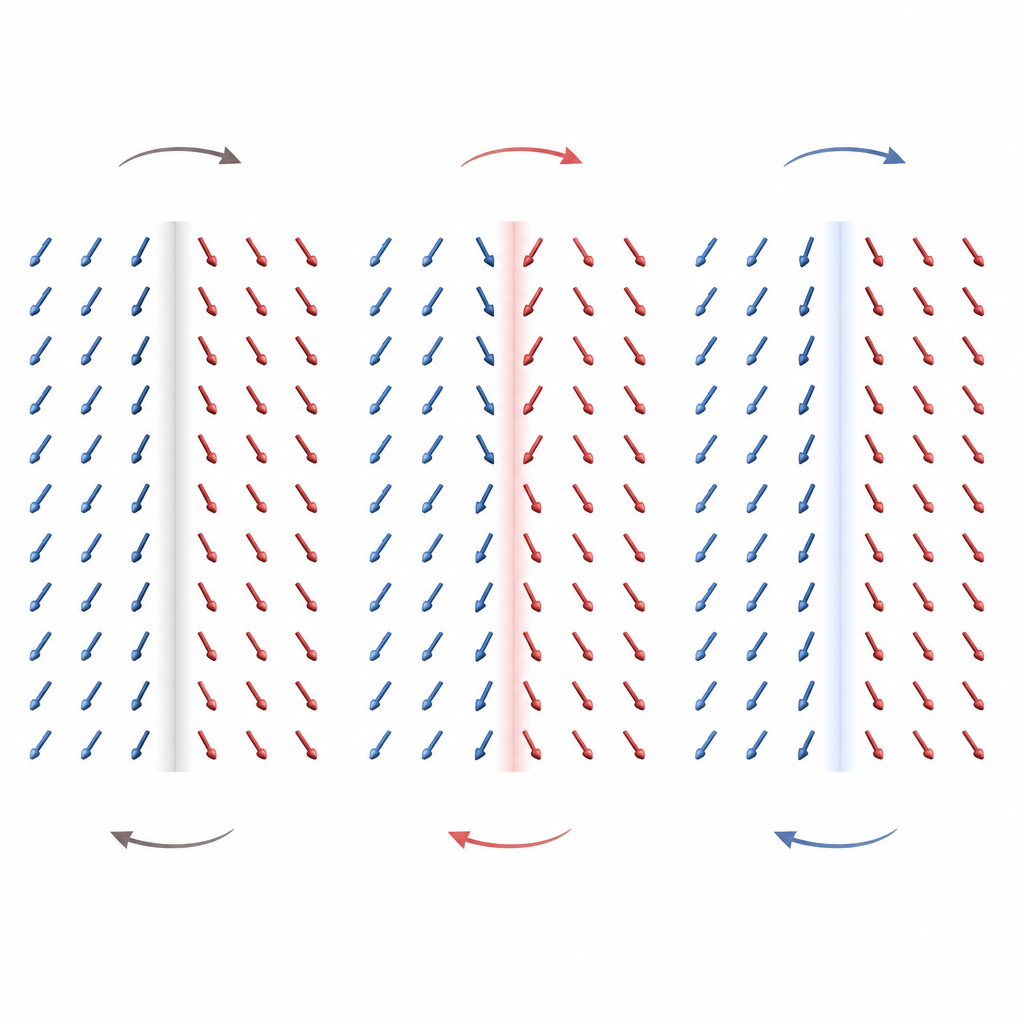
The team then turns from theory to the real-space landscape inside the crystal. With advanced scanning probe techniques, they map the domains, regions where the tiny tilts and strains all line up in one of three equivalent directions. These domains are separated by walls that run for micrometers through the material yet remain atomically sharp. Some walls are neutral, while others are “charged,” with dipoles facing head-to-head or tail-to-tail. Surprisingly, these charged walls are stable over long distances even though they hold bound charges that are usually energetically costly. At these walls the electric and structural orders both switch, meaning the boundary cannot be described as purely antiferroelectric or purely ferroelectric; it is a hybrid of both characters.
How these walls feel and respond
Closer inspection reveals that the hybrid walls have distinct local responses. Vertical and lateral piezoresponse measurements show a strong electromechanical signal at the charged walls, much larger than in the surrounding domains or at neutral walls. Simulations indicate that this comes from opposite shear strains on either side of the wall, causing tiny upward or downward displacements when an electric field is applied. Electrostatic force microscopy shows that positively and negatively charged walls are screened differently, likely by charged molecules or ions at the surface that rearrange over time. Atomic-resolution electron microscopy confirms that the walls are only a fraction of a unit cell wide, with a subtle phase shift in the crystal lattice and abrupt changes in both the alternating and net displacements of atoms across the interface.
Steering nanoscale walls with an electric tip
To test whether these hybrid walls can be controlled, the researchers apply local electric fields using a sharp conductive tip. Under fields much stronger than those used in everyday electronics, individual head-to-head and tail-to-tail walls shift by hundreds of nanometers, moving toward each other and sometimes annihilating. As the walls curve and change orientation, their charge state and piezoresponse vary smoothly, turning a once “discrete” softness into a continuously tunable property. Neutral walls are largely pinned unless they interact with charged neighbors, highlighting how the different types of walls are coupled through small structural mismatches and defects.
What this means for future devices
The work shows that by allowing dipoles in an antiferroelectric to tilt instead of lining up strictly opposite, nature creates walls that blend the traits of several material classes. These hybrid domain walls behave as controllable two-dimensional systems with adjustable electrical and mechanical responses. Beyond this one crystal, the symmetry arguments suggest that many other noncentrosymmetric materials with similar patterns could host comparable noncollinear order and hybrid walls. Such systems may become key building blocks for future domain-wall-based devices, where useful functions are not in the bulk of a material but confined to narrow, movable sheets just a few atoms thick.
Citation: Ushakov, I.N., Topstad, M., Khalid, M.Z. et al. Hybrid antiferroelectric–ferroelectric domain walls in noncollinear antipolar oxides. Nat. Nanotechnol. 21, 648–654 (2026). https://doi.org/10.1038/s41565-026-02139-8
Keywords: antiferroelectricity, domain walls, ferroelectric materials, noncollinear order, oxide crystals