Clear Sky Science · en
Proton–electron temporal asynchrony on femtosecond timescales enables anti-corrosive low-iridium anodes for PEM electrolysers
Why protecting clean hydrogen devices matters
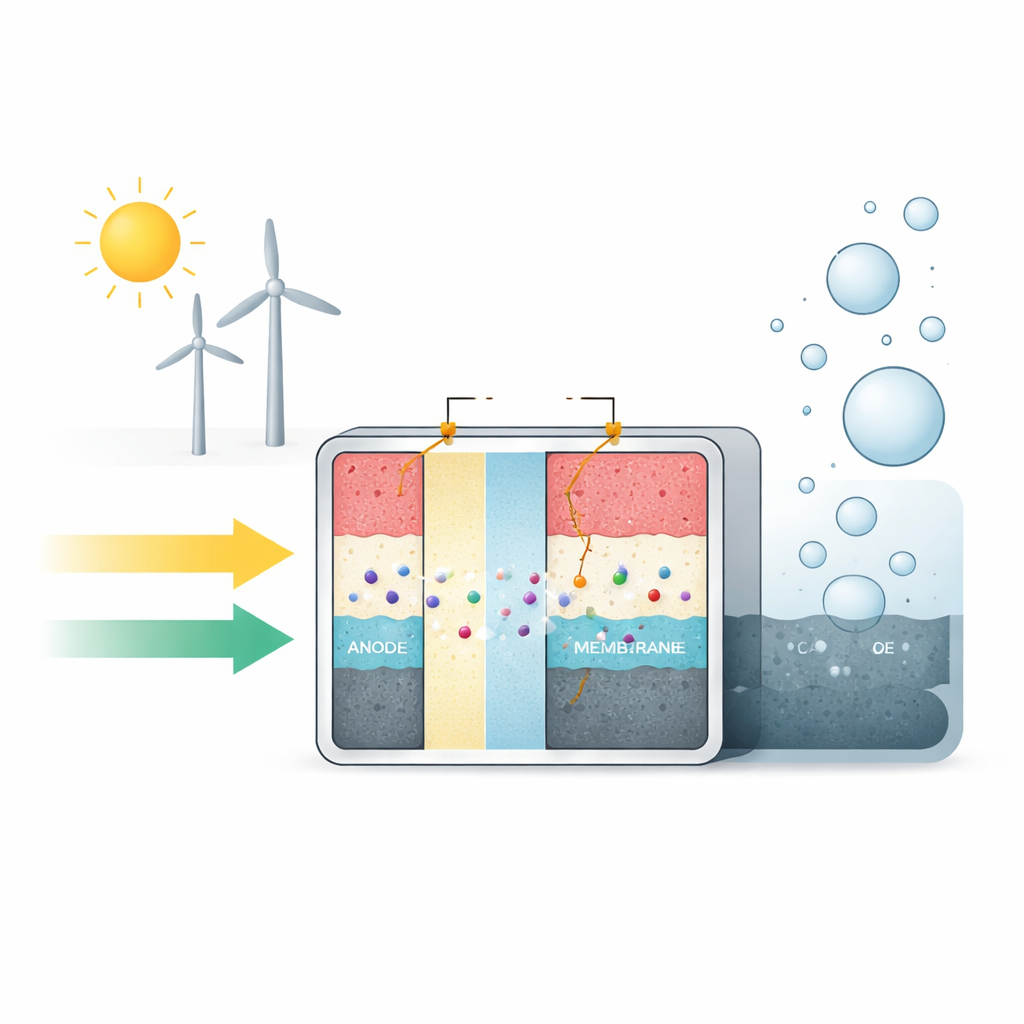
Producing hydrogen from water using renewable electricity is one of the most promising ways to store clean energy. A leading technology for this is the proton exchange membrane water electrolyser, which can run at high power and respond quickly to changes in sunshine and wind. But the metal coating that drives the oxygen-producing reaction on the anode side is expensive and prone to slowly dissolving away. This study uncovers what happens in the first tiny fraction of a trillionth of a second at that anode surface and shows how to redesign it so that far less of the precious metal is lost, while still delivering industrial-level performance.
The hidden weakness in today’s water splitters
Most commercial devices rely on iridium oxide as the anode catalyst because it can survive the harsh acidic environment better than almost any other material. Yet when engineers try to cut down the amount of iridium to save cost, the coating corrodes more quickly. Earlier work pointed to a highly oxidized iridium state, often written as Ir in a +6 charge state, as a key culprit because it can dissolve into the liquid. However, existing measurement tools were too slow to see how this state formed and disappeared right when the device was switched on, leaving the true origin of corrosion a matter of debate. This paper tackles that long-standing puzzle by watching electrons and protons move on timescales of femtoseconds—millionths of a billionth of a second—where chemical bonds are actually made and broken.
Watching charges move in femtoseconds
The researchers built a custom setup that couples a working electrolyser electrode to ultrafast laser pulses. One laser pulse briefly excites the catalyst, while another follows at a precisely delayed moment to track how its light absorption changes. These subtle color shifts reveal where electrons are located and how nearby protons in the liquid respond. For commercial iridium oxide, the team found that as soon as a driving voltage is applied, electrons leave iridium centers and protons pile up at the surface almost at the same instant—within about 100 femtoseconds. Calculations showed that when both charges are present together, it becomes much easier to create empty spots in the crystal lattice. Those vacancies are a fingerprint of atoms leaving the solid and entering the solution, meaning that perfectly synchronized proton and electron motion directly promotes corrosion.
A new pathway that separates the steps
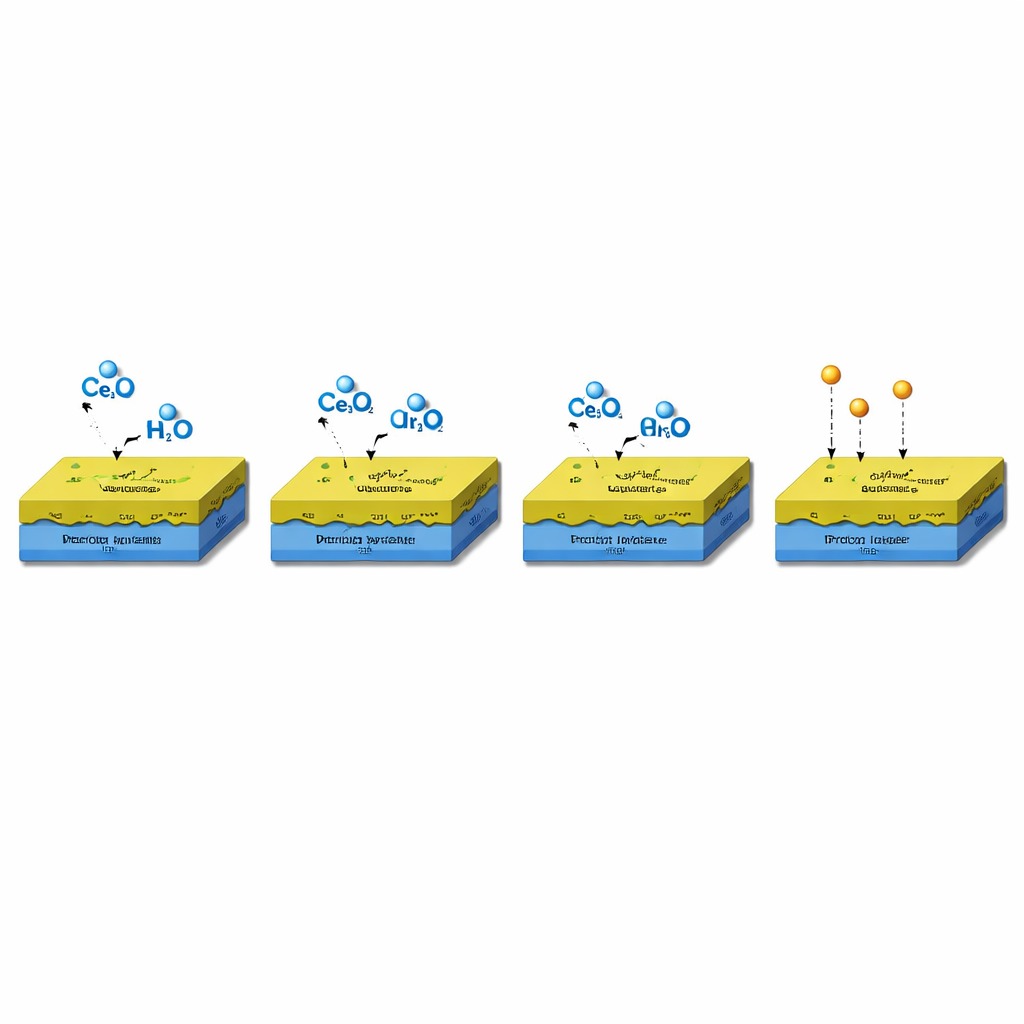
Guided by this insight, the authors sought a way to speed up proton motion so that it would not build up in the wrong place at the wrong time. They blended iridium oxide with a small amount of cerium oxide, a so‑called Lewis acidic oxide that gently attracts and conducts protons along its surface. Detailed tests showed that a composition containing about ten percent cerium oxide gave the best results. Rather than mainly altering the electronic structure of iridium, the added oxide opened a soft pathway for protons to travel quickly away from the iridium sites. Ultrafast measurements revealed a striking shift in timing: electrons still moved within the first 100 femtoseconds, but the clear signal from surface protons now appeared later, between 100 and 300 femtoseconds. This temporal “misalignment” prevented protons and highly oxidized iridium from coexisting, keeping vacancy formation energetically costly and strongly suppressing dissolution.
From microscopic timing to real-world durability
To connect these ultrafast snapshots to device behavior, the team combined many complementary techniques. Ultraviolet–visible spectroscopy under pulsed voltages showed that the mixed cerium–iridium oxide could store far more of the desired active iridium states without losing them to side reactions. Quartz crystal microbalance measurements and isotope tracing experiments confirmed that proton transfer, including the movement of heavier deuterium ions, was significantly faster in the modified catalyst. When built into full membrane electrode assemblies and tested in realistic water electrolysers, the new anode delivered high current densities—up to 3 amperes per square centimeter—at lower operating voltages than standard iridium oxide, even though it used less iridium. Most notably, the cells ran steadily for about 1,400 hours and endured tens of thousands of rapid start–stop cycles and simulated day–night solar patterns without noticeable degradation.
What this means for future clean energy systems
In everyday terms, the study shows that corrosion in these devices is triggered in the very first instants after switching on, when protons and electrons arrive together at the iridium surface. By inserting a carefully chosen oxide that acts as a proton highway, the researchers deliberately introduce a tiny delay between the two, breaking that destructive partnership. This simple shift in timing allows engineers to use much less iridium while still building robust, long‑lived water splitters. Beyond one specific material, the work demonstrates that “when” charges move can be as important as “how much,” opening a new design principle for electrochemical technologies that aim to turn renewable electricity into clean fuels and chemicals.
Citation: Shen, W., Gao, FY., Sun, X. et al. Proton–electron temporal asynchrony on femtosecond timescales enables anti-corrosive low-iridium anodes for PEM electrolysers. Nat. Nanotechnol. 21, 598–605 (2026). https://doi.org/10.1038/s41565-026-02136-x
Keywords: hydrogen production, water electrolysis, catalyst corrosion, ultrafast spectroscopy, clean energy materials