Clear Sky Science · en
Protonic nickelate device networks for spatiotemporal neuromorphic computing
Why tiny devices that think like brains matter
Today’s artificial intelligence runs on huge data centers that devour energy. Our brains, by contrast, perform far richer computations while sipping the power of a dim light bulb. This article reports a step toward brain‑like hardware: a new kind of tiny device network made from a special oxide material that processes information in space and time, remembers recent events, and recognizes patterns such as spoken digits and early signs of epileptic seizures—all on an energy budget far below that of conventional chips.
A material that can both remember and respond
The researchers build their system from a perovskite nickelate, NdNiO3, a crystalline oxide whose electrical properties can be dramatically altered by inserting hydrogen. When hydrogen atoms enter the material near a metal contact, they donate electrons and turn that region from a good conductor into a much more resistive state. By placing palladium (Pd) and gold (Au) electrodes on a thin nickelate film and annealing it in hydrogen, the team creates “clouds” of hydrogen under selected contacts. Moving these clouds with brief voltage pulses changes how easily current flows, allowing the same film to behave sometimes like a fast, fading response element and sometimes like a stable memory cell.
Two layers on one chip: fast dynamics and steady memory
The hardware platform is organized like a simple artificial brain built entirely from this nickelate film 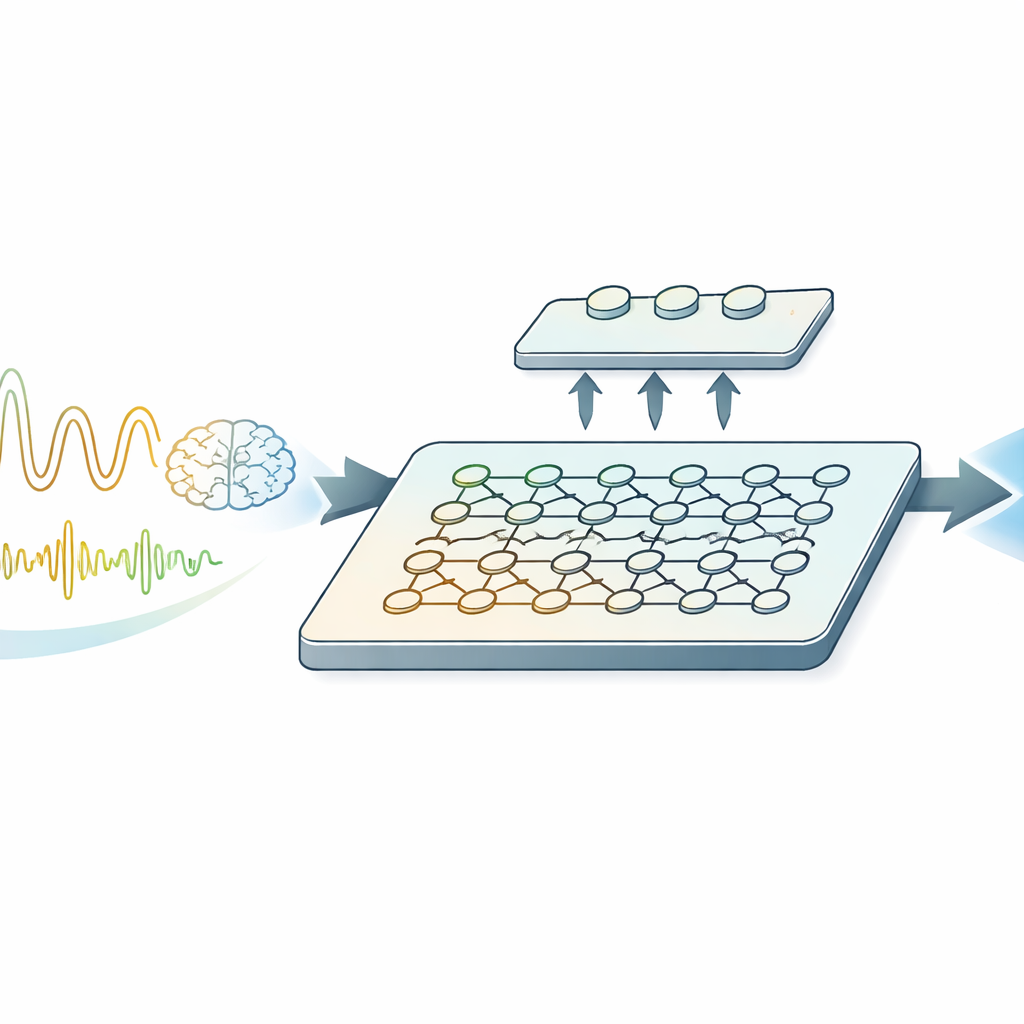
When neighbors matter: emergent network behavior
A key advance is that the processing layer does not act as isolated elements. When a pulse hits one Pd–Pd node, the redistribution of hydrogen and voltage in the nickelate film subtly changes the fields experienced by neighboring nodes. Experiments on small arrays show that the current in a “reference” device grows larger when nearby nodes also receive pulses, and this effect depends more on how their hydrogen clouds compare than on simple physical distance. Simulations confirm that these substrate‑mediated interactions reshape the overall potential landscape. The result is network‑level behavior: the pattern of activity across many nodes carries richer information than any single device alone, echoing how groups of neurons cooperate in the brain.
From simple patterns to speech and brain waves
To demonstrate practical computing, the authors first wire the nickelate arrays into a compact pattern‑recognition experiment. Simple 5×5 black‑and‑white shapes are converted into trains of voltage spikes that drive the Pd–Pd layer. The evolving currents at selected pads are then translated into voltages that feed the Pd–Au output layer, whose resistances are trained to distinguish among the patterns. The hardware correctly classifies the inputs, showing that spatiotemporal processing plus a linear readout can implement a full recognition pipeline on the same material. The team then models much larger networks based on their measured device behavior. For spoken‑digit recognition, sound waveforms are preprocessed into spike trains across many frequency channels before entering the nickelate processing layer 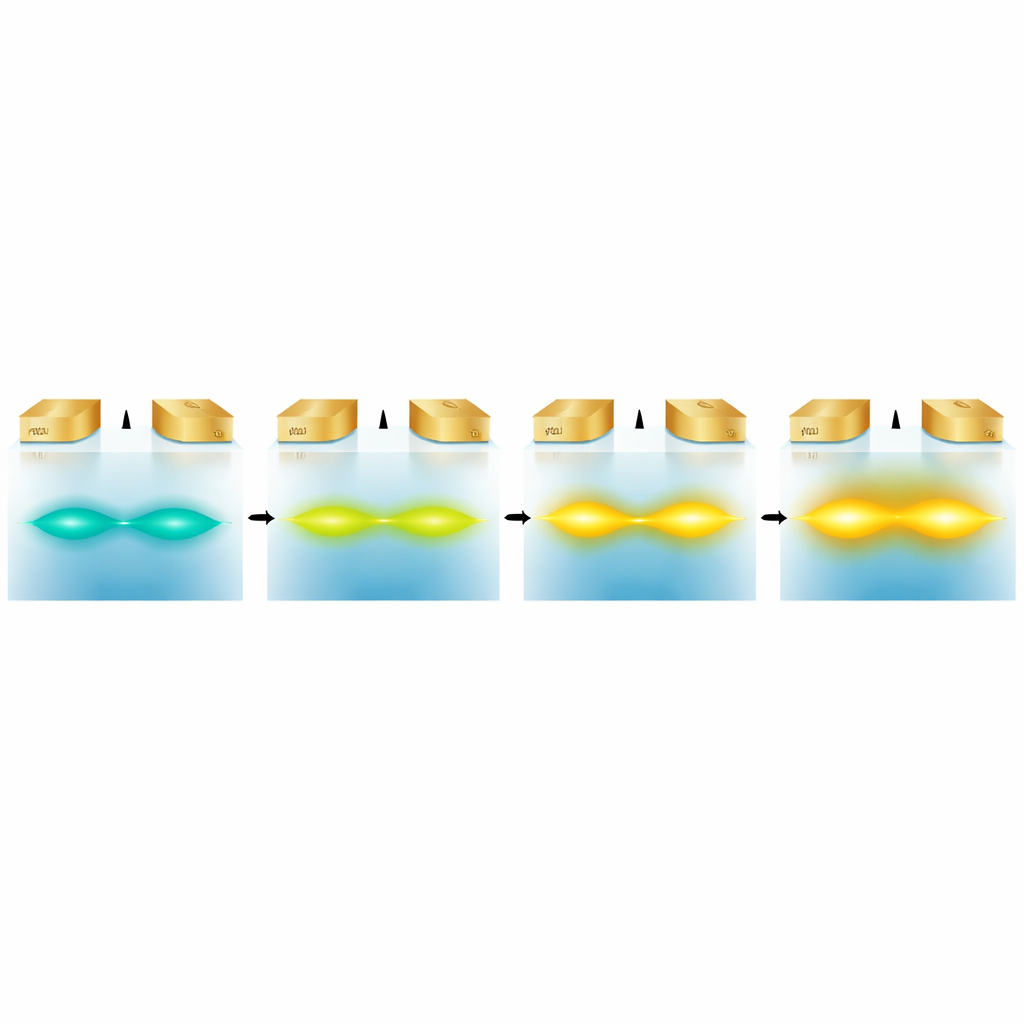
What this means for future intelligent hardware
In everyday terms, this work shows that a single, carefully engineered material can both “feel” rapid streams of input and “remember” what matters for later decisions, much like a simplified patch of brain tissue. Because the nickelate devices operate on nanosecond pulses and tiny amounts of energy, they offer a promising route to compact, low‑power chips that analyze sound, speech, or medical signals in real time without shipping data to distant servers. The same principles—proton motion shaping electrical pathways and devices influencing one another through a shared substrate—could be extended or combined with other advanced materials, pointing toward hardware that natively embodies the intertwined space‑ and time‑dependent computations our brains perform with such ease.
Citation: Zhou, Y., Shah, S., Dey, T. et al. Protonic nickelate device networks for spatiotemporal neuromorphic computing. Nat. Nanotechnol. 21, 579–587 (2026). https://doi.org/10.1038/s41565-026-02133-0
Keywords: neuromorphic hardware, protonic nickelate, spatiotemporal computing, reservoir computing, low-power AI