Clear Sky Science · en
Super-moiré spin textures in twisted two-dimensional antiferromagnets
Magnetism in atom-thin building blocks
We usually think of magnets as solid chunks of metal stuck to a fridge door. In this work, scientists shrink magnetism down to stacks of atom-thin crystals and discover that, by gently twisting these layers, they can create entirely new magnetic patterns that are much larger and more intricate than the underlying atomic lattice. These giant patterns could become the information carriers in future low‑energy, ultra‑compact magnetic technologies.
Twisting sheets to make new patterns
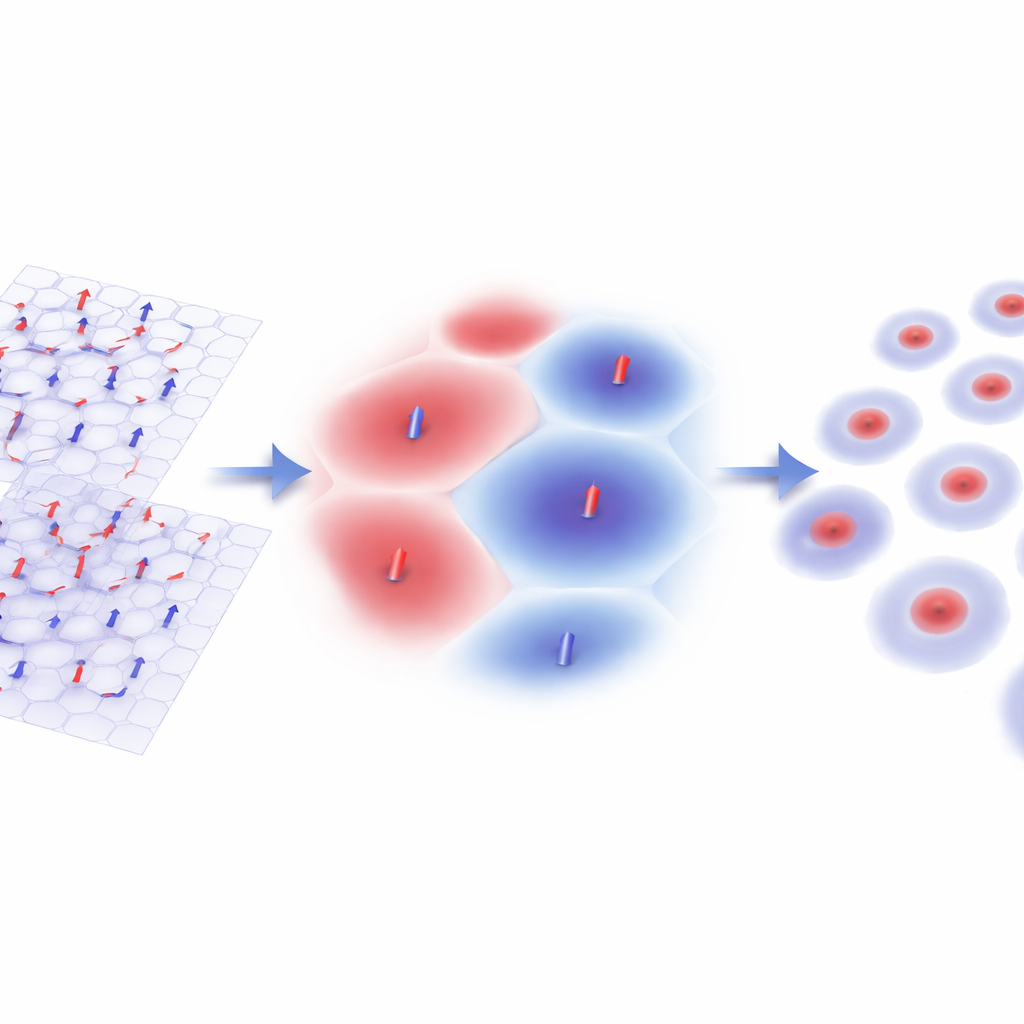
When two patterned surfaces are laid on top of each other with a slight rotation, they form a larger, slow-varying pattern known as a moiré pattern—similar to what you see when two window screens overlap. In ultrathin materials, this effect does more than create a visual pattern: it reshapes how electrons and atomic magnets interact. The team studied a material called chromium triiodide, or CrI₃, which behaves like a two-dimensional magnet when peeled into few-atom-thick sheets. They stacked two bilayers of CrI₃, twisted them by a tiny angle of less than two degrees, and fully encapsulated them to keep them stable at low temperatures.
Looking at tiny magnets with a quantum sensor
To see the magnetic landscape inside these twisted stacks, the researchers used a quantum sensor built from a single atomic defect in diamond, known as a nitrogen‑vacancy center. This defect behaves like a highly sensitive compass that can be scanned just tens of nanometres above the sample surface, mapping the weak magnetic fields produced by the spins in the CrI₃ layers. By converting the measured stray fields into maps of local magnetization, the team could distinguish regions that behaved like ordinary ferromagnets, with spins aligned, from regions where spins cancel each other, producing antiferromagnetic behavior.
Magnetic textures that outgrow the lattice
Conventional theory predicted that any magnetic pattern should closely follow the moiré lattice, meaning its size would shrink as the twist angle increased and the moiré cells became smaller. Instead, the experiments and large-scale computer simulations revealed the opposite trend. Around twist angles of about 1.1 degrees, the system developed magnetic textures hundreds of nanometres wide—up to ten times larger than the moiré spacing—forming what the authors call super‑moiré magnetic states. Within broad ferromagnetic regions, the sensors detected subtle, long‑range variations, and in nominally antiferromagnetic regions they observed stripes and dot-like patterns arranged in hexagonal arrays that extended across many moiré cells.
Competing forces and swirling spin islands
These oversized patterns arise because several magnetic forces compete with one another. Exchange interactions try to align neighboring spins, magnetic anisotropy prefers spins pointing in specific directions, and a chiral force known as the Dzyaloshinskii–Moriya interaction encourages spins to twist. As the twist angle of the layers changes, the balance among these forces shifts across each moiré cell. Rather than allowing each small cell to behave independently, the system minimizes its overall energy by forming extended, smoothly varying textures that spill across many cells. Computer simulations including these competing terms reproduce large domains and twisted spin structures consistent with the measurements.
Hidden whirlpools of magnetism
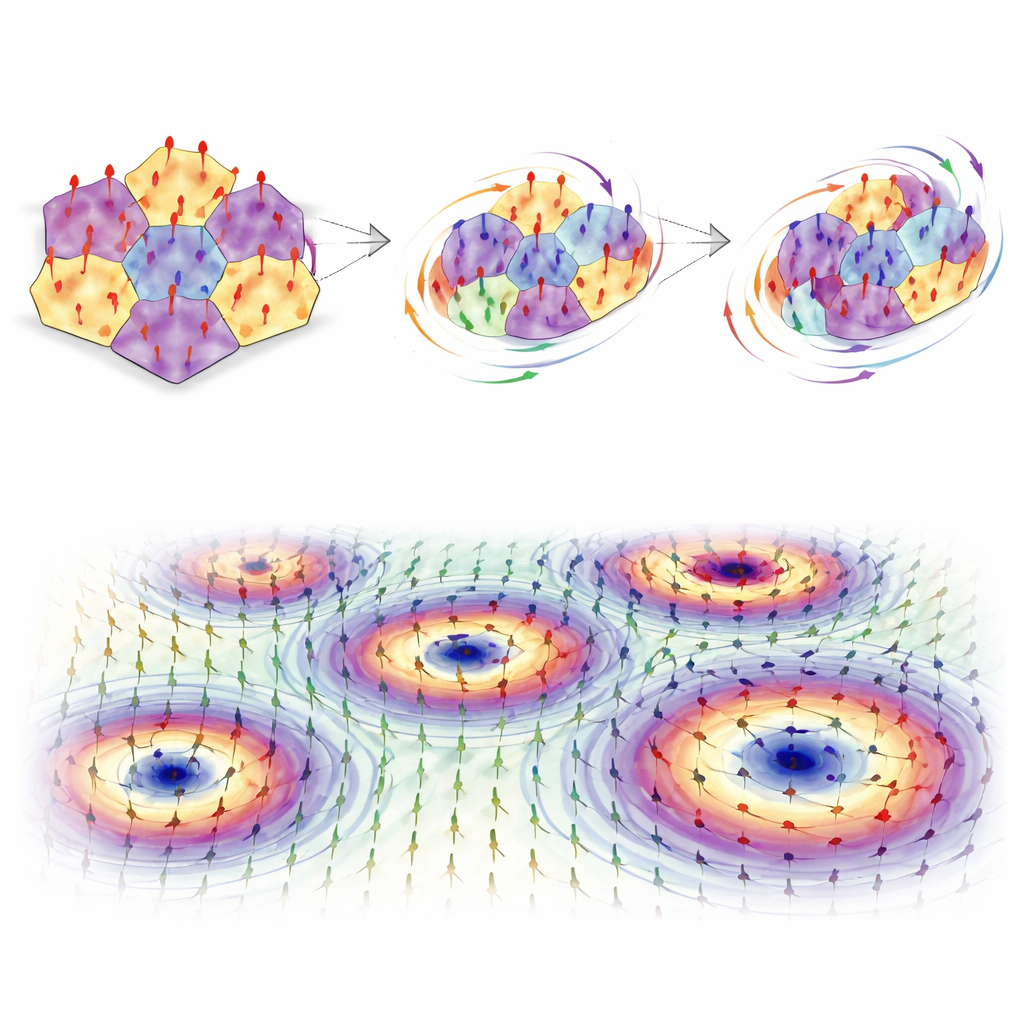
By cooling the devices in a magnetic field and zooming in on the tiny dot-like features, the researchers found evidence for magnetic whirlpools known as Néel-type skyrmions. In these objects, spins at the center point one way, spins far away point the opposite way, and those in between smoothly rotate in a radial fashion, forming a topologically protected knot. The skyrmions in the twisted CrI₃ devices are antiferromagnetic—neighboring layers or regions host opposite spin patterns—so they produce only weak net fields, yet the quantum sensor could still resolve their approximate 60‑nanometre size. The skyrmion patterns remained robust across a wide range of temperatures and magnetic fields, indicating that the twisted-layer design provides a stable platform for these exotic textures.
Why this matters for future devices
In simple terms, the study shows that gently twisting atom-thin magnets can generate large, stable islands of swirling magnetism that are much bigger than the twist pattern that seeds them. These super‑moiré spin textures and antiferromagnetic skyrmions could serve as information bits in future spin‑based electronics, combining stability, low stray fields, and compact size. The results also suggest that many other layered magnetic materials might host similar behavior when twisted, opening a broad playground for designing new magnetic phases and devices by controlling rotation, rather than by changing chemical composition.
Citation: Wong, K.C., Peng, R., Anderson, E. et al. Super-moiré spin textures in twisted two-dimensional antiferromagnets. Nat. Nanotechnol. 21, 359–365 (2026). https://doi.org/10.1038/s41565-025-02103-y
Keywords: 2D magnetism, moiré materials, skyrmions, twisted van der Waals layers, spintronics