Clear Sky Science · en
Impact of intensive control on malaria population genomics under elimination settings in Southeast Asia
Why malaria control in one border region matters to us all
Malaria still sickens hundreds of millions of people every year, and the rise of drug resistant parasites threatens to roll back decades of progress. This study follows an ambitious malaria elimination program in a remote part of Myanmar and asks a simple question with far reaching implications: when you attack malaria hard with clinics and mass treatment, what happens to the parasite population itself? By reading the parasites’ DNA over five years, the researchers show how intensive control reshapes malaria in ways that can either help or hinder long term success.
A village network on the front line
In Kayin State, along the Myanmar–Thailand border, health workers set up nearly 1,500 small malaria posts in villages to offer rapid testing and treatment. In 69 villages where infections remained common, communities also received mass drug administration, where almost everyone took a full course of antimalarial medicines over three months. These efforts cut malaria cases by about 97 percent in just a few years. To see what was happening behind the scenes, scientists collected over 5,000 blood spots from infected patients between 2015 and 2020 and sequenced the genomes of more than 2,000 Plasmodium falciparum parasites. 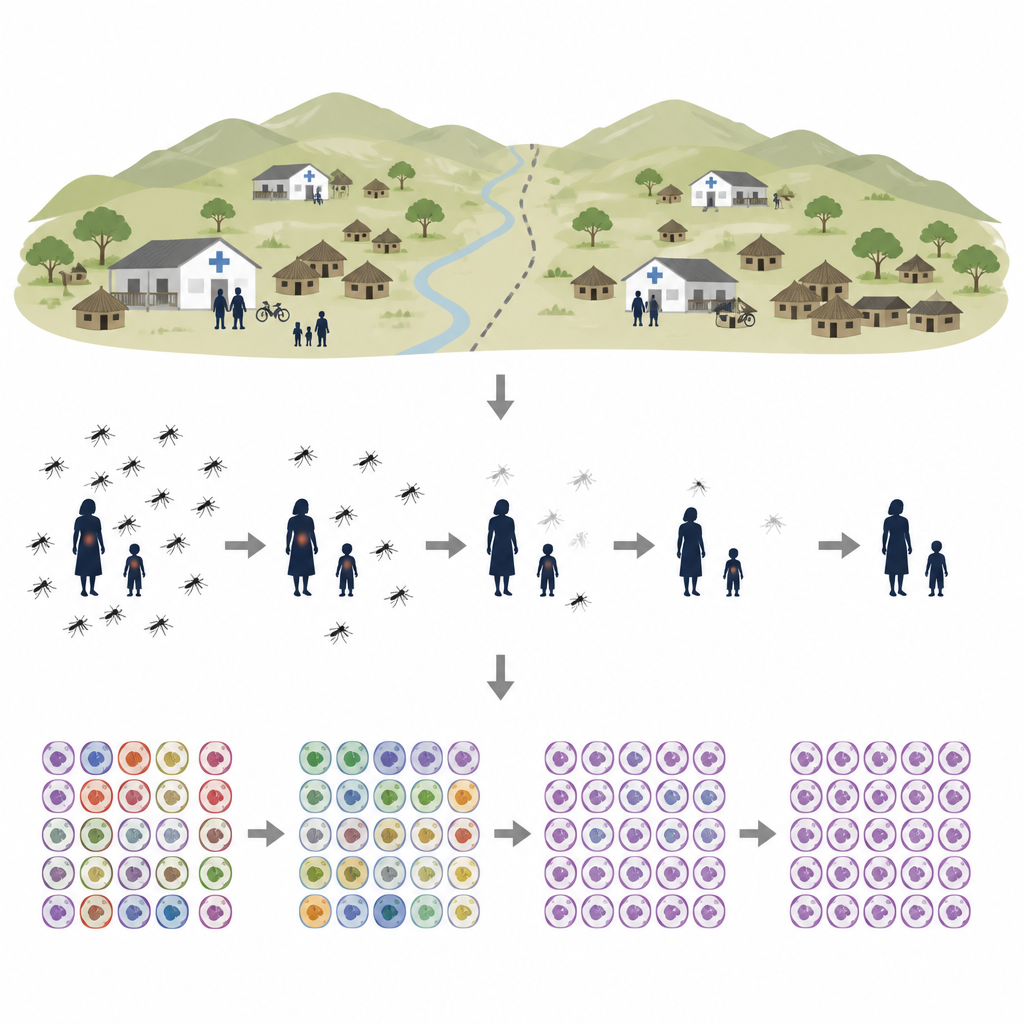
Parasites caught in a genetic squeeze
The DNA records revealed that the parasite population in Kayin was extremely small and inbred. Among nearly 1,800 infections carrying just one parasite strain, the team found only 166 distinct genetic types. Most infections were near copies of a handful of lineages that had expanded repeatedly, like a few family trees dominating a shrinking town. New combinations created when parasites mixed in mosquitoes were rare, and many lineages persisted for years in the same local areas. Parasites sampled within about 20 kilometers of each other were often closely related, while those farther apart were genetically distant, showing that transmission was highly local and long range spread was uncommon.
Drug resistance kept in check, then one winner emerged
Because antimalarial drugs are central to the control program, there is a constant worry that resistant parasites will take over. The team focused on changes in a parasite gene called kelch13, which carries mutations linked to resistance to artemisinin, a key drug. For several years, many different kelch13 variants coexisted at modest and fairly stable levels, and the size of parasite clusters did not differ between resistant and non resistant types. This suggests that, in this setting, drug pressure was not strongly favoring any single resistant lineage. In 2020, however, as malaria was pushed back to a few northern villages, one lineage carrying the R561H variant suddenly dominated the remaining infections. This surge appears to reflect chance survival during a severe population crash rather than a fast, drug driven sweep across the region. 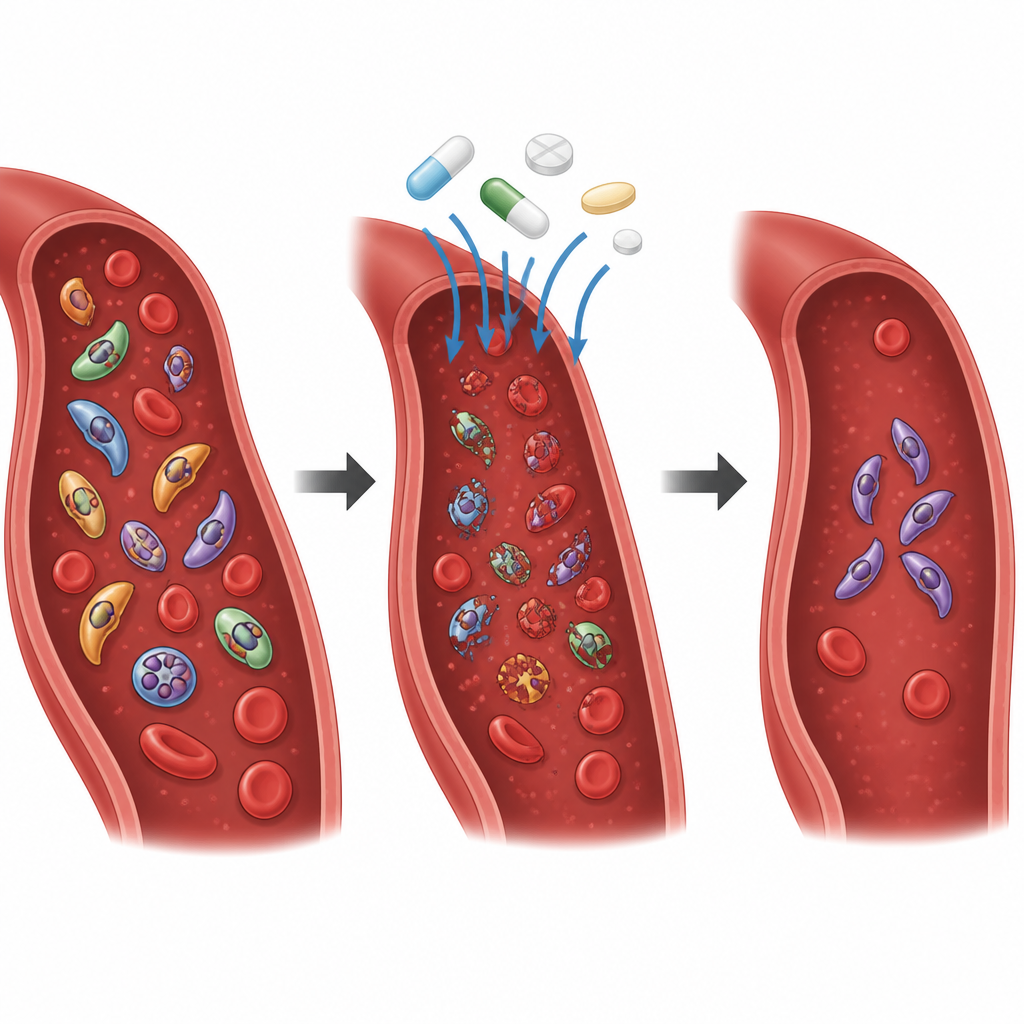
Tracing the reach of parasites across Southeast Asia
By comparing genomes from Kayin with parasites from nearby clinics and from Cambodia, Laos and Vietnam, the researchers found that Southeast Asia’s malaria parasites are split into western and eastern groups. There were strong genetic links between Kayin and neighboring border clinics, showing shared parasites moving within this western zone. In contrast, there was no sign of recent mixing with parasites from eastern countries, and key genetic markers of resistance to another drug, piperaquine, were absent from Kayin. This suggests that, at least during the study period, highly resistant parasite strains that trouble parts of Cambodia and Vietnam had not yet invaded this area.
How mass drug use reshaped local parasite families
The study also tested whether mass drug administration left a detectable genetic fingerprint. In three regions where communities received repeated treatment, the parasites found after mass drug administration were much less related to those seen before, compared with similar areas that did not receive mass treatment. This pattern fits the idea that mass drug administration clears most local infections, then the few parasites that return form new, genetically distinct lineages. At the same time, standard genetic measures such as the share of mixed infections or simple diversity did not track well with falling case numbers once transmission became very low, while a measure called effective population size did decline in step with ongoing control.
What this means for the endgame against malaria
For non specialists, the main message is that as malaria nears elimination, its parasites begin to look like a small, isolated group rather than a large, mixing population. In Kayin State, intense use of village clinics and targeted mass treatment slashed malaria cases without clearly accelerating the spread of dangerous drug resistance. Instead, the parasite population shrank and became dominated by a few local lineages, with one resistant type rising late mainly because so few competitors remained. The work shows that reading parasite genomes can help health programs see where transmission still lingers, check whether resistant strains are arriving from elsewhere and judge whether control efforts are driving the parasite population toward local extinction.
Citation: Li, X., Arya, G.A., Thu, A.M. et al. Impact of intensive control on malaria population genomics under elimination settings in Southeast Asia. Nat Microbiol 11, 1361–1373 (2026). https://doi.org/10.1038/s41564-026-02327-1
Keywords: malaria, drug resistance, genomic surveillance, mass drug administration, Southeast Asia
See more on the researcher's website: https://texasbiomedical.theopenscholar.com/anderson-lab/