Clear Sky Science · en
Community context reshapes microbial proteomes and reduces functional overlap
Why tiny neighbors matter
Our bodies, soils and oceans are filled with vast communities of microbes that quietly run much of the planet’s chemistry. Yet even when several species seem able to eat the same foods, they often live side by side instead of wiping each other out. This study asks how bacteria manage to share space and resources so effectively, and finds that they do it by changing which proteins they make depending on who their neighbors are.
Building simple model communities
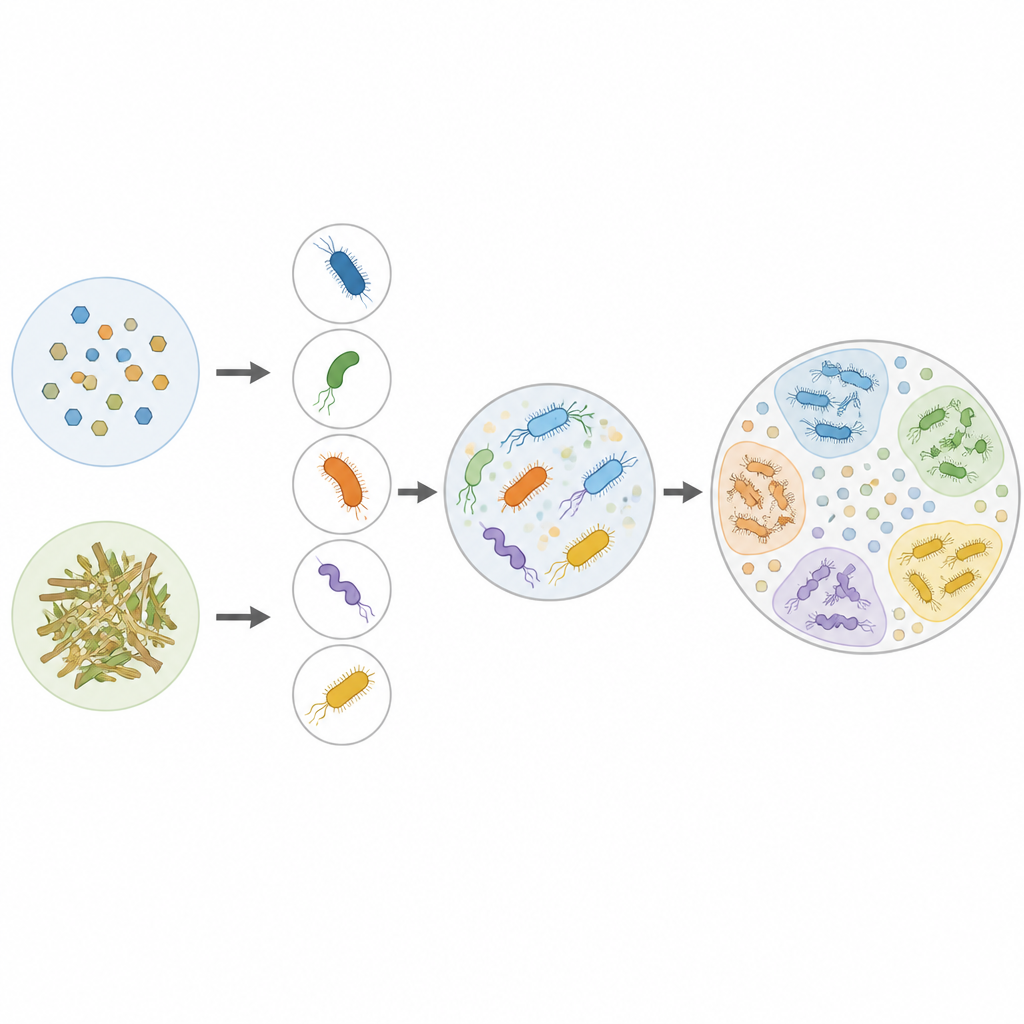
To untangle this puzzle, the researchers assembled small, carefully controlled communities of gut microbes taken from humans and cows. Each community contained up to four bacterial species that are known to play key roles in breaking down carbohydrates in the gut. The teams grew these microbes either alone, in pairs, or in four-species groups, and fed them two different food sources: a simple sugar (fructose) or a complex plant fiber made from ground wheat straw. This design let them separate the influence of the physical environment, such as the type of food, from the influence of living with other species.
Watching proteins as a window into choices
Rather than only counting how many cells grew, the scientists focused on which proteins each microbe produced under different conditions. Proteins carry out nearly all cellular tasks, from digesting food to sensing neighbors, so their abundance offers a direct readout of what a microbe is actually doing. Using high-resolution mass spectrometry, the team measured thousands of proteins per species in both the cell interior and the surrounding liquid. They then compared these protein patterns across single-species cultures, mixed communities, and two food types to see how microbes rewrite their internal "work plans" when the social or nutritional context changes.
Community neighbors outweigh the environment
The analyses showed that while switching between simple sugar and plant fiber did reshape protein patterns, the biggest shifts came from who else was present. For several species, the main source of variation in protein levels was the community composition rather than the carbon source. Bacteria grown in real communities looked very different from artificial mixtures assembled from isolates, even when the overall species ratios were matched. In pairwise cultures, each bacterial partner triggered a distinct and reproducible protein signature in its neighbor, revealing that microbes respond in a specific way to specific counterparts instead of following a single generic "crowded" program.
Less overlap, more shared output
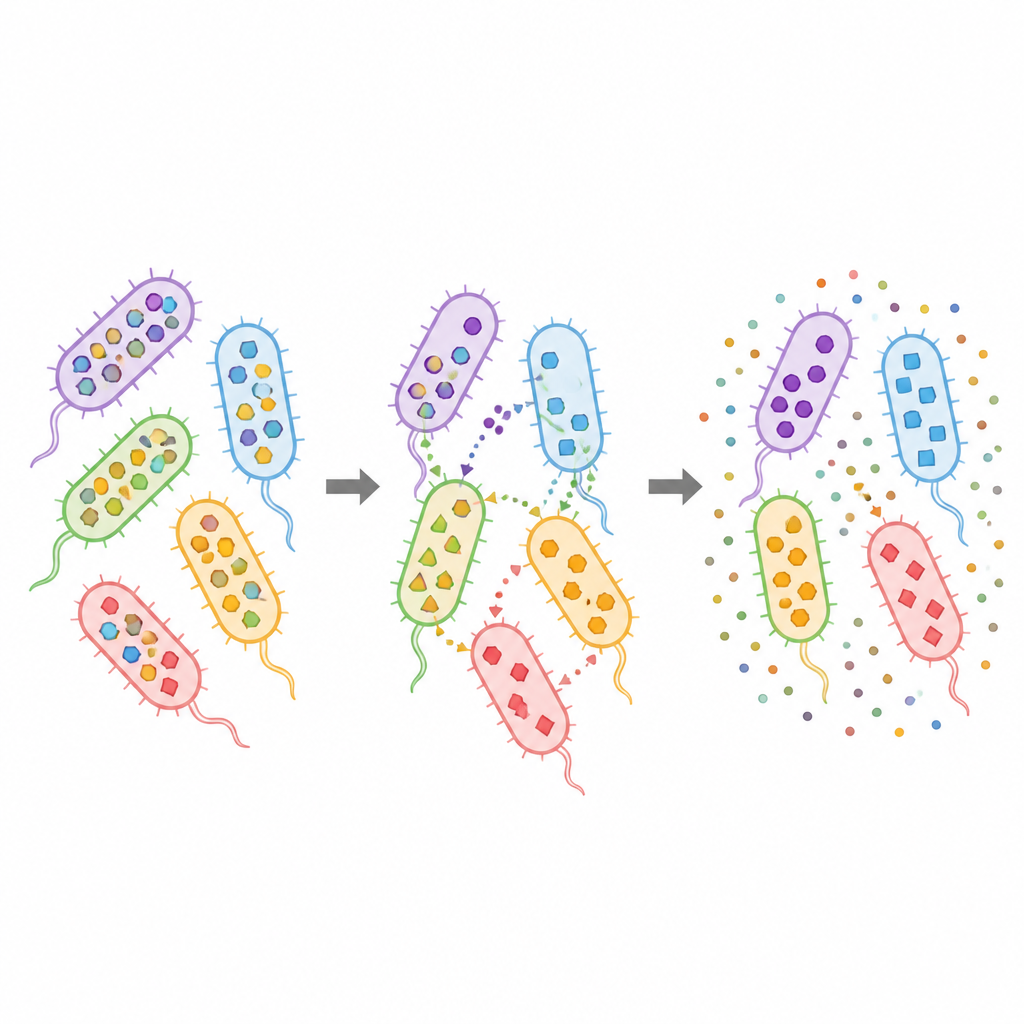
To understand what these changes mean for community function, the team grouped proteins into broad tasks such as energy use, metabolism and adaptation. They then compared the functions that would be expected if each species behaved as it does alone with the functions actually observed when the species grew together. In most communities, there was a clear drop in the overlap of functions between species: microbes seemed to turn down or drop many tasks that their neighbors could also perform, especially more specialized or adjustable pathways. Core processes needed for survival stayed active in all species, but optional extras, such as certain small-molecule production routes, were often trimmed back. Communities that showed reduced functional overlap were more likely to achieve higher total growth than predicted from their members’ solo performance.
Shaping niches through flexible behavior
These findings support a view of microbial communities as flexible, self-organizing systems. Instead of each species rigidly following a fixed genetic blueprint, bacteria adjust which parts of their toolkit they actually use depending on the company they keep. By dialing protein production up or down, they appear to avoid costly redundancy, divide metabolic labor and exploit byproducts released by their neighbors. For a lay audience, the takeaway is that microbes are not just competing for the same meal; they are also negotiating their roles on the fly, reshaping their niches through changes in protein production. This dynamic adjustment helps explain how many similar microbes can coexist and why diverse communities often operate more efficiently than the sum of their parts.
Citation: Moraïs, S., Mazor, M., Amit, I. et al. Community context reshapes microbial proteomes and reduces functional overlap. Nat Microbiol 11, 1336–1347 (2026). https://doi.org/10.1038/s41564-026-02310-w
Keywords: microbial communities, gut microbiome, protein expression, niche partitioning, metabolic cooperation