Clear Sky Science · en
Chikungunya virus persists in joint-associated macrophages and promotes chronic disease in mice
Why sore joints after infection matter
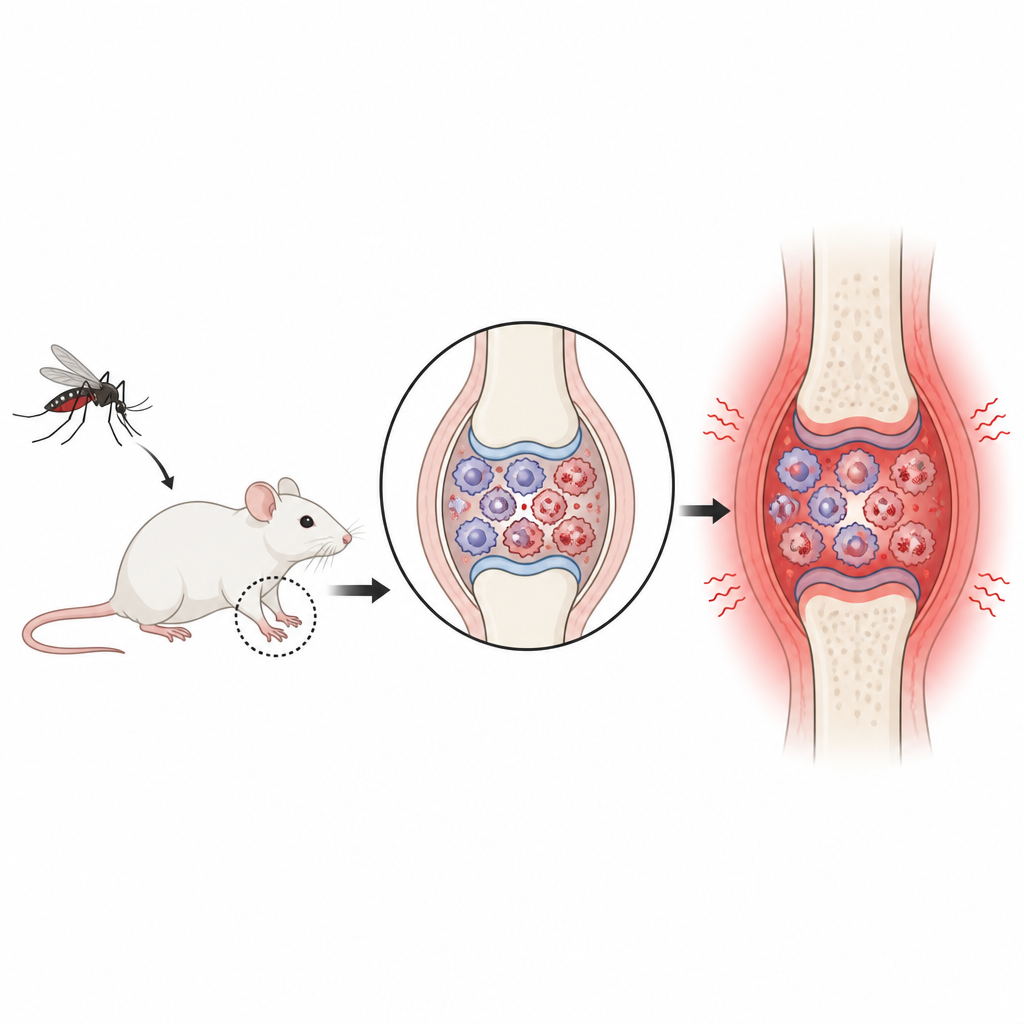
Many people who catch chikungunya, a virus spread by mosquitoes, recover from the initial fever but are left with aching, swollen joints that can last for months or even years. These long-lasting symptoms resemble rheumatoid arthritis and can seriously affect daily life. This study asks a simple question with big implications: where does the virus hide in the body, and what keeps the joint inflammation going long after the first infection has passed?
Looking closely at infected joints
To explore this, researchers used mice infected with chikungunya virus, as well as two related viruses that also cause joint problems. They focused on tissues around the ankle joints several weeks after infection, a time when the initial illness had passed but inflammation remained. Using powerful tools that read the activity of individual cells and map them in space inside the tissue, along with flow cytometry to count and categorize immune cells, they built a detailed map of which cells were present, what they were doing, and whether they still carried viral material.
Macrophages as hidden virus carriers
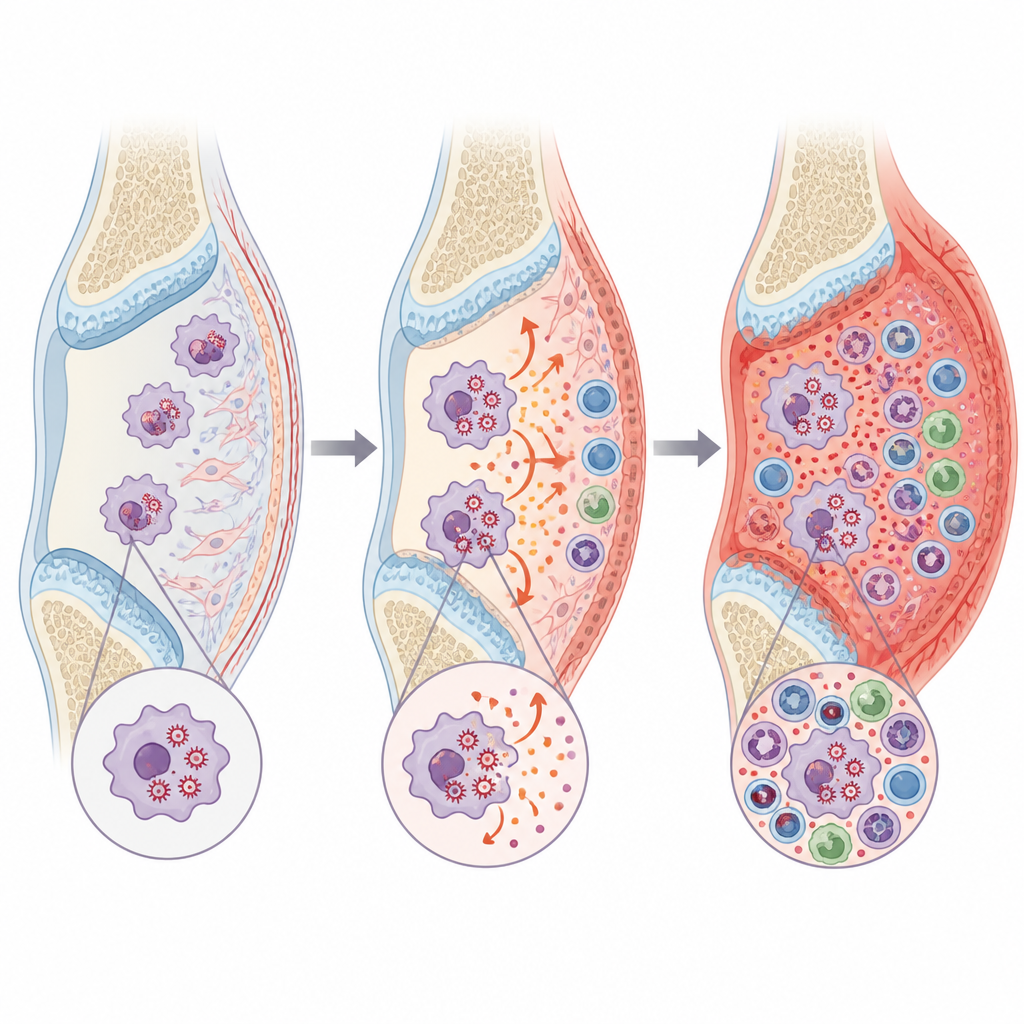
The team discovered that a particular group of immune cells called macrophages had piled up in the joint tissues and showed strong signs of activation. Instead of helping to calm inflammation, these macrophages were brimming with genes linked to inflammatory signals that can damage cartilage and bone. Crucially, when the scientists measured viral genetic material, they found that most of the remaining chikungunya RNA in the joint was inside these macrophages. High-depth sequencing revealed full viral genomes and even the forms associated with active replication, suggesting that the virus was not simply leftover debris but was still making copies of itself inside these cells.
A feedback loop with helper T cells
Another key player in the inflamed joints was a type of white blood cell known as CD4 helper T cells. These cells were more abundant in infected joints and produced high levels of interferon gamma, a signal that can switch macrophages into a highly alert state. When the researchers removed CD4 T cells from mice after the acute infection had already begun, the macrophages in the joints showed less of a surface molecule used to present fragments of virus to T cells, indicating that the T cells help keep macrophages in an activated, presenting state. At the same time, some inflammatory signals changed rather than simply fading, hinting at a complex tug-of-war between different immune pathways.
Shared patterns across related viruses
The story did not stop with chikungunya. When the scientists examined mice infected with Mayaro virus and Ross River virus, they saw a similar pattern: joint macrophages rich in an activation marker and carrying viral RNA, along with increased numbers of CD4 T cells. Spatial mapping within joint tissue showed that viral RNA appeared mainly in macrophages and fibroblasts, the structural cells that help build tendons and ligaments, and that these infected cells were often located near one another. This close proximity may allow the virus to spread locally from cell to cell while avoiding full clearance by antibodies in the bloodstream.
Turning down the viral engine
To test whether ongoing viral replication was truly driving chronic inflammation, the researchers treated infected mice during the chronic phase with a small molecule drug that blocks alphavirus replication. After a week of treatment, the amount of viral RNA in joint tissue fell, and the macrophages showed reduced activation, including lower levels of the presentation marker linked to CD4 T cell engagement. Inflammatory gene activity in the joints dropped toward levels seen in uninfected animals, even though the overall numbers of immune cells in the tissue changed little. This suggests that simply quieting the viral engine inside these long-lived cells may be enough to ease joint inflammation.
What this means for lingering joint pain
In plain terms, this work suggests that chronic joint pain after chikungunya and related infections may be fueled by a small population of immune cells that quietly harbor replicating virus within the joints. These macrophages, nudged on by helper T cells, keep sending out distress signals that inflame surrounding tissues. By targeting the persistent viral RNA in these cells, it may be possible to reduce long-term swelling and pain. While this study was done in mice and more work is needed in humans, it offers a clear framework for thinking about chronic post-viral arthritis and points to antiviral treatment as a potential way to help patients whose symptoms do not fade with time.
Citation: Zarrella, K.M., Sheridan, R.M., Ware, B.C. et al. Chikungunya virus persists in joint-associated macrophages and promotes chronic disease in mice. Nat Microbiol 11, 1302–1317 (2026). https://doi.org/10.1038/s41564-026-02303-9
Keywords: chikungunya, chronic arthritis, macrophages, viral persistence, joint inflammation