Clear Sky Science · en
Identification of transporter-dependent capsular loci associated with the invasive potential of Escherichia coli
Why a bacterial coat matters for human health
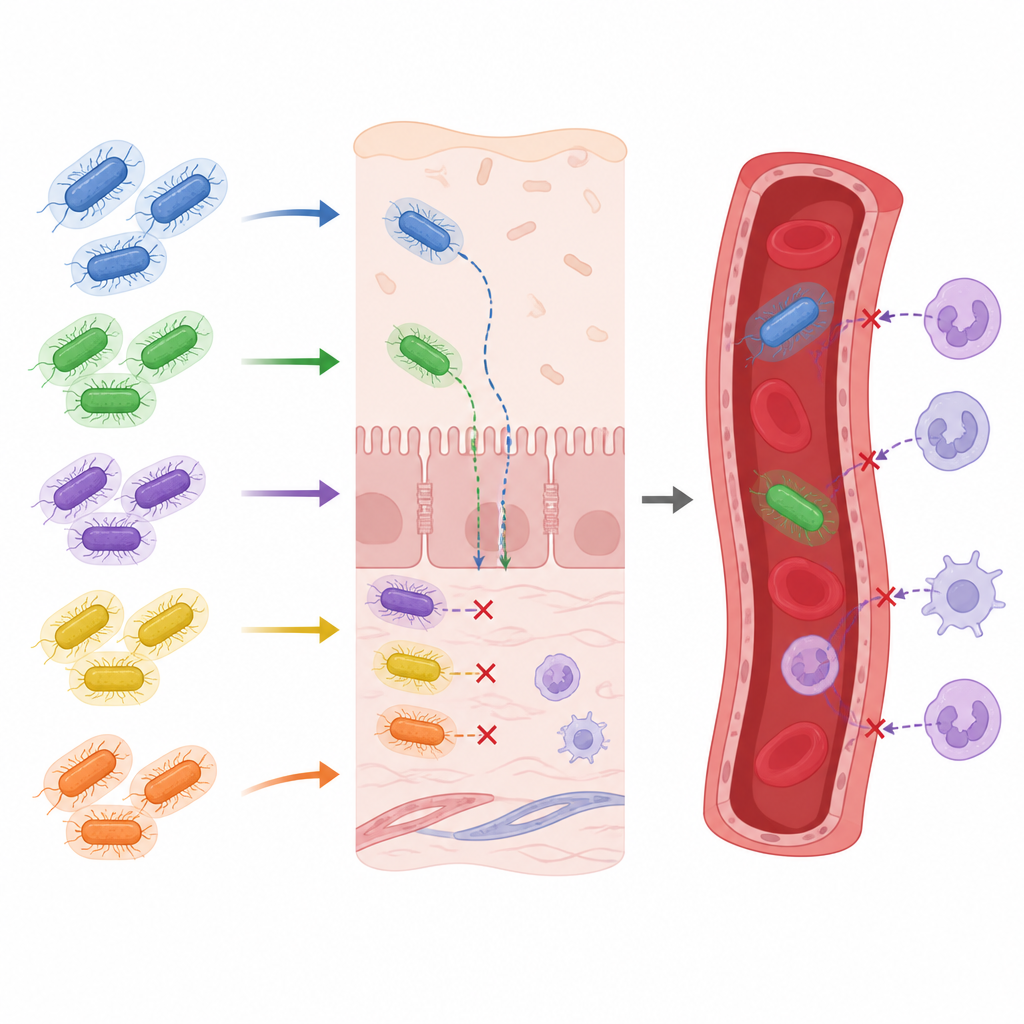
Many strains of Escherichia coli live harmlessly in our guts, but others can slip into the bloodstream and cause life threatening infections that are increasingly resistant to antibiotics. This study asks a simple but important question: what is it about some E. coli strains that makes them so invasive, and can we use that knowledge to design better diagnostics and vaccines? The authors focus on the bacteria’s outer sugar coat, called a capsule, and use modern genome analysis to map which capsule types are most often linked to serious disease.

Reading the genetic barcode of the bacterial coat
The capsule that surrounds an E. coli cell is built by a cluster of genes that act like a molecular recipe. Instead of testing capsules in the lab one by one, the team created a large computer readable catalogue of these gene clusters, based on more than 18,000 bacterial genomes collected worldwide. They concentrated on two major capsule groups that move their sugars across the cell surface using a molecular transporter. By comparing the gene content of these clusters, they defined 90 distinct capsule blueprints and built a reference database that existing software can use to "type" an E. coli strain directly from its DNA sequence.
Which capsule types show up in real infections
Armed with this typing system, the researchers examined E. coli from many different sources: bloodstream infections, urinary tract infections and symptom free gut carriage, mainly in Europe but also from low and middle income countries. They found that a surprisingly small set of capsule types dominates serious infections. In European bloodstream and urinary infections, five capsule types, notably ones known as K1, K5, K2, K52 and K100, accounted for more than half of cases and most multidrug resistant infections. In healthy carriers, capsules were more mixed, yet some of the same types still appeared, hinting that they are common in the population as a whole.
Linking capsule type to invasiveness
To understand which capsules truly favor invasion, the team compared how often each type appeared in harmless gut carriage versus bloodstream disease, while also accounting for the bacterial family tree. Some capsule types, especially K52, K14 and K100, were far more likely to be found in blood than in carriers, suggesting they give bacteria a particular edge in causing deep infections. Classic capsule types such as K1 and K5 were also linked to higher risk, though not as strongly as these front runners. The analysis showed that both the capsule and the underlying bacterial lineage matter: some lineages with certain capsules are especially prone to invading older adults or causing difficult to treat infections.
How capsules change and spread
The study also explores how capsule types evolve. Within major multidrug resistant lineages, the capsule region of the genome behaves as a hot spot for gene swapping. Segments of DNA can be shuffled by homologous recombination, and mobile elements called insertion sequences can carry extra capsule genes into place. In a few cases, entire capsule clusters ride on plasmids, small DNA circles that move between bacteria, bringing both capsule genes and antibiotic resistance at once. This constant remixing helps explain why even closely related E. coli strains can display very different surface coats.
What this means for future prevention
For a layperson, the key message is that not all E. coli are equally dangerous, and their sugar coat is one of the main clues to that danger. By building a detailed genetic map of capsule types and showing which ones are most strongly tied to invasive disease, this work provides a foundation for smarter vaccines and targeted therapies. In principle, future vaccines could focus on capsule types that are both common in bloodstream infections and relatively rare in harmless gut residents, reducing severe disease without wiping out helpful bacteria. The new typing tools also make it easier to track these high risk capsule types around the world and to see how they respond as new treatments are rolled out.
Citation: Gladstone, R.A., Pesonen, M., Pöntinen, A.K. et al. Identification of transporter-dependent capsular loci associated with the invasive potential of Escherichia coli. Nat Microbiol 11, 1205–1216 (2026). https://doi.org/10.1038/s41564-026-02283-w
Keywords: Escherichia coli, bacterial capsule, bloodstream infection, antimicrobial resistance, vaccine targets