Clear Sky Science · en
Bacterial Schlafen proteins mediate phage defence
Ancient Virus Fighters Hidden in Bacteria
Viruses do not only make people sick; they also attack bacteria, the microscopic workhorses that shape our environment and our bodies. This study uncovers a surprising link between how human cells and bacteria fend off viral invaders. The researchers show that a family of proteins called Schlafens, already known for blocking virus growth in humans, play a similar defensive role in bacteria, hinting at an immune strategy that has been conserved for billions of years.
Finding Shared Tools Across Life
Scientists first discovered Schlafen proteins in mammals, where some family members chop up transfer RNAs (tRNAs) – small molecules essential for building proteins – to shut down viral replication. The team wondered whether simpler organisms might use related proteins in a similar way. By scanning thousands of bacterial and archaeal genomes, they identified nearly 6,000 “prokaryotic Schlafen” proteins that share the same core chemical signature as human Schlafens. Many of these genes sit in stretches of DNA packed with known immune functions, suggesting that they, too, belong to bacterial defense arsenals.
These bacterial Schlafens rarely act alone. In almost every case, the core Schlafen unit is fused to another domain that appears to work as a sensor, tuned to recognize signs of infection. The authors catalogued 55 different domain combinations, from enzyme-like segments to parts resembling antibody folds. This patchwork architecture hints at a modular system: a shared “attack” core reused over and over, paired with diverse “alarm” modules that listen for different viral cues.
Putting Bacterial Schlafens to the Test
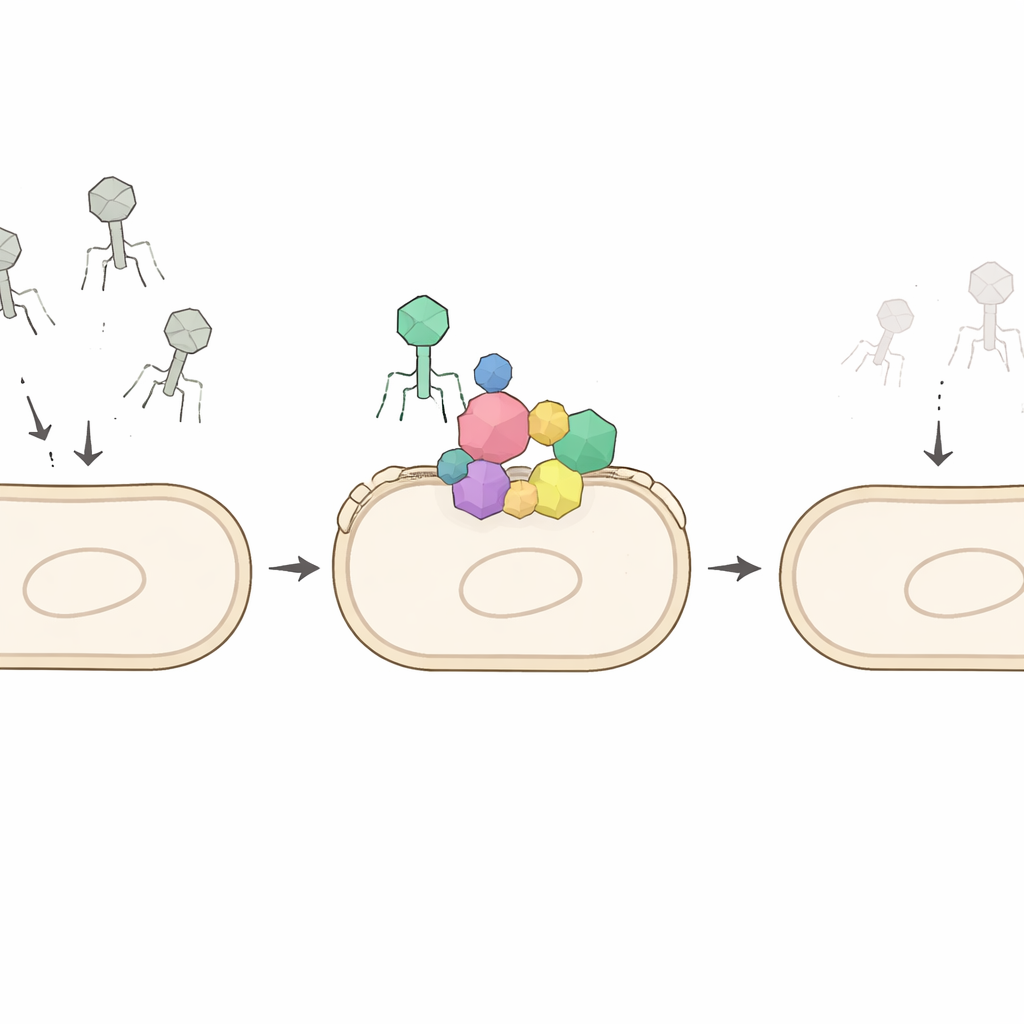
To move from prediction to proof, the researchers transplanted seven Schlafen systems from various bacteria into a laboratory strain of Escherichia coli and exposed the cells to a panel of bacteriophages – viruses that infect bacteria. Two systems clearly protected the cells, each blocking a different subset of phages. One especially intriguing system, dubbed RorSlfn5, came from the bacterium Raoultella ornithinolytica and carried a previously uncharacterized immunoglobulin-like (Ig-like) domain at its tail end. This add-on domain resembled the fold found in antibody molecules and other cell-surface sensors in animals, raising the possibility that it acted as a viral detector.
A Tail Protein as the Alarm Bell
The team zoomed in on how RorSlfn5 defends against the well-studied T5 phage. When phage levels were low, E. coli cells equipped with RorSlfn5 survived infections that wiped out unprotected cells. At high viral doses, the defensive cells still died, but they produced far fewer new phages, meaning that the virus’s ability to multiply was sharply reduced rather than completely aborted. By isolating rare “escape” phages that could grow despite the defense and sequencing their genomes, the researchers traced the problem to a single viral protein: the tail assembly chaperone that helps build the phage’s tail. Mutations in this tail protein allowed the virus to slip past RorSlfn5.
To prove that this tail component is the trigger, the scientists forced E. coli to make the tail protein even in the absence of infection. When RorSlfn5 was present and active, the cells stopped growing; when its catalytic core was disabled, they remained healthy. They also showed that the Ig-like domain controls which tail proteins are recognized: swapping this domain between related Schlafen proteins transferred their phage preferences, much like swapping antennas on the same radio.
Cutting the Message to Halt the Virus
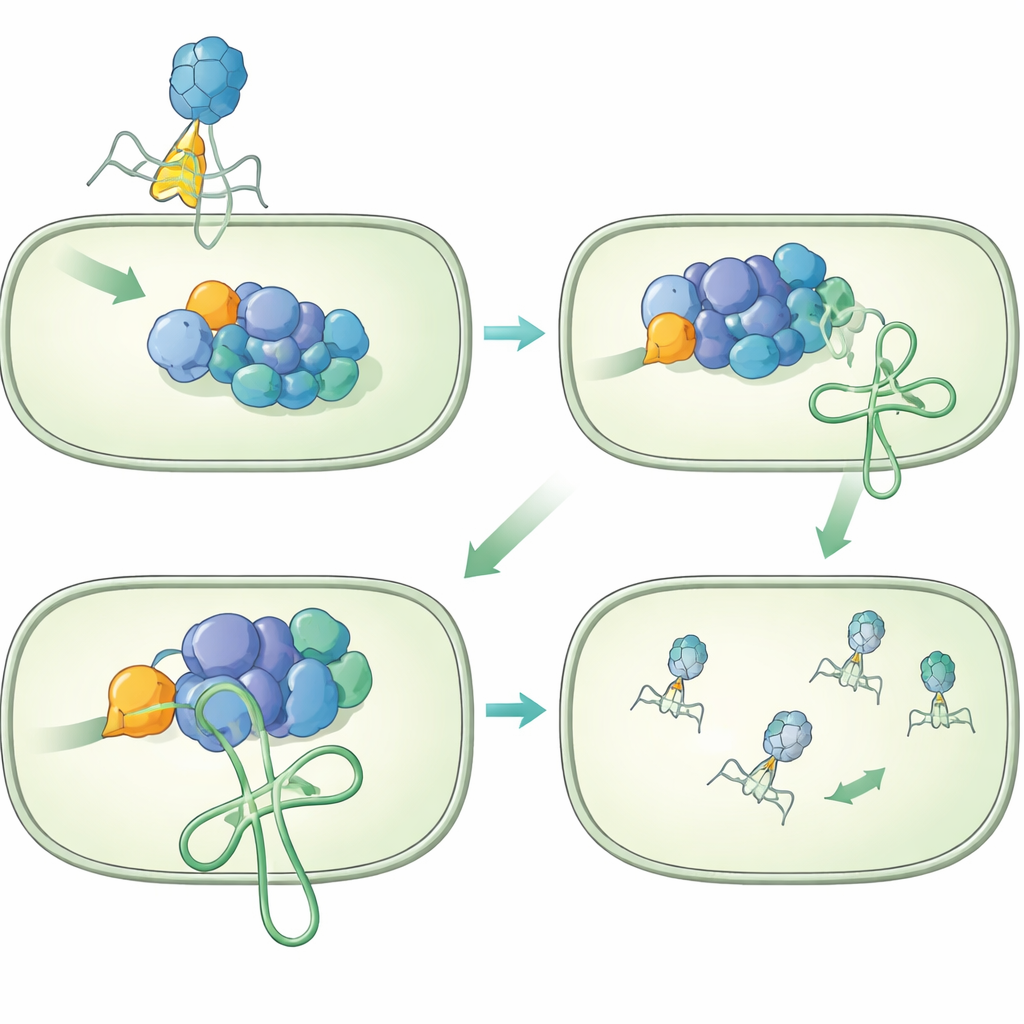
What happens after the tail protein flips the switch? The authors found that RorSlfn5 does not damage DNA or trigger a classic bacterial stress response. Instead, it acts as a highly specific RNA cutter. Using biochemical assays and high-resolution RNA sequencing, they showed that, once activated, RorSlfn5 slices both bacterial and viral tRNAs in a critical region called the anticodon arm, which is needed to read genetic code during protein production. In infected cells, fragments of particular tRNAs – including one encoded by the T5 phage itself – piled up, and the intact versions dwindled. In test-tube reactions, purified RorSlfn5 and the tail protein worked together to cut synthetic tRNAs in a manganese-dependent reaction, mirroring the behavior of human Schlafen enzymes. This targeted sabotage of the protein-building machinery starves the phage of the resources it needs to assemble new particles.
A Shared Immune Strategy Through Deep Time
This work reveals that Schlafen proteins form an ancient, conserved layer of antiviral defense. In both bacteria and humans, a Schlafen core waits for a viral signal detected by an attached sensor domain, then cripples viral replication by cutting tRNAs. Bacteria have diversified this basic blueprint by fusing Schlafens to many different sensor types, each tuned to its own viral cue, such as the tail assembly chaperones of T5-like phages. The discovery not only deepens our understanding of how microbes resist their viruses, but also suggests that key features of our own innate immunity trace back to molecular tools invented long before animals evolved.
Citation: Perez Taboada, V., Wu, Y., Cassidy, R. et al. Bacterial Schlafen proteins mediate phage defence. Nat Microbiol 11, 1037–1048 (2026). https://doi.org/10.1038/s41564-026-02277-8
Keywords: bacteriophage immunity, tRNA cleavage, Schlafen proteins, bacterial antiviral defense, evolution of innate immunity