Clear Sky Science · en
A free energy landscape analysis of resistance fluctuations in a memristive device
Why tiny memory devices can act like restless landscapes
Modern digital gadgets increasingly rely on exotic forms of memory that can both store information and help perform calculations. This article explores why one leading candidate, a “memristive” memory made from a phase-change material called germanium telluride, shows puzzling flickers in its electrical resistance. By treating these fluctuations as a window into an invisible energy landscape inside the material, the authors uncover how the atomic structure shifts over time—and why this matters for future brain-inspired and in-memory computing technologies.
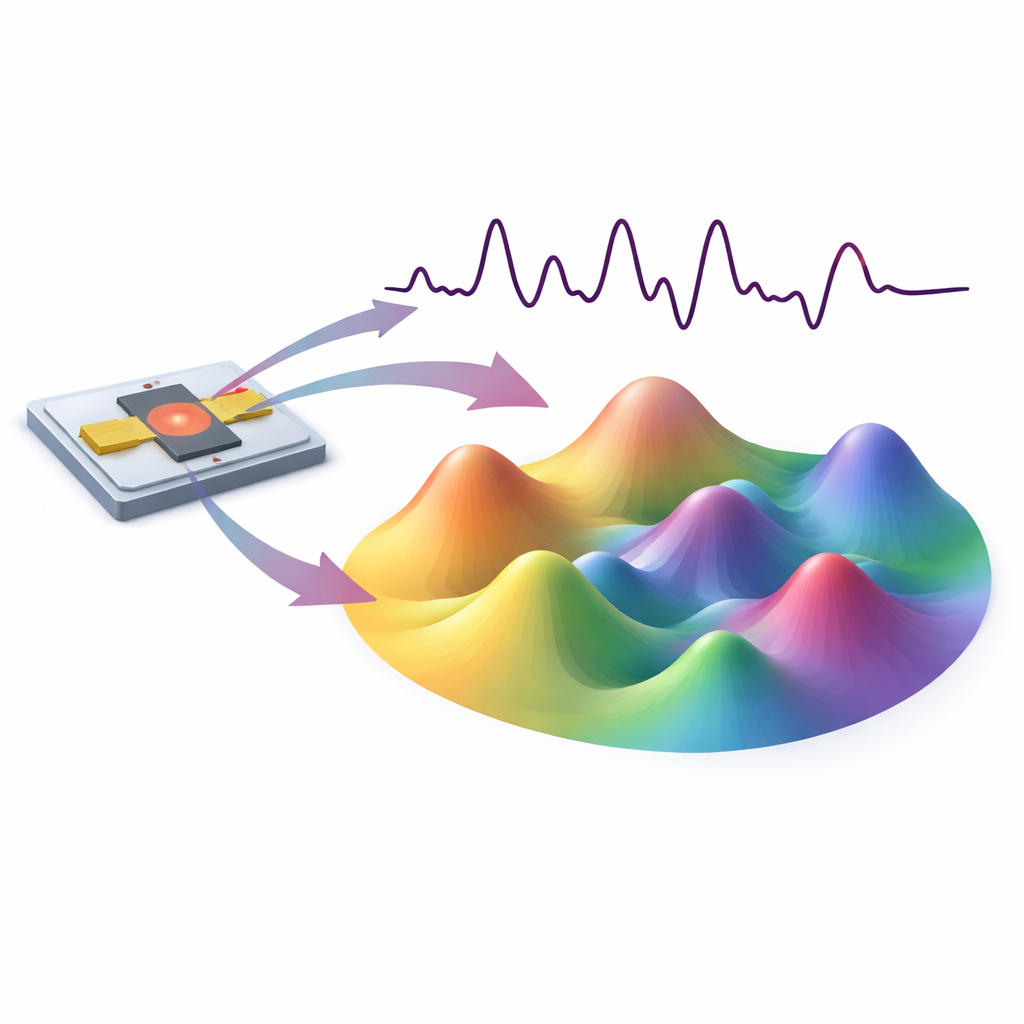
From simple switches to restless atoms
Memristive devices change their resistance when electric pulses rearrange atoms or magnetic moments, allowing them to remember past signals. In phase-change memories, short, intense pulses briefly melt a tiny region of material, which then cools into a disordered glassy state with very high resistance. This state is stable for years yet slowly evolves, causing the resistance to drift upward and to fluctuate. Traditional explanations picture this behavior as atoms hopping over a single energy barrier between two configurations, like a ball rolling between two hills. But as devices shrink to volumes containing only a countable number of atoms, that simplification breaks down: even tiny rearrangements can strongly affect resistance, and the material’s internal dynamics become much richer than a simple two-state switch.
Listening to noise in a nanoscopic glass
The researchers designed a specialized device in which a narrow strip of germanium telluride sits above a buried microheater. A very short voltage pulse melts a small region of the initially crystalline material, which then quenches into a glassy state that dominates the device’s resistance. By applying additional controlled heating pulses, they can tune the size of this glassy region. When the glass volume is large, the resistance shows continuous, noisy fluctuations with a classic “1/f” spectrum, suggestive of many overlapping microscopic processes. As they progressively shrink the glassy region, however, the behavior changes dramatically: the resistance now jumps between a handful of discrete levels, each with rapid small wiggles around a well-defined mean. This indicates that the device is switching between a small number of distinct structural configurations rather than fluctuating smoothly.
Using hidden states to map the terrain
To decode these jumps, the team uses a statistical tool known as a hidden Markov model. In this framework, the material is assumed to occupy a series of hidden states, each associated with a characteristic resistance. The model infers, from the noisy time trace, which state the system most likely occupies at each moment and how often it transitions from one state to another. By repeating this analysis over a wide range of temperatures, the authors extract how the transition rates change with temperature for each pair of states. The rates follow an activated behavior, meaning jumps over barriers become more frequent at higher temperatures. However, when they fit these data, they find that the characteristic “attempt frequencies” span an enormous range—over 16 orders of magnitude—and are often far below typical atomic vibration frequencies. This implies that something beyond simple energy barriers controls how quickly the system can explore new configurations.
Entropy narrows the pathways
To explain this, the authors move from a purely energetic picture to one based on free energy, which includes both energy and entropy. In this view, each resistance state corresponds to a “basin” in a high-dimensional landscape, whose depth reflects its energy and whose width reflects how many microscopic arrangements realize it. Passing from one basin to another requires squeezing through a narrower “saddle” region. By reanalyzing the transition rates using a standard theory of reaction rates, they separate the contributions from energy and entropy. They find that many transitions are dominated by negative entropic contributions: the saddle regions are much narrower than the basins. This entropic bottleneck can drastically slow transitions even when the energy barrier is modest, explaining why small barriers can still produce slow, experimentally visible resistance jumps.

Ageing, drift, and what it means for future electronics
The team also studies how the noise changes as the glass slowly ages after being formed. In a second set of experiments, they create a smaller glassy region without strong reheating and observe rare, abrupt shifts between segments of the resistance trace, each with its own internal noise pattern. A hidden Markov analysis reveals that these shifts do not march monotonically toward higher resistance; instead, the system wanders probabilistically through a rugged free-energy landscape. Overall, the work paints a picture of phase-change memory cells as tiny glassy systems exploring a complex, entropy-shaped terrain. For designers of neuromorphic and in-memory computers, this means that resistance drift and noise emerge naturally from the underlying landscape rather than from simple defects. While such fluctuations can limit precision, they may also be harnessed as a useful source of randomness for learning and probabilistic computing, provided the landscape is properly understood and controlled.
Citation: Walfort, S., Vu, X.T., Ballmaier, J. et al. A free energy landscape analysis of resistance fluctuations in a memristive device. Nat. Mater. 25, 643–650 (2026). https://doi.org/10.1038/s41563-026-02487-9
Keywords: phase-change memory, memristive devices, resistance noise, energy landscape, glassy materials