Clear Sky Science · en
Restoring the tumour mechanophenotype of vocal fold cancer reverts its malignant properties
Why the voice box matters
Our voices depend on two tiny folds of tissue that vibrate thousands of times a day. When cancer strikes this area, it can steal not only the ability to speak but also the natural motion that keeps the tissue healthy. This study looks at an unexpected idea: that the way vocal folds move and feel to the touch can actually tame, or inflame, the cancer growing within them.
From soft tissue to rigid scaffold
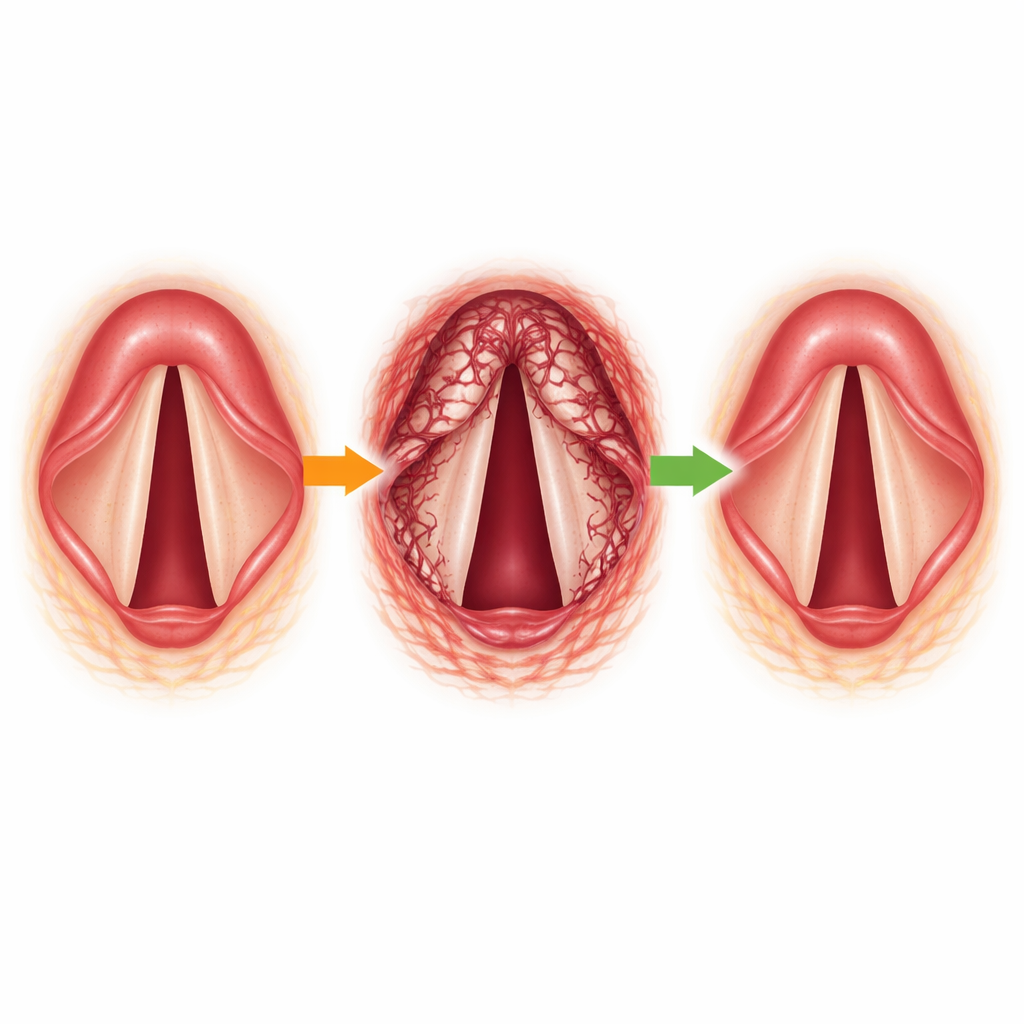
Healthy vocal folds are soft, layered structures supported by a loose, springy scaffold of proteins called the extracellular matrix. The researchers compared normal tissue with samples from patients at different stages of vocal fold cancer and found that tumours were packed with extra matrix components, especially several types of collagen and fibronectin. Measurements of tissue stiffness showed that cancerous vocal folds were more than three times as rigid as normal ones. This stiffening went hand in hand with altered cell surface receptors that sense the surrounding matrix, suggesting that cancer cells are constantly receiving growth-promoting mechanical cues.
How cancer cells change their grip and their moves
The team then turned to patient-derived cell lines that model early, still mobile tumours and more advanced, mechanically fixed tumours. In normal cells, key receptors that bind to laminin, a major basement membrane protein, sit at cell–cell contacts and in organized anchoring structures. In cancer cells, these receptors become patchy and migrate into small, scattered attachment sites or even inside the cell. On lab-made surfaces that mimic the stiffness of tissue, both early and advanced cancer cells grew and spread far better on rigid substrates than on soft ones. The stiffer the surroundings, the faster cells crawled and invaded three-dimensional gels, showing that rigidity actively fuels their spread.
Flocking behaviour in cancer cell crowds
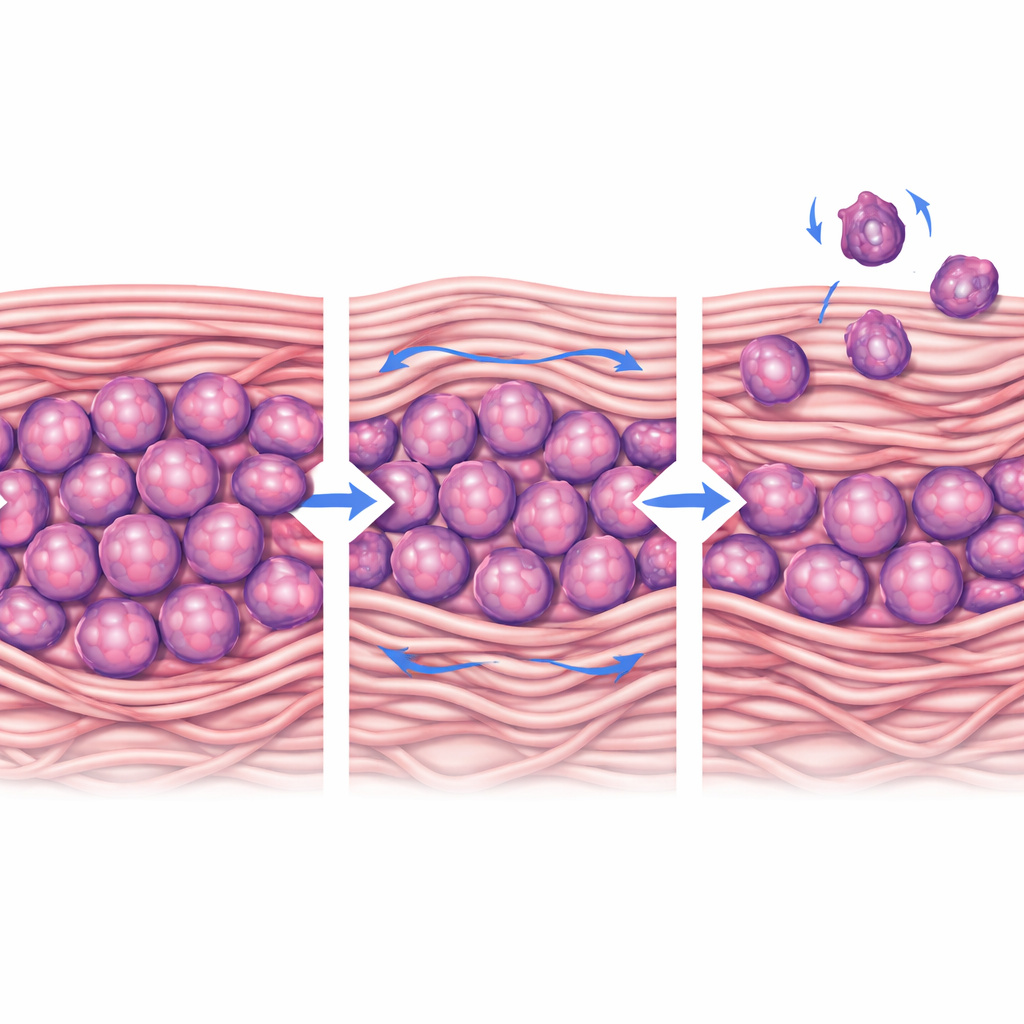
In tightly packed sheets, healthy vocal fold cells eventually slow down and “jam,” forming a quiet, protective layer. Using motion-tracking analysis, the researchers found that cancer cell sheets behave very differently. Early-stage tumour cells moved like a coordinated flock, with long-range, aligned motion across the whole layer, while still remaining densely packed. More advanced cells also showed collective motion, although with shorter-range coordination. In three-dimensional clusters, cancer spheroids rapidly spread across coated surfaces in a wetting-like process that depended less on their grip to the matrix and more on the internal mechanical state of the cluster. This flocking, solid-like motion may help tumour cells invade surrounding tissues without breaking apart.
When vibration pushes back
Vocal folds are not meant to sit still, so the team recreated two forms of mechanical activity: slow stretching that imitates breathing movements and rapid vibration that mimics speech. They found that both stretching and vibration lowered the levels of β-catenin, a protein that switches on growth-related genes when it accumulates in the nucleus of cancer cells. Vibration was especially powerful in advanced cancer cells, where it triggered the extrusion of highly contractile cells out of the layer and reduced both total and nuclear levels of another key growth controller, YAP. At the same time, vibration increased levels of AMOTL2, a protein that traps YAP outside the nucleus, hinting at a built-in brake that is reactivated when tissue is allowed to move.
Links to patient outcomes and new drug options
To connect these lab findings to real-world disease, the scientists analysed tumour samples from nearly 200 patients. They created an “ECM score” that summed up how strongly each tumour’s supporting stroma expressed several matrix and contractility markers. High scores, indicating abundant and active matrix, were associated with larger tumours, higher nuclear YAP in the cancer cells, and poorer disease-specific survival. Since YAP works together with TEAD transcription factors, the team tested two experimental drugs that block this partnership. Both reduced the viability of vocal fold cancer cells in culture, with advanced-stage cells being the most sensitive. In animal models, one of the inhibitors also slowed the growth of aggressive tongue tumours made from vocal fold cancer cells, without needing to soften the tissue itself.
What this means for people with vocal fold cancer
Put simply, this work suggests that vocal fold cancer is strongly influenced by how stiff and how mobile the tissue is. As tumours thicken and immobilize the folds, cells receive constant mechanical signals that keep powerful growth switches like β-catenin and YAP turned on. Restoring more normal mechanics through stretching or vibration appears to quiet these signals and can even push dangerous cells out of the tissue layer. At the same time, drugs that directly target the YAP–TEAD pathway show promise in preclinical models. Together, these findings raise the possibility that future treatments could combine mechanical “rehabilitation” of the voice box with molecular therapies to help restore a more normal, less aggressive state to vocal fold cancers.
Citation: Kaivola, J., Punovuori, K., Chastney, M.R. et al. Restoring the tumour mechanophenotype of vocal fold cancer reverts its malignant properties. Nat. Mater. 25, 868–882 (2026). https://doi.org/10.1038/s41563-025-02473-7
Keywords: vocal fold cancer, tumour mechanics, extracellular matrix, YAP signaling, tissue stiffness